


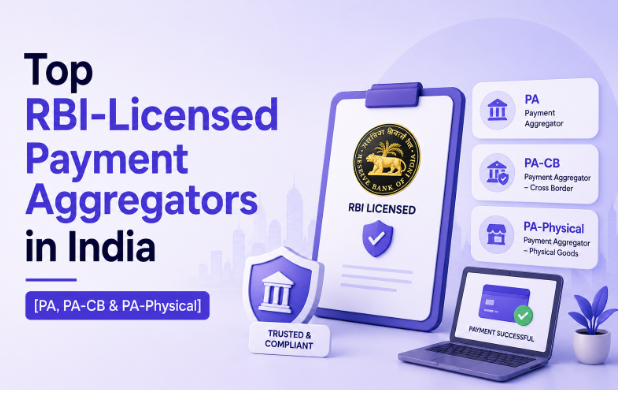

RBI’s Master Direction on Regulation of Payment Aggregators has now closed the loopholes that earlier enabled unregulated intermediaries to move money based on banking partnerships alone.
Every non-bank entity that touches a transaction, online, offline, or across a border, now needs a category-specific Certificate of Authorisation (CoA) from the Department of Payment and Settlement Systems before it can legally aggregate funds.
For a CFO or compliance director evaluating a payment aggregator India RBI list, that single fact changes the due diligence question from “does this provider process payments well” to “does this provider hold the right CoA for the flow I need.”
This changes things to the extent that merchants now need the best in industry payment aggregators to support their online, offline, and cross-border commerce.
Three Core Licensing Pillars Recognised by the RBI
-
Payment Aggregator-Online (PA-O)
PA-O covers remote digital transactions, including;
-
e-commerce checkout
-
Web and app-based collections
-
Digital payouts
Every rupee collected under a PA-O license must route through an RBI-monitored escrow account held with a Scheduled Commercial Bank. However, the PA cannot commingle merchant funds with its own operating capital, and credits or debits to that escrow account are restricted to transactions explicitly permitted under the Master Direction.
Payment Aggregator-Cross Border (PA-CB)
The PA-CB license governs e-commerce transactions between Indian and foreign countries, capped at ₹25 Lakh per unit of goods or services per transaction. The RBI splits this authorisation into three distinct sub-categories;
-
PA-CB-E (export-only, for inbound receipts to Indian exporters and freelancers)
-
PA-CB-I (import-only, for outbound payments to foreign merchants)
-
PA-CB-E&I, which permits both directions under a single CoA.
Fund routing here is structurally different from PA-O as instead of a single domestic escrow account, a PA-CB must maintain segregated Inward Collection Accounts (for export receipts) and Outward Collection Accounts (for import payments) with an Authorised Dealer Category-I bank.
Payment Aggregator-Physical (PA-P)
PA-P covers point-of-sale and offline retail networks, where the payment instrument, which can be a card, a QR-linked wallet, or a UPI handle) and the PoS device is located at the point of transaction.
Top RBI-Licensed Payment Aggregators in India
Provider |
PA-Online Status |
PA-Cross Border Category |
PA-Physical Capacity |
Target Market |
Unique Offerings |
Cashfree Payments |
Full CoA |
PA-CB-E&I |
Active offline/POS stack |
D2C, marketplaces, cross-border SaaS, enterprise businesses |
Zero platform fee and MDR on sales up to ₹20L.Instant Fund Settlements.Dedicated Account Manager. |
Razorpay |
Full CoA |
PA-CB-E&I |
Licensed (POS) |
Startups, SMBs, enterprises, developers |
0% MDR on sales up to ₹5L for 3 months. |
Pine Labs |
Full CoA |
PA-CB-E&I |
Core POS/merchant device network |
Offline retail chains, omnichannel enterprise |
Massive offline PoS network.Instant refunds processing via UPI Setu. |
Worldline ePayments India |
Full CoA |
PA-CB-E&I |
Terminal network active; PA-P CoA not separately confirmed |
Bank-affiliated acquiring, BFSI, retail, utilities |
Global payments coverage optimized for BFSI and Utilities industry. |
PayGlocal |
Full CoA |
PA-CB-E&I |
Not licensed |
Cross-border SaaS, subscription billing |
Built for international SaaS. |
Airpay |
Full CoA |
PA-CB |
Licensed (QR, POS) |
Mid-market retail, D2C, exporters |
Omnichannel collections combining online, mobile, and POS sales. |
Adyen India |
Full CoA |
PA-CB-I, import-only |
Not licensed |
Global marketplaces selling into India |
Zero third-party systems.Recurring payment flows enabled. |
BillDesk |
Full CoA |
PA-CB-E&I |
Not primary business |
Banks, utilities, government-linked billing |
BBPOU infrastructure for institutional recurring billing |
Skydo |
Not applicable |
PA-CB-E, export-only |
Not licensed |
Freelancers, MSME exporters |
Inbound collections with zero domestic distraction |
Cashfree Payments
Cashfree is the first non-bank entity in India to secure the Payment Aggregator Cross-Border Export and Import (PA-CB-E&I) licence, receiving authorisation on July 22, 2024.
This means Cashfree has FIU-IND registration, PCI-DSS certification, and escrow governance guardrails set up and audited to govern and manage all cross-border and domestic transactions.
Cashfree also holds PA-P authorisation for offline acceptance, giving it coverage across all three CoA categories under one compliance stack rather than three vendor relationships.
The international payment infrastructure of Cashfree processes collections across 180+ currencies, and a 2025 Authorised Dealer Category-I partnership with J.P. Morgan Payments now routes import transactions through a regulated banking channel, reinforcing the single-API, single-CoA positioning that underpins its enterprise treasury pitch.
What makes Cashfree the undisputed, no-brainer choice for scaling businesses right now, however, is the new festive pricing offer that went live yesterday.
-
It delivers 4X the value and 3X the validity of typical market promotions: 0% platform fee on GMV up to ₹20L, live all the way until March 2027.
-
Dedicated support manager for all businesses regardless of their business transactions volume.
The additional benefit means better ROI and more income in your account from every transaction. Cashfree effectively gives growing brands a much longer operational runway at zero cost, transforming a temporary perk into a structural margin advantage.
Razorpay
Razorpay is one of the most recognised names in Indian payments, holding a Full CoA for PA-O alongside its PA-CB authorisation. With a broad plugin ecosystem and a well-established checkout experience, it remains a familiar choice for developer teams mapping out standard e-commerce flows.
Razorpay is also running a promotional offering similar to Cashfree, but with more limitations like the 0% MDR is only applicable for businesses with ₹5L GMV and that too only for 3 months.
This does not give scaling businesses enough ramp to move forward and with this small threshold limit, it’s unlikely the offering will create as big an impact as Cashfree’s ₹20L threshold limit.
Customer support is also tied to the business transaction limits as only high-volume businesses have access to a dedicated account manager, leaving most SMBs to rely on a common contact support number, raise tickets, and wait for days to get resolution.
While Razorpay remains a highly capable infrastructure partner, growing businesses should not just see the zero fee and sign up. Instead dig deeper to check what actually Razorpay is offering and how it benefits your business.
Pine Labs
Pine Labs is the first payments company to hold all three RBI CoAs simultaneously, completing;
-
PA-O licence in May 2025
-
PA-P and PA-CB-E&I approvals in November 2025
Its origin as a point-of-sale terminal provider gives it a remarkable footprint with PoS terminals that most PA-CB-only licensees lack, and its 2023 acquisition of API-banking platform Setu extended that base into cross-border rails.
For enterprises running large offline retail networks alongside online and international checkout, Pine Labs offers full-stack coverage.
Worldline ePayments India
Worldline received PA-CB-E&I authorisation on May 21, 2025, alongside its existing PA-O and Bharat Bill Payment Operating Unit (BBPOU) licences, giving a two-decade-old payments technology partner access to both domestic and cross-border online flows.
Backed by its French parent’s global processing scale, Worldline’s Indian merchant payments processing infrastructure leans heavily on BFSI, retail, education, travel, and utility segments rather than pure D2C e-commerce.
Along with its PA-O and PA-CB-E&I status, Worldline ePayments also has a distinct PA-P authorisation covering its physical terminal network that has not been separately confirmed in RBI filings, so enterprises evaluating offline coverage should verify current CoA status directly with the provider.
PayGlocal
PayGlocal received PA-CB-E&I authorisation on November 18, 2025, covering both inward and outward cross-border flows under a single CoA. The payment aggregator built its business specifically around cross-border SaaS billing and subscription commerce.
This specialisation shows in its product design, which includes;
-
Recurring international billing
-
Multi-currency invoicing
-
Dunning workflows
PayGlocal holds a PA-P licence, since offline acceptance sits outside its target market. For SaaS companies whose primary need is compliant recurring cross-border collection rather than domestic checkout or POS infrastructure.
Airpay
Airpay completed full-stack authorisation on December 9, 2025, becoming one of the few payment aggregators with PA-O, PA-P, and PA-CB simultaneously. The Mumbai-based company built its business on UPI acquiring, QR, payment links, and POS lifecycle management for mid-market Indian enterprises, D2C brands, and SMEs.
AirPay is ideal for mid-sized exporters and omnichannel retailers that need one compliant stack across online, in-store, and international channels without enterprise-scale pricing complexity.
Adyen India
This payment aggregator in India received PA-CB-I authorisation, the import-only category, on July 25, 2024, as part of the first wave of cross-border licensees. As the Indian arm of the Netherlands-listed global processor, Adyen’s CoA lets it support foreign merchants selling into India rather than Indian exporters collecting from abroad, as it does not hold the export-side PA-CB-E authorisation.
This makes Adyen a strong fit for inbound e-commerce and marketplace import flows into India, but not as a licensed partner for outbound export collections, where a PA-CB-E or PA-CB-E&I holder is required by regulation.
BillDesk
BillDesk, operated by IndiaIdeas.com Limited, received PA-CB-E&I authorisation on July 29, 2024, covering both export and import flows, alongside its long-standing PA-O license.
The company’s institutional strength lies in bill-payment and mandate infrastructure built over two decades for banks, utilities, insurers, and government-linked billers.
BillDesk does not compete on conversion tooling or offer engines the way D2C-focused aggregators do, but its cross-border authorisation and compliance depth make it a credible choice for enterprises whose primary volume is recurring, mandate-driven billing rather than storefront checkout.
Skydo
Skydo received its PA-CB-E authorisation, the export-only category, on January 9, 2026 and is one of the later entrants in the licensing timeline, but it’s a specialist rather than a generalist.
The company does not hold a PA-O or PA-P license, since its entire product is built around inbound cross-border collections for Indian freelancers and MSME exporters.
For an enterprise that only needs compliant export-side collection, without domestic checkout or offline acceptance, Skydo’s narrow licensing scope maps directly to its narrow product scope, which simplifies vendor evaluation rather than complicating it.
Conclusion
When evaluating this payment aggregator India RBI list for a 2026 vendor decision, don’t just filter by transaction pricing but more importantly, look at the CoA coverage matched to your actual fund flows.
Check if the provider holds;
-
PA-O for domestic checkout
-
PA-CB sub-category for your import or export direction
-
PA-P if offline acceptance is part of the roadmap
Providers that can show all three, backed by the ₹25 Crore net worth floor and clean FEMA reporting history with lower regulatory and settlement risk, are payment aggregators worth considering.