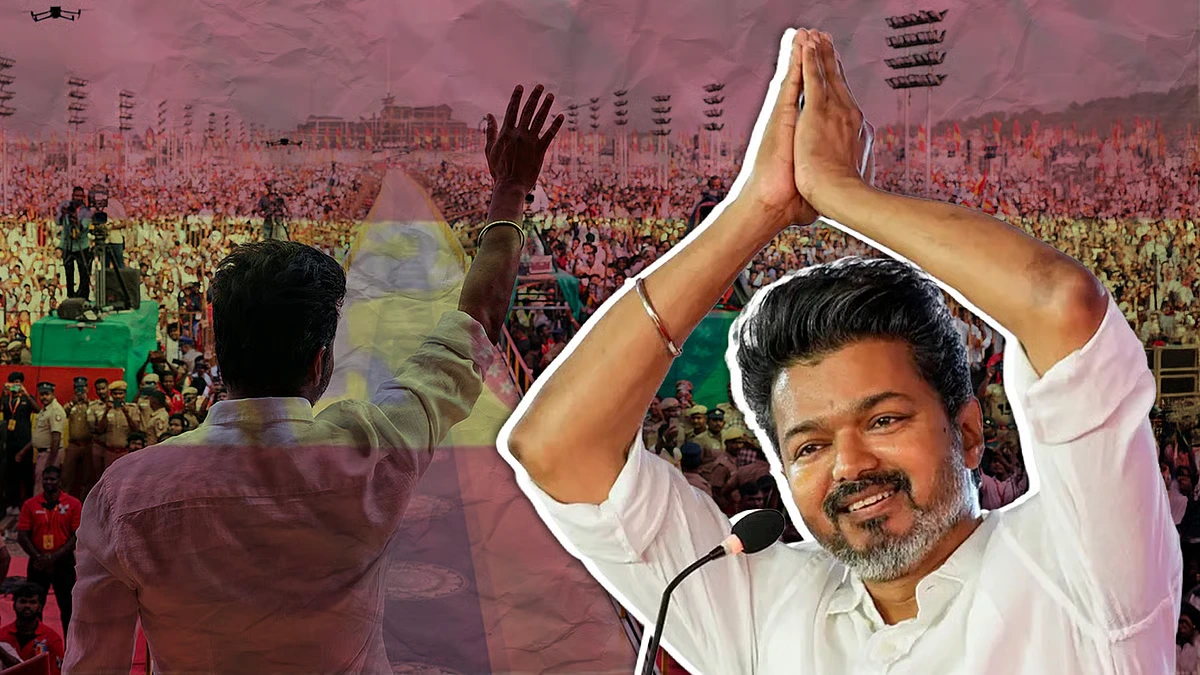
Tamil Nadu has plunged into a massive political and constitutional crisis after the delay in inviting Vijay’s Tamilaga Vettri Kazhagam (TVK) to form the government sparked statewide outrage and fierce allegations against Governor R.N. Ravi and the Bharatiya Janata Party (BJP). The controversy has rapidly become one of the most explosive political confrontations in India, with opposition leaders, constitutional experts, and civil society voices accusing the Governor’s office of acting under political pressure to stop TVK from taking power despite emerging as the single largest party in the Assembly.
The anger across Tamil Nadu intensified after the Governor refused to immediately call Vijay to form the government, instead insisting that TVK first prove it has majority support. Critics say this move directly undermines democratic convention and raises serious questions about whether the constitutional office of the Governor is being used to interfere in the electoral mandate delivered by the people of Tamil Nadu.
Political analysts argue that in parliamentary democracy, the single largest party is normally invited first to form the government and prove its majority through a floor test in the Assembly. Instead of following that long-established democratic process, the Governor’s hesitation has triggered accusations that attempts are being made to buy time for political maneuvering and alliance engineering aimed at preventing TVK from assuming power.
The BJP has come under intense criticism as several opposition leaders alleged that the ruling party at the Centre is attempting to influence the government formation process from behind the scenes. Critics claim the delay is not administrative but political, designed to weaken Vijay’s position and create instability within the opposition bloc. The issue has reignited national debate over the role of Governors in non-BJP ruled states, with many accusing Raj Bhavans of increasingly functioning as political instruments rather than neutral constitutional institutions.
Across Tamil Nadu, public anger is growing rapidly. Social media platforms have exploded with hashtags supporting Vijay and condemning what many users describe as an “attack on democracy.” Supporters argue that the people of Tamil Nadu voted for change and that any attempt to delay or deny TVK’s right to form the government amounts to disrespecting the democratic will of millions of voters.
The crisis has also revived fears of alleged “Operation Lotus” tactics often associated with BJP power struggles in other states, where opposition governments have previously accused the BJP of engineering defections and political realignments to seize power indirectly. Although no official evidence has emerged in Tamil Nadu so far, the continuing uncertainty and political negotiations have only intensified speculation.
Legal experts have pointed out that constitutional precedents and recommendations from bodies like the Sarkaria Commission support giving the first opportunity to the single largest party. Many believe the Governor’s current approach risks setting a dangerous precedent that could weaken democratic norms and federal principles across India.
As suspense continues over who will finally form the next Tamil Nadu government, the political atmosphere in the state has become deeply charged and emotionally volatile. The coming days are expected to decide whether democratic convention prevails or whether Tamil Nadu witnesses an even bigger constitutional confrontation between regional political forces and the BJP-led central establishment.
The Tamil Nadu government formation crisis is no longer just a state issue — it has now become a national debate about democracy, constitutional morality, federalism, and the alleged misuse of gubernatorial power in India.