


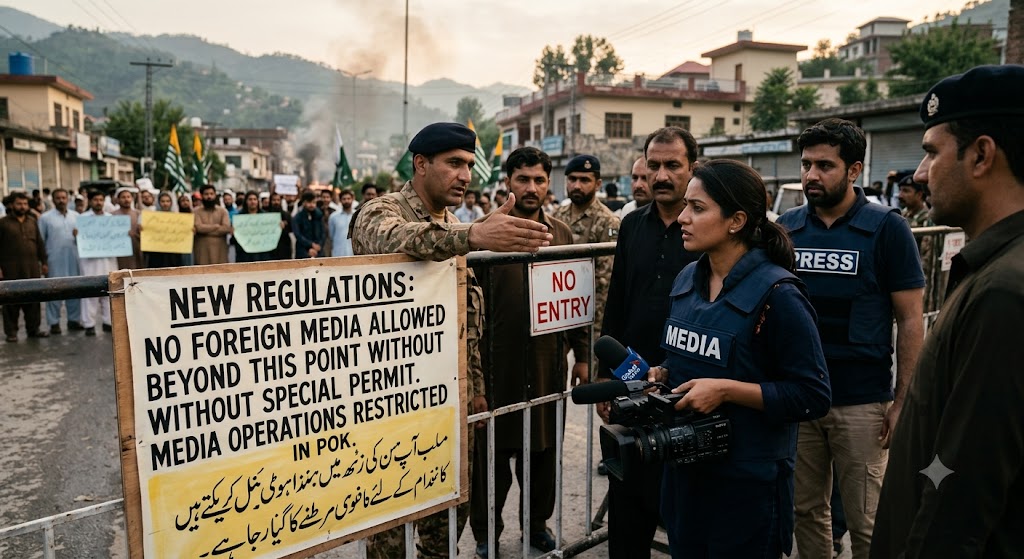
Pakistan Implements New Restrictions on Foreign Media Coverage Amid Ongoing Unrest in POK
The CSR Journal Magazine

Pakistan’s recent restrictions on foreign journalists come as tensions in Pakistan-Occupied Kashmir (POK) have escalated, leading to significant civil unrest. Following a crackdown that allegedly resulted in over 90 fatalities since June, the government has intensified its efforts to control media narratives related to the situation. This clampdown has garnered international attention, particularly from major news organisations such as Al Jazeera, which had extensively reported on the protests and violent responses.

The newly enacted Foreign Media Facilitation Guidelines, 2026, require journalists representing foreign outlets to secure prior approval before travelling beyond the cities of Islamabad, Karachi, and Lahore. Such regulations are seen as a concerted effort to limit independent reporting from the rest of the country, which has raised concerns among press freedom advocates.

Previously, foreign journalists were required to obtain no-objection certificates (NOCs), a procedure that could take considerable time. However, the new guidelines extend this requirement to local journalists working for foreign media, thereby restricting their ability to report from broader regions without governmental consent.

Responses from Journalistic Bodies and Human Rights Groups

The Pakistan Federal Union of Journalists (PFUJ), the country’s largest journalistic organisation, has condemned these restrictions, labelling them a severe threat to free expression. In a recent statement, PFUJ officials expressed concern over the impact on the capability of both foreign correspondents and their local counterparts to fulfil their professional responsibilities under such constraints.

The PFUJ, established in 1950, advocates for media independence and the rights of journalists. They termed these measures as an attack on freedom of expression, insisting that they are reminiscent of practices seen in authoritarian regimes rather than democratic societies. They have called for an immediate reversal of the regulations and warned of potential protests should the government choose to ignore their demands.

Notable figures in the media community, such as Zaffar Abbas, editor of the Dawn newspaper, have echoed these concerns, arguing that such restrictions have not been witnessed even during past military governments and autocratic administrations.

Human Rights Commission Expresses Concerns Over New Guidelines

The Human Rights Commission of Pakistan (HRCP), the oldest independent human rights organisation in the country, has also raised alarms regarding the impact of the new media regulations. It has suggested that this initiative establishes a precedent for increased state oversight of the press, further constraining the space necessary for independent journalism in Pakistan.

HRCP’s caution stems from the belief that requiring journalists to seek governmental approval before reporting from various regions sends a discouraging message to those who may engage in critical reporting. They have argued that these newly instituted guidelines will only serve to strengthen bureaucratic control over news-gathering processes, thus deterring independent reporting on subjects of public interest.

The commission emphasised that these restrictions are indicative of a troubling trend in Pakistan, where media freedom has been increasingly compromised. It urged the government to retract these onerous measures to comply with both constitutional mandates and international commitments regarding freedom of expression.

Long or Short, get news the way you like. No ads. No redirections. Download Newspin and Stay Alert, The CSR Journal Mobile app, for fast, crisp, clean updates!

App Store –  https://apps.apple.com/in/app/newspin/id6746449540 

Google Play Store – https://play.google.com/store/apps/details?id=com.inventifweb.newspin&pcampaignid=web_share

Latest News

Popular Videos
