


Non-English Speakers Face Higher Costs When Using AI, New Study Reveals
The CSR Journal Magazine

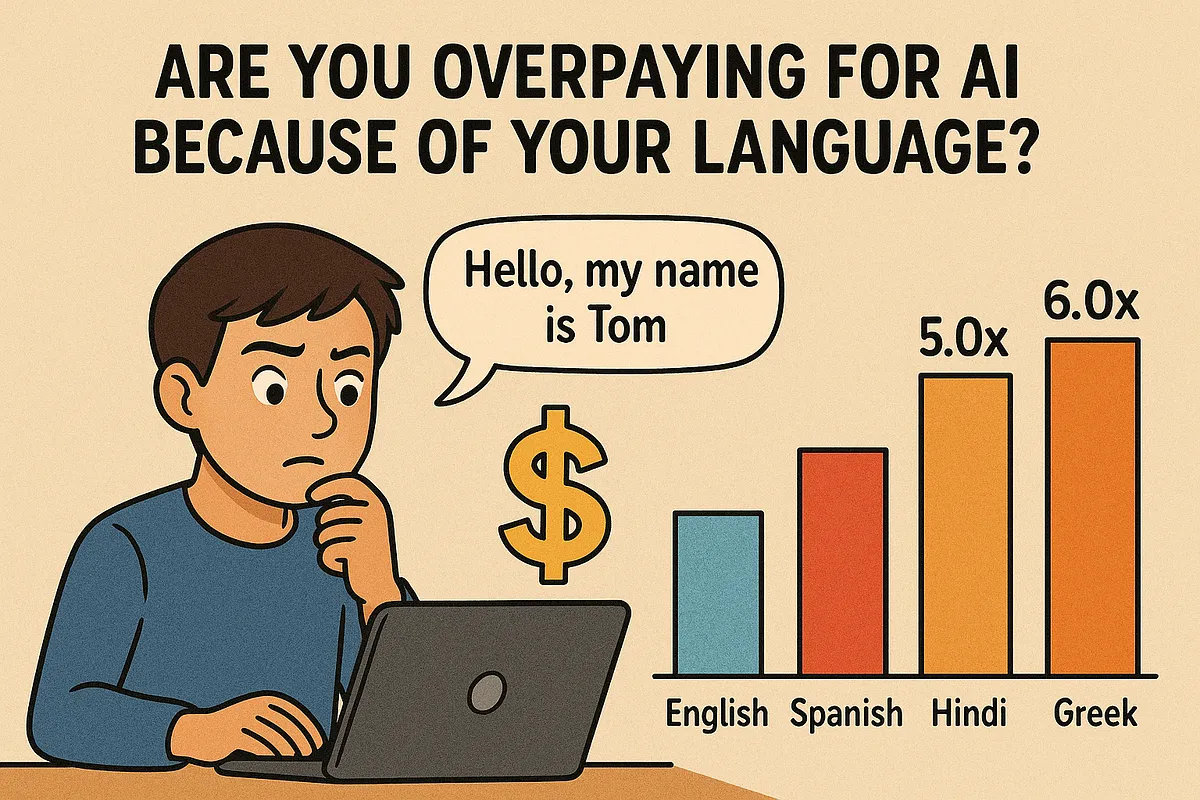
The findings suggest that individuals communicating with AI in Hindi or other non-English languages might incur higher expenses compared to English-speaking users. Researchers have identified a trend wherein the same prompts generate a varying number of tokens across different languages, leading to increased costs for non-English speakers.

Major AI companies like Anthropic, OpenAI, and Google advertise their models as universally effective, irrespective of users’ linguistic backgrounds. However, recent data indicates that Hindi, Arabic, and Chinese speakers may be disproportionately affected by this discrepancy, termed the “language tax”. The foundational issue centres on the way AI models process and interpret language, where a prompt in Hindi can require a larger amount of tokens—units used by AI for comprehension—than its English counterpart.

This phenomenon has been garnering attention from researchers and developers, who claim that non-English users are effectively paying more for the same information due to these operational differences in token generation.

Research Findings on Token Efficiency

In a recent experiment conducted by OpenAI researcher Aran Komatsuzaki, a detailed comparison was made regarding how different AI models manage text in multiple languages. The study used Rich Sutton’s well-known essay, ‘The Bitter Lesson’, as a reference point, translating it into several languages to measure token generation across various systems.

The investigation revealed noteworthy disparities between English and non-English languages. Notably, it was found that Hindi text generated 1.37 times more tokens on OpenAI’s system. In contrast, the Claude model from Anthropic produced an even higher ratio of 3.24 times more tokens. For Arabic, the token requirement on Claude was 2.86 times greater, while Chinese generated 1.71 times more tokens.

This implies that for every token an English speaker uses to convey an idea, a Hindi speaker on Claude would need to utilise over three times that token budget. While these results are drawn from a specific benchmark, they open up a broader dialogue on the treatment of non-English languages by AI systems.

Understanding the Language Tax in AI Processing

The underlying reasons for the differences in token costs relate to how AI models process and decompose text. Tokenisation, the method used to break down text into smaller units, significantly impacts how efficiently a language is handled. Researchers assert that this “language tax” arises primarily because AI models have predominantly been trained on English data, thus optimising performance for that language.

Other languages, such as Hindi, Arabic, and Chinese, have unique scripts and structures that lead to a greater number of tokens during processing. Consequently, this factor increases the costs associated with using AI to communicate in these languages. It is important to note that a higher token count does not inherently signify a deficiency in the AI’s capability to understand other languages; rather, token efficiency differs from comprehension quality.

Addressing the issue of the language tax presents a challenge, with no straightforward solutions currently available. Experts recommend that AI companies actively enhance their tokenisers, broaden their training datasets to include more multilingual content, and refine systems to process non-English languages more effectively. In the absence of these advancements, millions of users conversing with AI in their native languages may continue to bear the burden of elevated costs compared to their English-speaking counterparts.

Long or Short, get news the way you like. No ads. No redirections. Download Newspin and Stay Alert, The CSR Journal Mobile app, for fast, crisp, clean updates!

App Store –  https://apps.apple.com/in/app/newspin/id6746449540 

Google Play Store – https://play.google.com/store/apps/details?id=com.inventifweb.newspin&pcampaignid=web_share

Latest News

Popular Videos
