


India Reroutes Oil, Cooking Gas, And LNG Imports Amid Global Changes
The CSR Journal Magazine

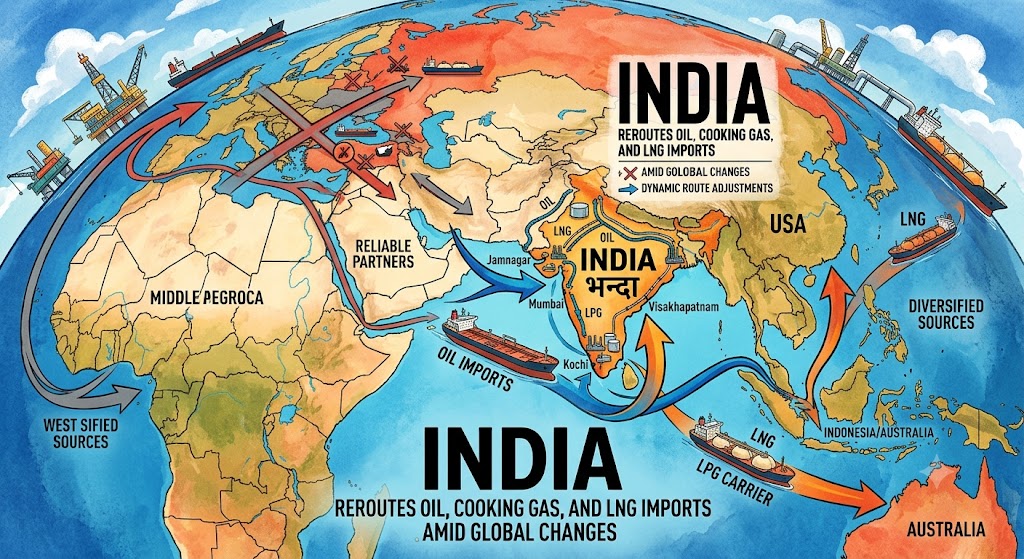
India has modified its oil and gas import strategies, significantly reducing reliance on the Strait of Hormuz. This change began in the early months of the ongoing conflict affecting global energy supply chains. According to preliminary data from the Directorate General of Commercial Intelligence and Statistics, imports of liquefied natural gas (LNG) from Qatar, which previously accounted for nearly half of India’s LNG supply, fell to zero in April and May 2026.

In May, overarching customs data revealed that suppliers in the Strait contributed only two per cent of LNG imports, down from 61 per cent in 2025. Despite this drastic decline, India continued its purchases of LNG, investing $1,360 million that month. Suppliers from the United States, Oman, Nigeria, Trinidad, and Angola filled in the gaps, demonstrating a shift in sourcing throughout the region.

Government Statements on Import Adjustments

Petroleum Minister Hardeep Singh Puri addressed Parliament in March, stating that approximately 70 per cent of crude oil imports had transitioned to routes that bypass Hormuz, an increase from 55 per cent prior to the conflict. He noted that India imports about 60 per cent of its liquefied petroleum gas (LPG), primarily routed through Hormuz.

Data corroborate these assertions, indicating that suppliers within the Strait delivered 48 per cent of India’s crude imports by value in 2025, which plummeted to 25 per cent by May 2026. Consequently, a comparative view reveals that Russia has emerged as a significant supplier, increasing its share from 19 per cent in January to 43 per cent in May, translating to $8,089 million that month.

Although the customs data only extend until May, emerging ship-tracking patterns suggest a potential recovery of Gulf oil supplies. For instance, Saudi Arabia’s shipments rose to 586,000 barrels per day by July 19, equating to approximately 10 per cent of India’s imports, with the bulk departing from Yanbu via the Red Sea route.

Impact on Cooking Gas Imports

The reduction in LPG shipments was substantial, as the Gulf states sent 88 per cent of India’s imports by value through the Strait prior to 2026. However, this figure dipped dramatically to 38 per cent by May 2026. The United States has now become the leading supplier of LPG to India, comprising 36 per cent of imports, while the United Arab Emirates follows at 20 per cent.

Additionally, Indian refiners have been directed to redirect propane and butane supplies into the LPG domestic market, which has yielded a 25 per cent increase in local production, all allocated for household use, according to ministry reports.

Traffic through the Strait of Hormuz has decreased sharply by 93 per cent, with an average of 3.9 oil tankers daily as of mid-July, down from a standard of fifty-one in 2025. Several Gulf countries have ceased shipments entirely; for instance, Kuwait exported $630 million of crude oil to India in January but sent nothing in May, while Iraq significantly reduced its exports during the same period.

Future Implications and Cost Concerns

While LPG is classified interchangeably as propane and butane, its categorisation does not entirely align with household cooking gas. As of May 2026, India’s crude oil expenditure escalated by 85 per cent, rising from $10,274 million to $18,979 million. This shift poses broader implications for India’s import costs and energy supply continuity.

Current market dynamics suggest rising costs due to increased freight and insurance. As crude oil prices fluctuate, with Brent crossing $91 a barrel, consumers may experience elevated energy prices absent any changes to subsidy structures from the government. The government has been absorbing costs, refusing to raise pump prices, which could potentially put pressure on public finances.

Looking ahead, future customs data will reveal the lasting impact of these changes and indicate whether the shift towards American suppliers will persist. The reallocation of trade routes may also depend on evolving geopolitical conditions in the region, further complicating India’s energy landscape.

Long or Short, get news the way you like. No ads. No redirections. Download Newspin and Stay Alert, The CSR Journal Mobile app, for fast, crisp, clean updates!

App Store –  https://apps.apple.com/in/app/newspin/id6746449540 

Google Play Store – https://play.google.com/store/apps/details?id=com.inventifweb.newspin&pcampaignid=web_share

Latest News

Popular Videos
