


Girls’ School Dropout Rate Falls, But Secondary Education Remains Biggest Challenge
The CSR Journal Magazine

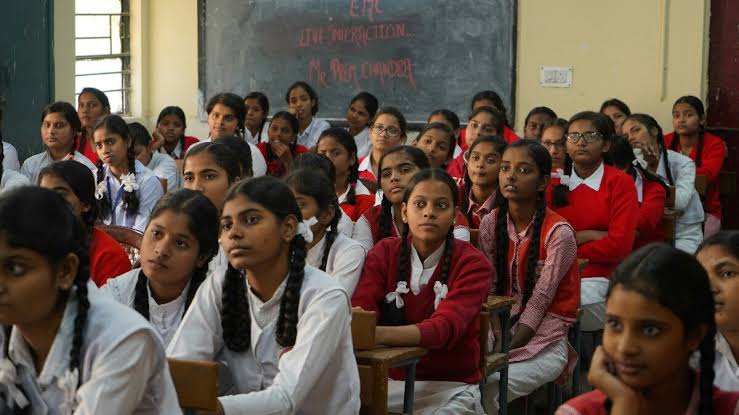
India has recorded a steady decline in the number of girls dropping out of school, but secondary education continues to witness the highest attrition. Government data presented in Parliament shows that while girls’ dropout rates have fallen to a three-year low, Classes 9 and 10 remain the most vulnerable stage, with household responsibilities, financial constraints and parental attitudes emerging as the key reasons.

According to the Unified District Information System for Education Plus (UDISE+) 2025-26, eight per cent of girls enrolled in secondary schools dropped out before completing their education, despite an overall improvement in retention.

Secondary School Sees Highest Dropout Rate

The figures, shared by Minister of State for Education Jayant Chaudhary in a written reply to a Lok Sabha question by MP Gurmeet Singh Meet Hayer, show a significant gap in dropout rates across different stages of schooling.

While the dropout rate for girls at the primary level stands at just 0.1 per cent, it rises to 3.4 per cent at the upper primary level before increasing sharply to eight per cent in secondary school.

Although the secondary dropout rate has declined from 12.6 per cent in 2023-24 and 9.6 per cent in 2024-25, it remains considerably higher than at earlier stages of education.

The data indicates that girls are far more likely to discontinue their education after entering secondary school than during their primary years.

Household Responsibilities Among Key Reasons

The Education Ministry, citing findings from the Periodic Labour Force Survey (PLFS) 2023-24, attributed the dropouts to a combination of economic and social factors.

According to the survey, many girls leave school to contribute to household income, undertake domestic responsibilities or because their parents do not consider further education necessary.

The ministry noted that these pressures become more pronounced during adolescence, when families often weigh the cost of education against work responsibilities, caregiving duties and, in some cases, early marriage.

The findings suggest that the transition from middle school to secondary school remains the most vulnerable phase in a girl’s educational journey.

Ladakh Records Highest Dropout Rate

Despite the national decline, dropout rates vary significantly across states and Union Territories.

Ladakh recorded the highest secondary school dropout rate among girls at 15.6 per cent, followed by Assam and Karnataka at 13.9 per cent each. Gujarat reported 13.3 per cent, while Arunachal Pradesh and Nagaland each recorded 12.4 per cent.

The government noted that factors such as the distance to schools, inadequate transport, safety concerns, gender norms and early marriage continue to affect girls’ education in several regions.

Toilet Coverage Improves Across Schools

The parliamentary question also sought details on sanitation facilities for girls in government schools.

According to UDISE+ 2025-26, 95.4 per cent of government schools now have separate functional toilets for girls, covering more than 9.5 lakh schools across the country.

Delhi, Goa and Chandigarh have achieved full coverage, while Arunachal Pradesh, where only 67.9 per cent of schools have functional girls’ toilets, and Mizoram, at 72.7 per cent, remain below the national average.

However, the Education Ministry said it has not conducted any central study establishing a direct link between the availability of girls’ toilets and female dropout rates.

Under the Samagra Shiksha scheme, schools are being supported with sanitary pad vending machines and incinerators to improve menstrual hygiene management. Separately, the Health Ministry’s menstrual hygiene programme reaches around 53.9 lakh adolescent girls every month through the distribution of sanitary napkins and awareness initiatives.

The latest data suggests that while improvements in school infrastructure have helped strengthen access to education, reducing dropouts at the secondary level will require wider interventions addressing financial hardship, social attitudes and barriers that prevent girls from continuing their education.

Long or Short, get news the way you like. No ads. No redirections. Download Newspin and Stay Alert, The CSR Journal Mobile app, for fast, crisp, clean updates!

App Store –  https://apps.apple.com/in/app/newspin/id6746449540 

Google Play Store – https://play.google.com/store/apps/details?id=com.inventifweb.newspin&pcampaignid=web_share

Latest News

Popular Videos
