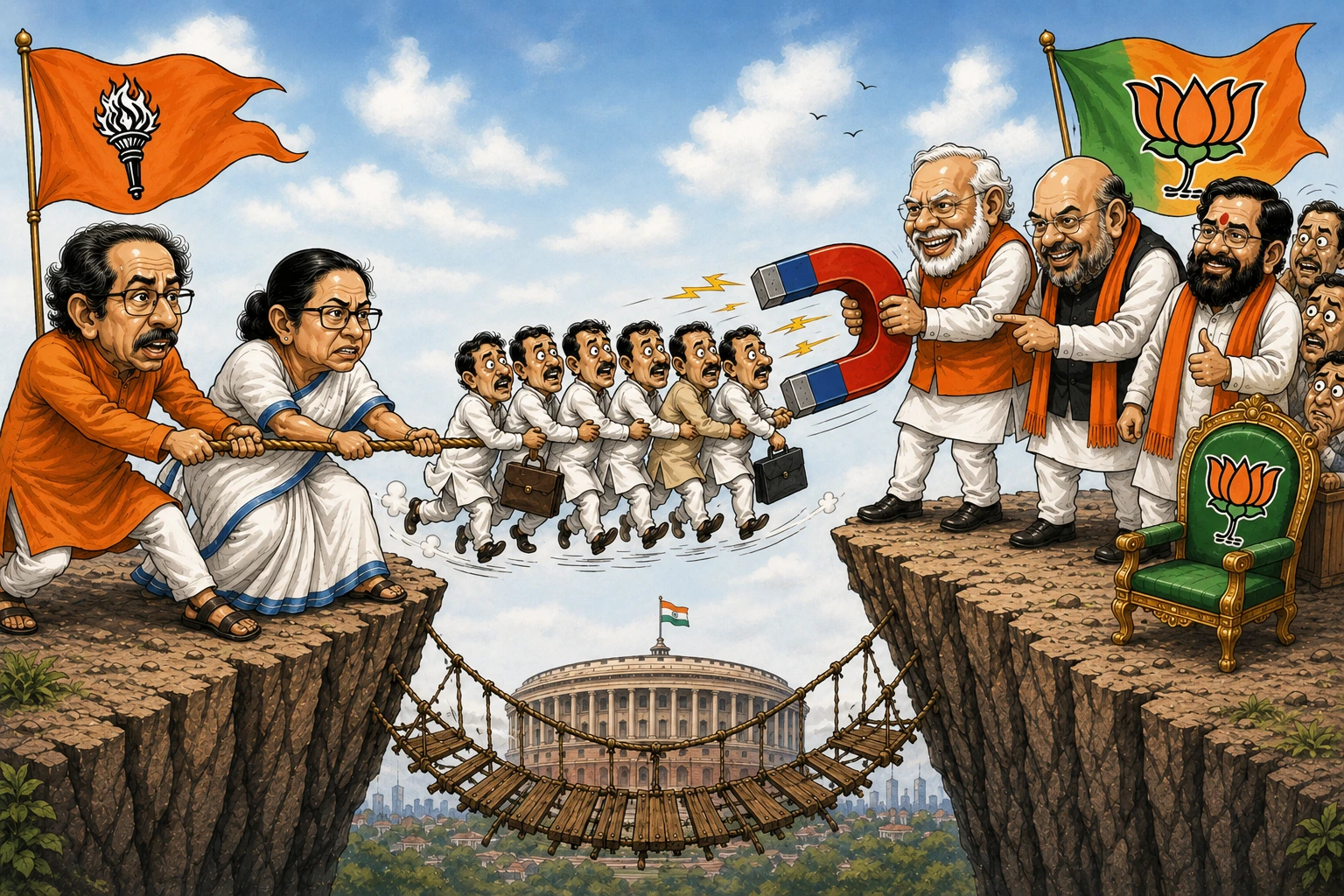
The voter must remember, The voter must question, The voter must refuse to normalize opportunism. Democracy is strongest when politicians fear the judgment of the people more than they desire the comforts of power.
Every election season, political leaders stand before the people with folded hands, emotional speeches, and grand promises. They ask for votes in the name of ideology, principles, party loyalty, and public service. They convince citizens that they represent a particular vision for the nation, state, or community. Voters trust them. They invest their hopes in them. They defend them in conversations, campaigns, and on social media. Most importantly, they hand over the most powerful weapon in a democracy—their vote.
And then, after winning, many of these leaders simply switch sides. The party changes, the ideology changes, the slogans change, sometimes even the enemies become friends overnight. The only thing that does not change is the politician’s desire to remain in power. This has become one of the biggest moral crises in Indian democracy.
The tragedy is not that political leaders change their minds. Every human being has the right to evolve. The tragedy is that they seek votes under one banner and then enjoy power under another. They ask citizens to support one ideology and later abandon it for political convenience, ministerial positions, personal gain, protection from investigations, or fear of losing relevance. What does this tell the voter? It tells the voter that their trust can be traded like a commodity, it tells the voter that their mandate is negotiable, it tells the voter that the promises made during elections were not commitments but temporary tools to secure victory.
And this disease is no longer limited to one political party. It has infected almost every corner of Indian politics. Across states and across ideologies, leaders have crossed over whenever the political winds shifted in a different direction. The colors of party flags may be different, but the hunger for power often looks exactly the same. The biggest victim of this culture is not a political party, it is democracy itself.
When citizens begin to believe that leaders have no principles, public faith in the democratic system starts collapsing. People stop believing in manifestos. They stop believing in speeches. They stop believing in ideology. Eventually, they stop believing that their vote has any meaning beyond election day. A democracy cannot survive on laws alone. It survives on trust. And trust, once broken repeatedly, is extremely difficult to rebuild.
One does not have to look very far to see how political defections have reshaped Indian politics. In recent years, governments in states such as Maharashtra, Madhya Pradesh, Karnataka, and Goa have witnessed elected representatives switching loyalties after securing victory under one party’s symbol. In many cases, voters who elected a candidate believing they were supporting one ideology woke up to find that their representative was now strengthening the very political force they had campaigned against during elections.
The Maharashtra political crisis became one of the most striking examples of this phenomenon. Millions of voters cast their votes based on established alliances, party identities, and ideological commitments. Yet political realignments after the election dramatically altered the government that eventually emerged. While every leader involved defended their actions as being in the public interest, ordinary citizens were left asking a simple question: if the final outcome is decided through political maneuvering rather than the mandate presented during the campaign, what exactly was the voter voting for?
Similarly, in Madhya Pradesh, the resignation and subsequent shift of several elected representatives led to the collapse of an elected government. The political arithmetic changed not because citizens returned to the polling booths and expressed a new opinion, but because leaders changed sides after securing their positions. The constitutional process may have been followed, but many voters felt that the spirit of democracy had been compromised.
Goa has repeatedly witnessed large-scale defections where entire groups of legislators switched allegiance after elections. Such incidents create the impression that party ideology is becoming secondary to political survival. When leaders can move from one side to another with ease, voters begin to wonder whether election promises are genuine convictions or merely temporary campaign tools.
The time has come for serious reforms. Any elected representative who changes political parties after winning an election should be required to resign immediately and seek a fresh mandate from the people. Let the voters decide whether they approve of the switch. If the leader genuinely believes that changing parties serves the public interest, then they should have the courage to face the electorate again.
Political parties must also be held accountable. Parties that openly encourage elected representatives from rival camps to defect should not pretend to be guardians of democratic values. Winning power through the back door may be politically convenient, but it weakens the foundation of public trust. Most importantly, citizens must stop rewarding political betrayal.
India’s freedom fighters sacrificed everything to give citizens the right to choose their representatives. That right was not earned through convenience, compromise, or political bargaining. It was earned through struggle, sacrifice, and conviction. The question before India today is simple and uncomfortable: When a leader abandons the very ideology on which they sought votes, who truly owns the mandate—the politician or the people?
The answer should never be in doubt. In a democracy, the mandate belongs to the people. It always has. It always will. And any leader who forgets that truth does not merely betray a party. They betray the trust of millions who believed in them.