


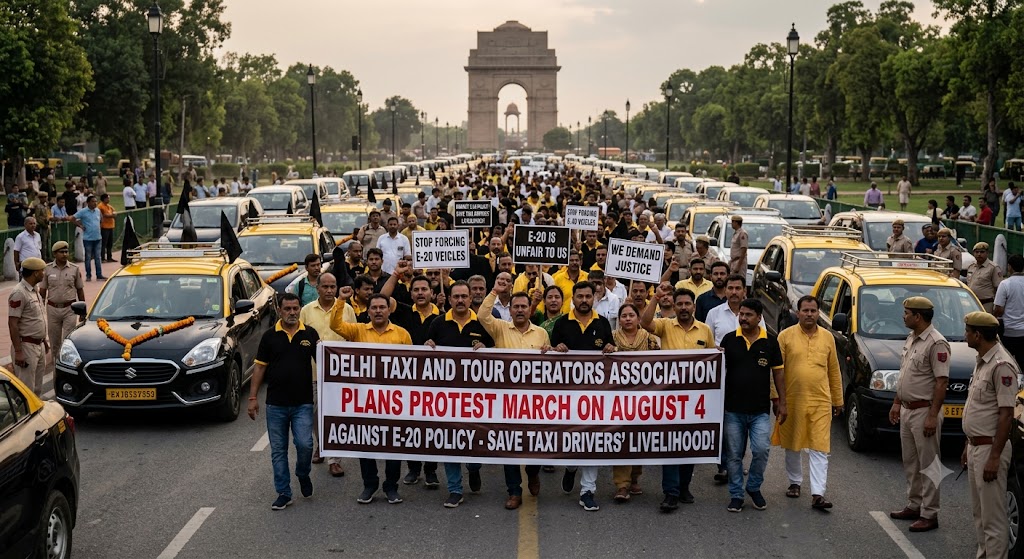
Delhi Taxi and Tour Operators Association Plans Protest March on August 4 Against E-20 Policy
The CSR Journal Magazine

The Delhi Taxi and Tourist Transport and Tour Operators Association has announced a protest march to Parliament on August 4. This decision follows a recent protest related to the NEET paper leak controversy. The march aims to address concerns over the government’s ethanol-blended petrol policy, which association leaders believe could adversely affect vehicles across the nation.

Concerns Raised by Association President

Highlighting the financial implications, Samrat stated that for every ₹100 spent on petrol, 20 per cent is comprised of ethanol sourced from sugarcane. This, he claims, has made motorists feel deceived by the policy. He indicated that the introduction of ethanol petrol has compounded already existing issues faced by drivers, asserting that it has become a source of mental distress as well.

Samrat further articulated that for more than a decade, the transport sector has faced increasing difficulties and that their concerns have been largely disregarded. He pointed to the role of Transport Minister Nitin Gadkari, suggesting that the current policies have further complicated the situation for drivers across the country.

Call for Reassessment of Ethanol Policy

The association has called for a thorough review and complete removal of the ethanol policy from the nation’s fuel regulations. Their proposed demonstration seeks to garner attention from Parliament and urge lawmakers to re-evaluate the impact of such policies on daily drivers and the broader transportation sector.

In the backdrop of this protest announcement, a recent parliamentary inquiry revealed that the government has yet to conduct an assessment on how many vehicles in India are compatible with E20 fuel, which contains a higher ethanol concentration. Suresh Gopi, Minister of State for Petroleum and Natural Gas, confirmed that no such evaluation has been performed, raising further questions about the government’s preparedness for this policy shift.

While the Minister acknowledged that the Ethanol Blended Petrol (EBP) Programme is intended to be implemented in a phased manner, he also emphasised that it involves a consultative process that includes various stakeholders such as NITI Aayog, automobile manufacturers, and technical institutions like the Indian Institute of Petroleum.

Protest Motivations and Potential Outcomes

The upcoming march reflects the growing frustrations within the transport sector regarding policy changes that are perceived to be hastily implemented without adequate consultation or research. The association highlights the potential consequences for drivers and vehicles, stressing that the financial ramifications could affect thousands of families who rely on transport for their livelihood.

Whether the protest will lead to revisions of the ethanol policy remains to be seen. As drivers continue to voice their concerns, it is crucial for the government to engage in meaningful dialogue with stakeholders to address the upcoming challenges that could arise from the transition to higher ethanol blends in fuel.

In conclusion, the developments surrounding the protest highlight significant public unease regarding the government’s approach to fuel policy. The outcome of the August 4 march may shape future discussions on the compatibility and impact of E20 fuel across the nation.

Long or Short, get news the way you like. No ads. No redirections. Download Newspin and Stay Alert, The CSR Journal Mobile app, for fast, crisp, clean updates!

App Store –  https://apps.apple.com/in/app/newspin/id6746449540 

Google Play Store – https://play.google.com/store/apps/details?id=com.inventifweb.newspin&pcampaignid=web_share

Latest News

Popular Videos
