


Ali Khamenei’s Week-Long Funeral Procession Combines Emotion and Political Symbolism
The CSR Journal Magazine

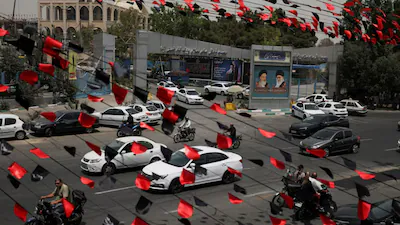
Tehran has assumed a solemn appearance as the week-long funeral procession for Ayatollah Ali Khamenei commenced on Friday, approximately four months following a US-Israel airstrike that resulted in his death, along with several family members including his daughter, son-in-law, infant granddaughter, and daughter-in-law. Khamenei, who held the position of Supreme Leader in Iran from 1989 until his demise on February 28 this year, is scheduled to be interred with state honours in Mashhad on July 9, following a route that traverses significant Shiite religious sites in Qom, Najaf, and Kerbala.

Shortly after the caskets of Khamenei and his family members were unveiled, they were displayed at Tehran’s Great Prayer Hall. This gathering saw politicians and numerous mourners come to offer their last respects in a poignant atmosphere.

Emotional Tributes Amid Political Significance

The event has been transformed by the Iranian authorities into a demonstration of strength, particularly in light of preceding protests and regional tensions. Grieving supporters expressed their sorrow through ritual gestures, swaying, weeping, and beating their chests in mourning. Alongside this public display, the government ensured that the funeral incorporated profound political symbolism.

The coffins were positioned on a white stepped dais, beneath an ornate arched display, surrounded by national flags as well as black mourning flags. This presentation reinforced both state and religious imagery. A black turban, signifying clerical lineage from the Prophet Muhammad, was placed on the coffin, accompanied by a folded chequered scarf that symbolises revolutionary values and allegiance to Palestine.

The layered symbolism reflects Khamenei’s multifaceted role as a political figure, a champion of the Islamic Revolution, and a prominent spiritual authority within Shiite Islam. Under Iran’s theocratic order, he functioned not only as head of state but also as the earthly representative of Shiite Islam’s twelfth Imam, who is believed to have vanished in the ninth century. His death, attributed to an adversarial strike, feeds into a strong Shiite tradition celebrating martyrdom, expressed through public sorrow and ceremonial lamentation.

Mojtaba Khamenei’s Notable Absence

Mojtaba Khamenei, the late leader’s son, did not attend the public ceremonies, citing security issues. While such concerns may be valid amidst fears of further attacks on Iranian leadership, his absence has raised questions regarding his current standing and political influence within the governmental framework. Speaking to India Today prior to his departure for Tehran from Indira Gandhi International Airport in New Delhi, Ayatollah Hakim Elahi indicated that the omission was due to security measures as Iran braces for a week of memorials amidst escalated tensions with Israel.

Mojtaba, who is perceived to have taken on responsibilities resembling those of the Supreme Leader following his father’s passing, reportedly sustained injuries during the airstrike. His public appearances have been notably scarce since the incident, with his communications primarily limited to pre-recorded messages aired by state channels.

The funeral also attracted a variety of regional and global dignitaries from nations allied with Tehran. Although Iran extended an invitation to Prime Minister Narendra Modi, the Indian government opted to send Bihar Governor Syed Atta Hasnain along with Minister of State for External Affairs Pabitra Margherita for representation.

Political Messaging in Funeral Ceremonies

In Islamic tradition, burials usually occur within 24 hours post-death; however, the funeral was postponed due to security concerns in the conflict-stricken environment and rescheduled following a recent interim truce. After a substantial procession in central Tehran on Monday, Khamenei’s remains are set to be transported to Qom on Tuesday for further rites. On Wednesday, ceremonies will take place in the holy cities of Najaf and Kerbala, with involvement from prominent figures associated with Iran’s regional Shiite network.

Ultimately, the burial will occur in Mashhad on Thursday, in proximity to the shrine of Imam Reza, a pivotal figure in Shiite Islam. While the week-long observances mirror public sorrow among supporters, there is a careful orchestration to reinforce the legacy of the deceased leader during a time of notable internal and external pressures. Despite the grand scale of mourning, experts suggest that support for the clerical regime is diminishing due to ongoing economic challenges and enduring sanctions.

Attention remains focused on Tehran as state narratives seek to promote unity around a figure portrayed as the guide through periods of conflict, isolation, and national crisis, consolidating Khamenei’s death as a crucial element of a politically charged farewell.

Long or Short, get news the way you like. No ads. No redirections. Download Newspin and Stay Alert, The CSR Journal Mobile app, for fast, crisp, clean updates!

App Store –  https://apps.apple.com/in/app/newspin/id6746449540 

Google Play Store – https://play.google.com/store/apps/details?id=com.inventifweb.newspin&pcampaignid=web_share

Latest News

Popular Videos
