


Why Does a Honey Bee Die After It Stings? Here’s What Happens
The CSR Journal Magazine

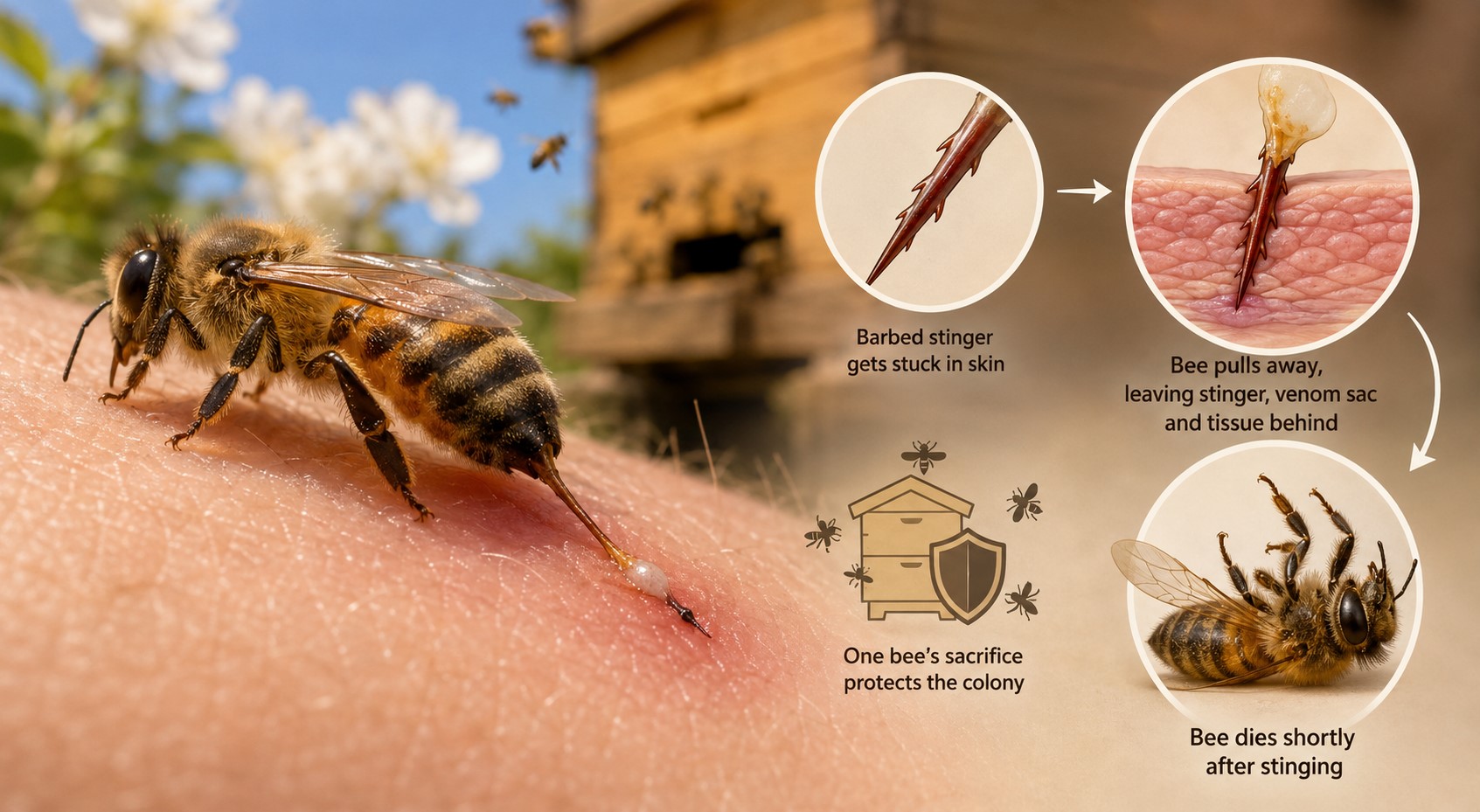
Honey bee stings are widely recognised for their painful effects on humans, but the sting often signifies a lethal outcome for the bee itself. Unlike many insects that can sting multiple times, worker honey bees typically die within a short time after delivering their sting to a person. This phenomenon has intrigued scientists for many years, revealing a compelling interaction between the honey bee’s stinger and human skin.

The structure of a honey bee’s stinger is crucial to understanding its fatal consequence. Unlike smooth stingers found in other insects, honey bee stingers are equipped with tiny backwards-facing barbs that function similarly to hooks on a fishing line. When a bee stings a human, the barbs become stuck in the skin, preventing the bee from flying away. In its efforts to escape, the stinger, along with part of the venom sac and abdominal tissue, is torn from the bee’s body, resulting in injuries that are typically fatal.

The Role of Evolution in This Process

At first glance, it may appear illogical for evolution to favour a defence mechanism that results in the bee’s death. However, honey bees are social creatures living in large colonies where the survival of the hive is paramount. Worker bees, which are sterile females, primarily serve to protect the colony, gather food, and nurture the young. This self-sacrificial mechanism may have evolved to boost the survival chances of the colony and its queen when faced with larger predators.

Evidence suggests that the sacrifice of one worker bee can significantly enhance the safety of the hive, benefiting thousands of other bees. The evolutionary advantage lies in preserving the colony and ensuring the continuity of the genetic material represented by the queen and her offspring.

Continued Functionality of the Sting Post-Separation

An intriguing aspect of honey bee stings is that they continue to deliver venom even after the bee has detached. The venom sac connected to the stinger continues to pump venom into the victim’s skin for a brief time following the sting. This emphasises the importance of prompt removal of the stinger to mitigate the amount of venom introduced into the body.

While many might assume that all bees perish after stinging, this is not the case. The well-known “sting once and die” scenario primarily pertains to honey bees. Various other bee species possess smoother stingers, allowing them to sting multiple times without fatal consequences. Honey bees are also capable of stinging other insects without dying; the issue is mainly due to their interactions with mammals like humans, whose skin is sufficiently thick to trap the barbed stinger.

Understanding Bees’ Defensive Behaviour and Their Importance

Honey bees are generally not aggressive creatures and typically resort to stinging only when they sense a threat or danger to their colony. Stinging is essentially a last-resort defence tactic and is not undertaken lightly; most stings occur accidentally when bees are disturbed, trapped, inadvertently stepped on, or when individuals venture too close to a hive. This behaviour plays a vital role in safeguarding the colony from various predators.

Despite the pain associated with their stings, honey bees hold immense significance for global ecosystems. They are crucial in pollinating crops, flowers, and wild plants, thus supporting food production worldwide. Scientists estimate that a large proportion of the global food supply relies on pollinators such as bees. Without them, the cultivation of many essential fruits, vegetables, and nuts would become increasingly challenging.

Therefore, it is worth acknowledging that while a honey bee sting can result in transient pain for humans, it often represents a profound sacrifice for the defence of its hive. This unique behavioural trait showcases the complex social structure within honey bee colonies, where the welfare of the group supersedes that of individual members.

Long or Short, get news the way you like. No ads. No redirections. Download Newspin and Stay Alert, The CSR Journal Mobile app, for fast, crisp, clean updates!

App Store –  https://apps.apple.com/in/app/newspin/id6746449540 

Google Play Store – https://play.google.com/store/apps/details?id=com.inventifweb.newspin&pcampaignid=web_share

Latest News

Popular Videos
