


Skyroot Aerospace’s Vikram-1 Becomes India’s First Private Orbital Launch
The CSR Journal Magazine

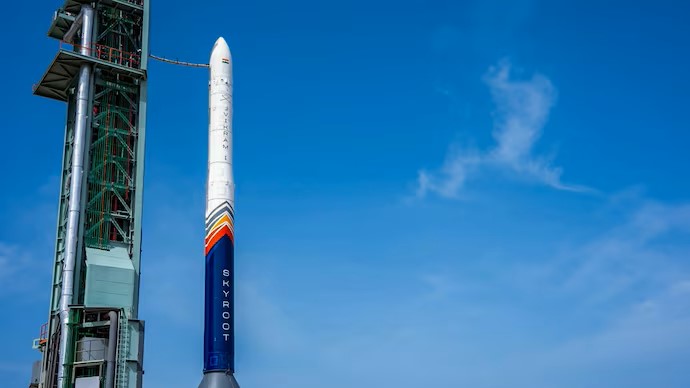
Skyroot Aerospace made a significant achievement on Saturday by becoming the first private Indian company to successfully launch an Indian-designed and built rocket into orbit on its inaugural flight. This milestone represents a major advancement for India’s burgeoning private space sector.

The rocket, named Vikram-1, was launched from the First Launch Pad at the Satish Dhawan Space Centre in Sriharikota, as part of a mission titled Aagaman. The launch successfully placed the vehicle in its planned low-Earth orbit at an altitude of around 450 km, effectively deploying multiple payloads. These included Skyroot’s SCOPE satellite, Grahaa Space’s Solaras satellite, and various in-orbit experiments.

By achieving this feat, Skyroot has positioned itself among a select group of private space enterprises worldwide that have successfully designed, built, and launched a rocket into orbit from their first attempt.

Prime Minister and ISRO React to the Successful Launch

Following the successful mission, Prime Minister Narendra Modi personally reached out to congratulate the Skyroot team. In a gesture of support, he sent a handwritten postcard bearing the phrase “Vande Mataram,” which was taken aboard the Vikram-1 rocket during its flight.

Dr V Narayanan, Chairman of ISRO, extended his heartfelt congratulations to Skyroot, noting that this accomplishment reflects years of innovation and engineering expertise. He expressed confidence in the growing maturity of India’s private space sector and emphasised the importance of collaboration between the Indian Space Research Organisation and industry partners.

Dr Pawan Goenka, Chairman of IN-SPACe, characterised the launch as a landmark event for the nation. His statement highlighted the significance of this achievement in placing India among a small group of countries capable of independently reaching space.

Company Leaders Highlight Future Ambitions

Pawan Kumar Chandana, co-founder and CEO of Skyroot, stated that the success of Vikram-1 marks merely the beginning of the company’s aspirations in the space sector. He expressed pride in reaching their designated orbit and deploying their payloads successfully, underlining the company’s long-term vision of making space access more widely available.

During the mission, Vikram-1 accomplished all key flight milestones, confirming the efficacy of its propulsion, avionics, and guidance systems under actual flight conditions. Skyroot acknowledged that the mission provided valuable data that will enhance the performance of future launches in the Vikram series.

Naga Bharath Daka, co-founder and COO, emphasized that Mission Aagaman was the result of years of meticulous engineering and dedicated testing. He mentioned that the company is already applying insights from this mission to future projects, focusing on building a robust launch capability from India.

Technical Specifications and Future Launch Plans

The Vikram-1 is a multi-stage launch vehicle capable of transporting payloads weighing up to 350 kg into low-Earth orbit. Its construction utilises an all-carbon composite structure and features in-house developed propulsion systems, which include 3D-printed engines and solid-fuel motors.

Skyroot has announced that the successful launch of Vikram-1 lays the groundwork for its commercial launch programme. The next vehicle in its series, Vikram-2, which will have the capability to carry payloads of up to 1,000 kg, is scheduled for its first flight in 2027. Additionally, the company is working on a fully reusable launch vehicle aimed at minimising costs associated with space access.

Long or Short, get news the way you like. No ads. No redirections. Download Newspin and Stay Alert, The CSR Journal Mobile app, for fast, crisp, clean updates!

App Store –  https://apps.apple.com/in/app/newspin/id6746449540 

Google Play Store – https://play.google.com/store/apps/details?id=com.inventifweb.newspin&pcampaignid=web_share

Latest News

Popular Videos
