


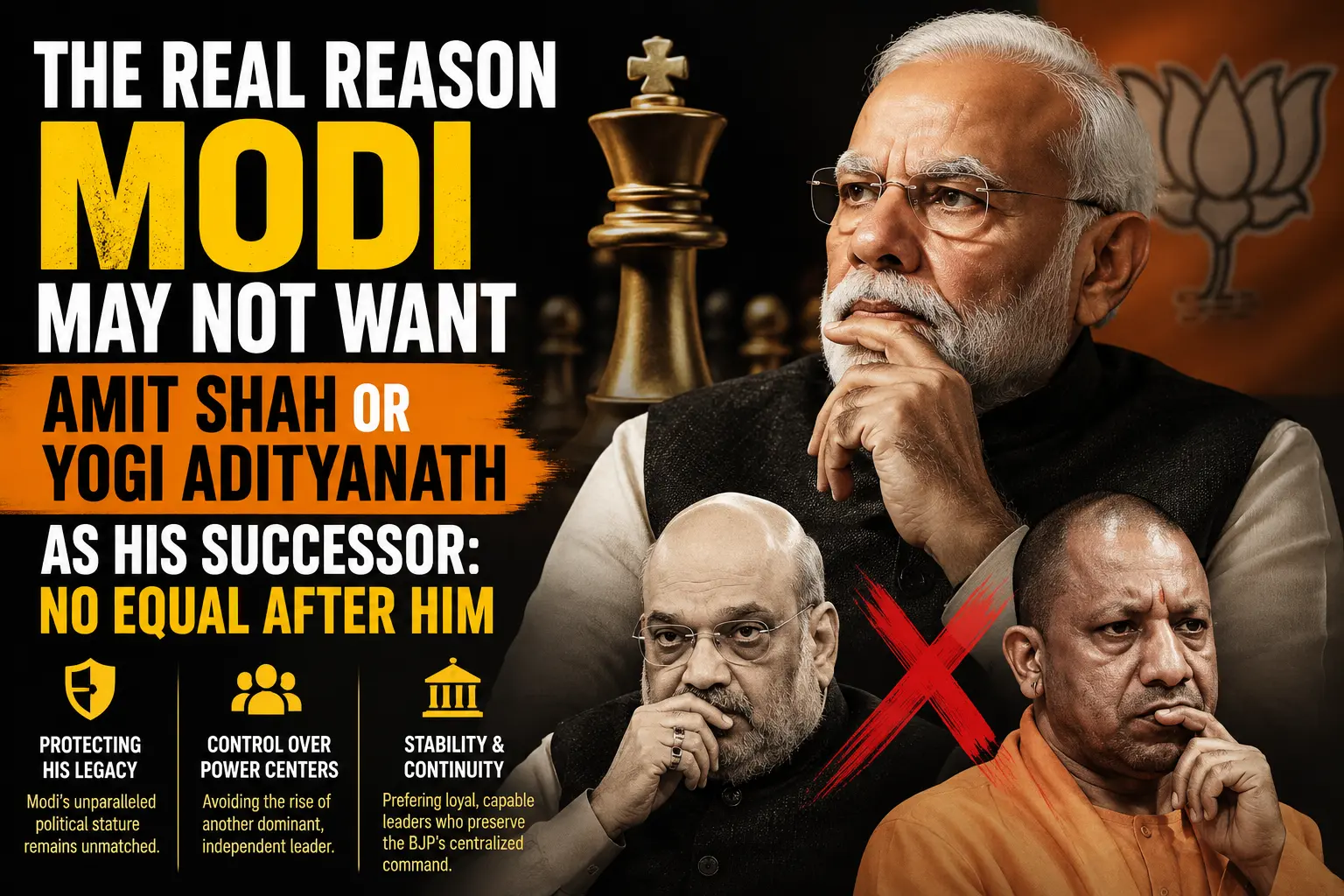

One of the most important — and least openly discussed — aspects of the Narendra Modi succession debate is this: Modi may not actually want a successor who becomes as politically dominant, independent, or larger-than-the-party as he himself became. This possibility fundamentally changes how one should analyze the future of the BJP.
Most public discussions assume succession is about identifying the “next strongman” after Modi. Names like Amit Shah and Yogi Adityanath dominate because they are seen as powerful, assertive, ideological, and nationally visible. But power transitions in highly centralized political systems rarely work that way. In reality, dominant leaders often prefer controlled successors over equally dominant heirs. And there are strong political, psychological, organizational, and historical reasons why Modi may think similarly.
The first and most important factor is legacy protection. Narendra Modi is not just another BJP prime minister. He has transformed the BJP into a personality-driven political structure in a way unseen since Indira Gandhi reshaped the Congress around herself. Before Modi, the BJP traditionally functioned through collective leadership:
-
Vajpayee,
-
Advani,
-
Murli Manohar Joshi,
-
Party Presidents,
-
RSS Influence,
-
and State Leaders balancing each other.
Modi changed this completely.
Today:
-
elections revolve around Modi,
-
welfare schemes are branded around Modi,
-
foreign policy is personalized around Modi,
-
and even state elections frequently become presidential-style campaigns centered on him.
This level of concentration naturally creates a problem: Any successor with comparable charisma and independent authority could eventually overshadow Modi’s own legacy. Historically, towering leaders are often cautious about creating equals. Indira Gandhi weakened several Congress regional satraps because she did not want parallel power centers. Many authoritarian or highly centralized leaders globally have preferred loyal administrators over charismatic successors precisely because dominant successors eventually rewrite political history.
Modi is a deeply strategic politician. It would be politically naïve to assume he has not considered this risk. This is where Amit Shah and Yogi Adityanath become complicated choices. Amit Shah is unquestionably powerful. He understands the BJP machinery perhaps better than anyone after Modi himself. But Shah’s strength is also exactly why he could become risky in the long term. A Modi-Shah transition would effectively mean transferring the entire centralized political machine to another equally hard political operator.
Shah already has:
-
organizational control,
-
deep government influence,
-
strong electoral credentials,
-
intelligence-network familiarity,
-
and cadre respect.
If Shah became PM, he would not merely inherit Modi’s system — he could eventually fully own it. That distinction matters enormously in power politics. The same applies, perhaps even more dramatically, to Yogi Adityanath. Yogi’s rise is unique because he is the first BJP leader after Modi who has developed a truly independent emotional support base at a mass level.
His appeal is not borrowed from Delhi. It comes from:
-
religious symbolism,
-
ideological clarity,
-
strongman image,
-
and direct voter mobilization.
This makes Yogi extremely valuable electorally, but potentially uncomfortable for a centralized leadership structure. Unlike many BJP chief ministers, Yogi does not appear politically dependent on Delhi for survival. In fact, among sections of the BJP grassroots, he is already viewed not merely as a future leader but as a future ideological icon. That is a very significant distinction.
For a leader like Modi, who spent decades building unparalleled authority inside the BJP, empowering someone with autonomous national charisma could create future instability in the party hierarchy.
The BJP today operates through a highly centralized command model:
-
Modi at the top,
-
limited internal dissent,
-
strong message discipline,
-
centralized campaign management,
-
and carefully controlled power distribution.
A very dominant successor could disrupt this equilibrium.
There is also another deeply important factor: comparison.
As long as Modi remains the BJP’s tallest figure historically, his political aura stays unmatched. But the moment a successor becomes equally dominant or develops a larger cult-like following within sections of the party, comparisons become inevitable. Political history is filled with examples where successors gradually redefine the legacy of their predecessors.
Modi may not want:
-
a successor who competes with his historical stature,
-
a leader who shifts BJP ideology in a sharper direction,
-
or someone who builds an independent national movement inside the party.
This may explain why Modi’s long-term political behavior often appears carefully calibrated to prevent the rise of alternative national power centers. Over the past decade, the BJP has increasingly become a system where:
-
state leaders remain important,
-
but no leader besides Modi fully dominates nationally.
Even powerful chief ministers operate within centrally controlled boundaries. This structure may not be accidental. It may be intentional succession management. In this context, the most logical Modi strategy may actually be something very different from what television debates suggest.
Instead of promoting one overwhelmingly dominant heir, Modi may prefer:
-
a controlled collective leadership model,
-
multiple competing senior leaders,
-
stronger organizational control from Delhi,
-
and gradual generational transition.
Such a model protects three things simultaneously:
-
Modi’s historical legacy
-
BJP organizational stability
-
Centralized command structure
This is why the possibility of a “weaker but manageable” successor cannot be dismissed. In many political systems, outgoing dominant leaders often prefer successors who are:
-
loyal,
-
administratively competent,
-
ideologically aligned,
-
but not independently mass charismatic.
Such leaders preserve continuity without threatening the original leader’s historical stature. This does not necessarily mean Modi would choose a weak prime minister. Rather, he may prefer someone whose authority initially depends on:
-
the BJP organization,
-
RSS support,
-
coalition consensus,
-
and the Modi legacy itself.
In that model, Modi remains the permanent ideological center of the BJP even after leaving office. This possibility also explains why succession inside the BJP remains unusually opaque despite Modi’s long tenure. If Modi truly wanted to project a clear heir, the BJP machinery could easily begin doing so. Instead, multiple names circulate simultaneously:
-
Amit Shah,
-
Yogi Adityanath,
-
Nitin Gadkari,
-
Rajnath Singh,
-
Devendra Fadnavis
-
Himanta Biswa Sarma,
-
and emerging organizational figures.
That ambiguity itself may be strategic. An unclear succession race prevents any single leader from becoming too powerful too early. It also ensures that ultimate authority remains with Modi for as long as he remains politically active. There is another psychological dimension that should not be ignored.
Modi’s political rise was built through relentless personal struggle:
-
years in organizational politics,
-
ideological training,
-
electoral battles,
-
internal BJP competition,
-
and eventually defeating senior leaders to become the party’s unquestioned center.
Leaders who rise through such difficult political journeys often become highly protective of the authority they build. They rarely create easy pathways for equally dominant successors. This is not unique to Modi. It is common across global politics. The stronger and more personalized the leadership model becomes, the harder it becomes to willingly produce an equal successor. That is why the BJP after Modi may initially look very different from the BJP under Modi.
Instead of one towering figure immediately replacing him, India may witness:
-
controlled transition,
-
distributed authority,
-
competing factions balanced carefully,
-
and a leadership structure designed specifically to ensure no single leader quickly becomes “the next Modi.” Keeping these factors in mind.
Here are a few options that Modi might comfortably consider :
-
Dharmendra Pradhan could emerge as a serious dark-horse choice for Narendra Modi because he combines organizational loyalty, RSS acceptability, administrative experience, and relatively low personal political threat. Unlike Yogi Adityanath, he does not command an independent mass movement, and unlike Amit Shah, he is not viewed as an overpowering parallel center of authority. Pradhan has also played a major role in BJP expansion in eastern India, particularly Odisha, which makes him strategically valuable for the party’s long-term national growth.
-
Shivraj Singh Chouhan fits another possible Modi preference model: a leader with strong governance experience, soft public image, electoral credibility, and wide acceptability without appearing nationally overpowering. Shivraj has repeatedly shown loyalty to the central leadership even after being sidelined at different moments in Madhya Pradesh politics. His “non-threatening” style may actually work in his favor in a post-Modi transition where Delhi may prefer stability over another highly dominant personality.
-
Nitin Nabin represents a very different possibility — a younger, organization-first leader who could become part of a long-term generational transition project inside BJP. His elevation at a relatively young age signals that the party is preparing a future leadership pipeline beyond the current big faces. Modi may prefer grooming leaders like this because they rise entirely within the post-Modi BJP structure rather than carrying independent national stature before reaching Delhi.
“The most realistic post-Modi scenario may not be the rise of another towering political strongman, but the elevation of leaders who are capable, loyal, organizationally dependent, and unlikely to challenge Modi’s unmatched legacy inside the BJP.”