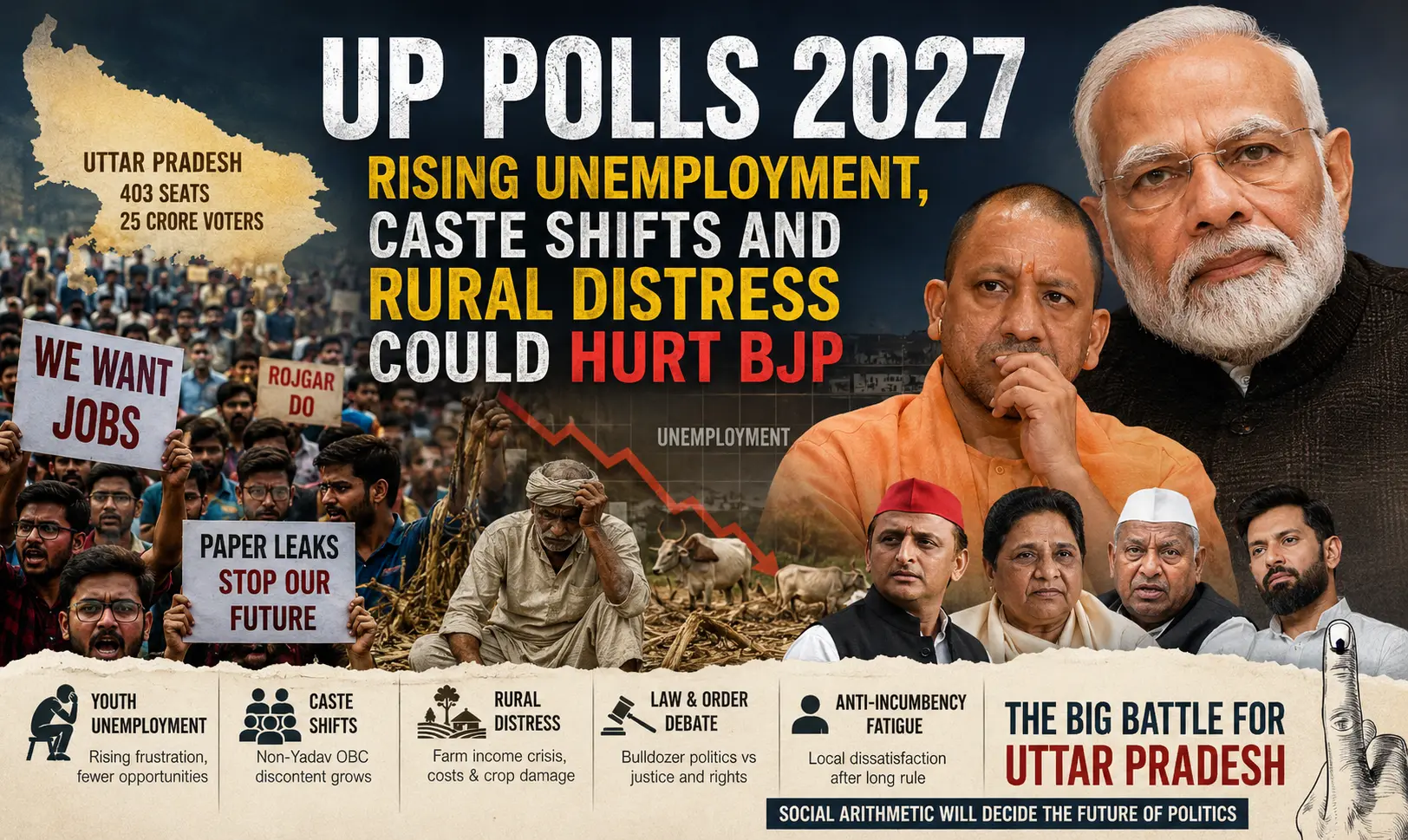
The road to the next Uttar Pradesh Assembly election is no longer a predictable march for the ruling party. What once appeared to be an invincible political machine is now entering a phase of visible stress, social recalibration, economic anxiety, and growing opposition consolidation. Uttar Pradesh — India’s most politically crucial state with nearly 25 crore people and 403 Assembly seats — is once again becoming the battlefield that could redefine the future of national politics.
For years, the electoral dominance of Narendra Modi and Yogi Adityanath rested on a powerful combination of Hindu consolidation, welfare delivery, muscular nationalism, and fragmented opposition votes. In the 2022 Uttar Pradesh Assembly elections, the BJP and its allies secured around 43% vote share and won 273 seats, while the Akhilesh Yadav-led alliance crossed nearly 32% vote share with 125 seats. The numbers clearly showed BJP dominance — but they also revealed something important: a swing of merely 5-6% votes across regions can dramatically alter seat outcomes in Uttar Pradesh because of the state’s caste-heavy electoral arithmetic.
The single biggest factor that could decide the election outcome is whether the opposition succeeds in converting social anger into a unified political movement. Uttar Pradesh has historically punished divided opposition parties, but whenever anti-BJP votes consolidate, the political arithmetic changes dramatically. Muslims constitute roughly 19-20% of Uttar Pradesh’s population, Yadavs around 9-10%, and Dalits nearly 21%. If even partial consolidation occurs between these blocs along with sections of non-Yadav OBC voters, the electoral map could tighten rapidly in over 150 constituencies where victory margins were relatively narrow in recent elections.
Another major factor is the shifting mood among backward caste communities. Non-Yadav OBCs are estimated to constitute nearly 35-40% of Uttar Pradesh’s population and were instrumental in BJP’s rise after 2014. But increasing murmurs around representation, unemployment, and local political neglect are beginning to emerge within smaller caste groups such as Kurmis, Mauryas, Nishads, Rajbhars, and Lodhs. Political analysts often point out that even a 7-8% erosion within the BJP’s OBC support base could significantly hurt the party across eastern and central Uttar Pradesh.
Youth frustration may emerge as the most explosive issue of the election. Uttar Pradesh has one of India’s youngest populations, with nearly 55-60% voters estimated to be below 35 years of age. Yet unemployment and recruitment controversies continue to dominate conversations. According to periodic labour force surveys and independent economic studies, youth unemployment in several northern states remains significantly above the national average, particularly among educated graduates. Repeated exam paper leaks, delayed police and teacher recruitments, and limited private sector expansion have created deep anger among aspirational youth. In a state where millions prepare for government jobs every year, even isolated recruitment controversies can politically snowball into statewide resentment.
Rural distress is another silent factor. Nearly 65% of Uttar Pradesh’s population still depends directly or indirectly on agriculture and rural income systems. While free ration schemes have benefited crores of families, economic pressure remains intense due to inflation, rising medical costs, stagnant farm income, and stray cattle issues damaging crops. The political challenge for the BJP is that welfare support reduces distress temporarily but does not automatically generate long-term economic satisfaction.
The BJP may also face the challenge of perception fatigue after nearly a decade of dominance in Uttar Pradesh. Long incumbencies naturally generate resentment against local MLAs, district-level leadership, and bureaucratic functioning. In many constituencies during previous elections, BJP candidates reportedly won despite local dissatisfaction largely because of Modi’s personal popularity. However, if local anti-incumbency combines with economic frustration, the electoral impact could become more visible.
Law and order, once projected as the government’s strongest achievement, may also become a double-edged issue. Supporters view the government’s tough policing approach as necessary for stability, while critics increasingly argue that bulldozer politics, encounter narratives, and selective state action have created fear and alienation among sections of society. Opposition parties are likely to frame the election around the idea that governance cannot survive only on symbolism and centralised authority.
The Muslim vote could also play a decisive role. In many western and eastern Uttar Pradesh constituencies, Muslim voters influence outcomes directly due to demographic concentration. If tactical voting strengthens and opposition fragmentation reduces, BJP’s margins could shrink sharply in dozens of seats. Political observers often note that Uttar Pradesh elections become difficult for the BJP whenever Muslim consolidation combines with even partial backward caste drift.
There is also an internal organisational dimension that cannot be ignored. Uttar Pradesh elections are not won only through rallies and television messaging — they are won booth by booth. The BJP’s organisational strength remains unmatched, but even minor cadre fatigue or internal factionalism can become costly in closely contested seats. Out of 403 Assembly constituencies, over 100 seats in recent elections were decided by margins below 20,000 votes, showing how small shifts in voter behaviour can create major political consequences.
At the same time, writing off the BJP would be politically premature. The party still possesses enormous electoral machinery, ideological consolidation, welfare networks, and the continuing popularity of Narendra Modi among significant sections of voters. Beneficiaries of free ration schemes, housing programs, women-centric welfare delivery, and Hindu consolidation continue to form a powerful support base.
But the central question of the election may ultimately be this: can emotional and identity-driven politics continue to overpower economic anxieties indefinitely in India’s largest state?
Uttar Pradesh has repeatedly shown that political dominance can appear unshakeable until social arithmetic suddenly changes beneath the surface. The coming election may not simply decide who forms the next state government. It could determine whether the BJP’s long-standing electoral formula still possesses the same emotional force among voters facing unemployment pressure, rising costs, rural distress, and growing demands for representation and opportunity. UP Polls 2027: Rising Unemployment, Caste Shifts and Rural Distress Could Hurt BJP.
And if the opposition manages to convert scattered dissatisfaction into a disciplined social coalition, the BJP could face its toughest Uttar Pradesh election battle in more than a decade.