


Nancy Grace Roman: The Visionary Behind the Hubble Space Telescope
The CSR Journal Magazine

Nancy Grace Roman, often referred to as the Mother of Hubble, played a pivotal role in the advancement of space observation. Born on May 16, 1925, in Nashville, Tennessee, she developed an interest in astronomy at a young age, inspired by nature walks with her mother. Her ambition to become an astronomer was evident by the seventh grade, a notable aspiration for a girl during the mid-20th century in the United States.

Despite facing gender-based discouragement from educators, including a physics department head who typically advised young girls against pursuing physics, Roman persevered. She obtained her doctorate from the University of Chicago in 1949. Her academic journey was met with challenges, particularly as Yerkes Observatory declined to appoint women to permanent positions, prompting her to seek opportunities elsewhere.

In 1954, Roman transitioned to the Naval Research Laboratory in Washington DC, where she contributed to radio astronomy, a pioneering field at the time. This move coincided with her growing involvement in NASA, an agency she joined in 1959, becoming the first woman to hold an executive position there.

The Contribution to the Hubble Space Telescope

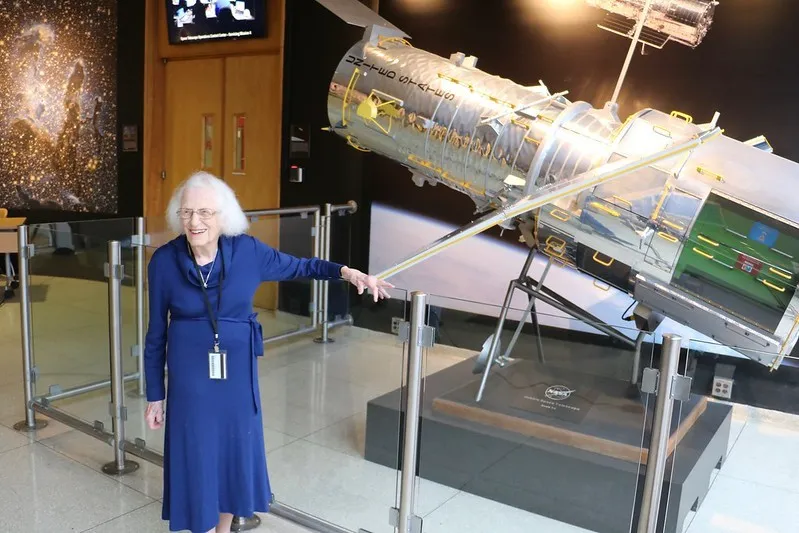
Roman’s influence on the Hubble Space Telescope’s development is a testament to her foresight and determination. Initially, during the post-World War II era, NASA faced financial constraints and skepticism regarding ambitious projects like Hubble. Understanding that Earth’s atmosphere obstructs clear views of celestial bodies, Roman advocated for space-based telescopes that could provide unobstructed observations.

Under her leadership, NASA successfully launched four Orbiting Astronomical Observatories between 1966 and 1972, establishing the groundwork for the Hubble Space Telescope. These missions illustrated the significance of astrophysical observations from space, setting the stage for future advancements in the field.

One of Roman’s most notable achievements was the introduction of charge-coupled devices (CCDs) as image sensors for Hubble, enhancing the precision of astronomical imaging. She also engaged with the scientific community to define Hubble’s objectives and established a set of essential specifications to guide discussions with Congress.

Legacy and Future Innovations

Roman retired from NASA in 1979 and passed away on December 25, 2018, at the age of 93, leaving a profound legacy. Although she did not witness all of her contributions come to fruition, a new telescope named after her is set to revolutionise space observation. The Nancy Grace Roman Space Telescope is scheduled for launch, with NASA aiming for as early as September 2026.

This new telescope will feature a primary mirror of approximately 2.4 metres, comparable to Hubble’s, but will be capable of capturing images of a sky area at least 100 times larger. Its surveying capabilities are expected to be over 1,000 times faster than those of Hubble, promising a wealth of astronomical discoveries.

In its first five years, the Nancy Grace Roman Space Telescope is projected to uncover more than 1,00,000 distant worlds, alongside hundreds of millions of stars and billions of galaxies. It is also set to probe dark energy, which is believed to be accelerating the expansion of the universe, while searching for potentially habitable planets, ensuring that Roman’s vision continues to influence science well into the future.

Long or Short, get news the way you like. No ads. No redirections. Download Newspin and Stay Alert, The CSR Journal Mobile app, for fast, crisp, clean updates!

App Store –  https://apps.apple.com/in/app/newspin/id6746449540 

Google Play Store – https://play.google.com/store/apps/details?id=com.inventifweb.newspin&pcampaignid=web_share

Latest News

Popular Videos
