


Monsoon Fully Covers India With July Recording Excess Rainfall of 42 Per Cent
The CSR Journal Magazine

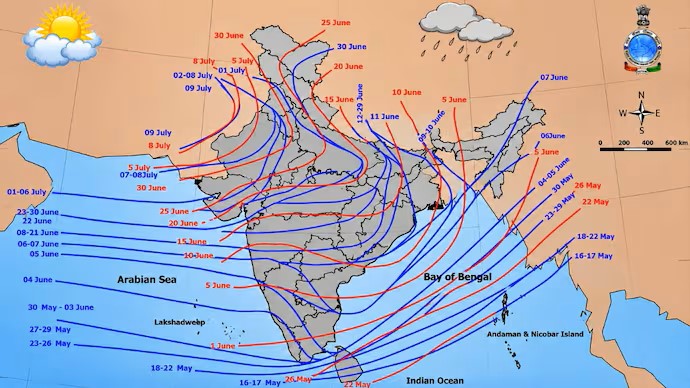
The southwest monsoon has now completely enveloped the entire nation, marking a significant achievement in its seasonal progress. This follows an unusually slow start that raised concerns regarding a potential extended dry spell. As of July 9, the monsoon reached the remaining regions of Rajasthan, Haryana, and Delhi, thereby finalising its advance across India.

Typically, the southwest monsoon concludes its coverage by July 8, making this year’s completion only slightly delayed due to a prolonged hiatus observed in June. The rapid revival of the monsoon stands in stark contrast to the stagnation experienced the previous month, which was among the driest beginnings to the rainy season in over a century.

Weak cross-equatorial winds and a sluggish monsoon trough, combined with the onset of a powerful El Niño, had considerably curtailed rainfall during June. However, improved conditions were observed in early July, attributed to several low-pressure systems that developed over central India and the Bay of Bengal.

Excess Rainfall Recorded in July

According to data from the India Meteorological Department (IMD), India experienced a remarkable 42 per cent increase in rainfall between July 1 and July 8, receiving an average of 92.3 mm compared to the normal 65.1 mm. This substantial increase indicates a significant improvement in weather conditions across the nation.

Central India was noted as the wettest area during this period, with states such as Madhya Pradesh, Maharashtra, Gujarat, Chhattisgarh, and Odisha receiving large quantities of excess rainfall. Madhya Pradesh was particularly prominent, registering one of the highest surpluses, while Gujarat and Chhattisgarh reported widespread heavy to very heavy rain due to active monsoon systems influencing the region.

As a result of this rainfall, the overall seasonal rainfall deficit in the country has shown marked improvement. The deficit had reached over 60 per cent at various points in June but has gradually decreased over the past week, although the distribution of rainfall remains inconsistent.

Predictions for Continued Monsoon Activity

Despite widespread improvements, certain regions including parts of Tamil Nadu, Andhra Pradesh, Telangana, Ladakh, West Bengal, Assam, Meghalaya, and Bihar still face rainfall deficits. Additionally, several northeastern states continue to experience precipitation levels below the normal range.

The IMD anticipates that the active monsoon phase will persist over northern India for the next few days, with heavy rainfall forecast in Uttarakhand, Himachal Pradesh, Uttar Pradesh, Punjab, Haryana, and Delhi. However, it has been indicated that rainfall activity in central India may decrease after July 9, as the current low-pressure system shifts towards Uttar Pradesh.

This completion of the monsoon’s advance represents a vital milestone for the kharif sowing season, providing much-needed relief to farmers who have faced uncertainty in recent weeks. The arrival of fresh inflows into reservoirs and improved soil moisture levels across much of the country stand to significantly benefit agricultural prospects. Nonetheless, meteorologists will continue monitoring regional disparities in rainfall for the duration of the season.

Long or Short, get news the way you like. No ads. No redirections. Download Newspin and Stay Alert, The CSR Journal Mobile app, for fast, crisp, clean updates!

App Store –  https://apps.apple.com/in/app/newspin/id6746449540 

Google Play Store – https://play.google.com/store/apps/details?id=com.inventifweb.newspin&pcampaignid=web_share

Latest News

Popular Videos
