


app-store-logo
play-store-logo
March 12, 2026

Isro Conducts Successful Test of Enhanced CE20 Cryogenic Engine
The CSR Journal Magazine

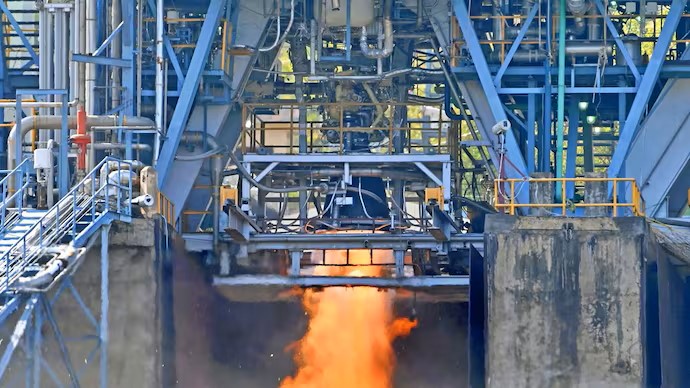
The Indian Space Research Organisation (Isro) has successfully completed an important ground test of its CE20 cryogenic engine, showcasing its higher thrust capability that is expected to significantly improve the performance of India’s heavy-lift rocket, the LVM3. This sea-level hot test was conducted on March 10, 2026, at the Isro Propulsion Complex located in Mahendragiri, Tamil Nadu. During this test, the engine functioned for 165 seconds, generating an impressive thrust of 22 tonnes.

Role of CE20 in Heavy-Lift Missions

The CE20 engine is responsible for powering the cryogenic upper stage of the LVM3 rocket, which plays a vital role in launching heavy satellites. Additionally, it will support India’s Gaganyaan human spaceflight programme. Prior to this latest test, sea-level tests conducted on the engine had been limited to generating 19 tonnes of thrust. The recent advancement marks a critical stride toward enhancing the rocket’s capabilities.

Future Goals for LVM3’s Payload Capacity

Isro aims to increase the LVM3’s payload capacity by utilizing an upgraded C32 cryogenic stage, which is expected to achieve 22 tonnes of thrust for future missions. This latest test serves to validate the engine’s ability to reliably operate at this elevated power level before it is authorized for flight missions.

Technical Challenges Faced During Testing

Conducting a sea-level test of a cryogenic engine like the CE20 introduces several technical challenges. The engine is equipped with a high area ratio nozzle, optimized for performance in the nearly vacuum of space. When assessed on Earth, variances in atmospheric pressure can potentially lead to flow separation within the nozzle, causing significant vibrations and thermal stresses that may impair the engine’s integrity.

Innovative Safety Measures Implemented

To mitigate these challenges, Isro employed a Nozzle Protection System alongside a multi-element igniter during the test. The agency has confirmed that both the engine’s performance and the test facility operated as anticipated throughout the firing duration. The engine used in this test had already completed a remarkable 20 successful hot tests, allowing engineers to validate several advanced technologies.

Advancements in Engine Technology

These technological advancements include enhancements in ignition systems, the development of indigenous turbopump bearings and sensors, and systems designed to facilitate Gaganyaan missions, such as the capacity to restart the engine during flight. This successful test represents a significant milestone as Isro gears up the LVM3 for more powerful launches and prepares for future crewed space ventures.

Long or Short, get news the way you like. No ads. No redirections. Download Newspin and Stay Alert, The CSR Journal Mobile app, for fast, crisp, clean updates!

App Store –  https://apps.apple.com/in/app/newspin/id6746449540 

Google Play Store – https://play.google.com/store/apps/details?id=com.inventifweb.newspin&pcampaignid=web_share

Latest News

Popular Videos
