


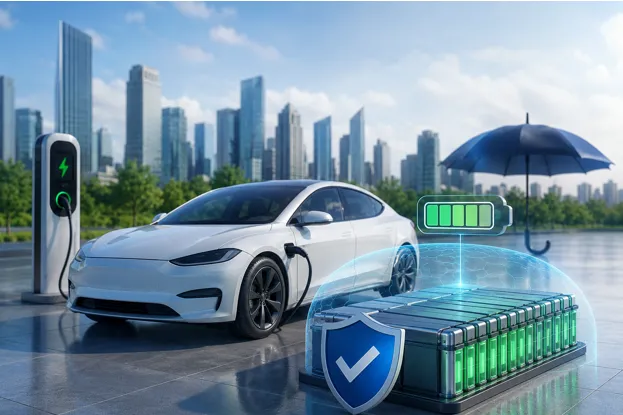

For most of the automobile’s history, the value of a used car came down to a familiar set of variables, mileage, service history, accident record and age. Electric vehicles have quietly added a new one to that list and it may turn out to be the most important of all. The health of the traction battery, how much of its original capacity it still holds and how well it has been treated, is becoming the single biggest factor in what, an EV is worth. That shift is now working its way into how car insurance is priced, structured and settled.
Why the battery became the centre of gravity?
In a petrol car, no single component dominates the vehicle’s value. In an electric vehicle, the battery pack routinely accounts for a third or more of the total cost. That concentration changes the risk calculation entirely. The most costly part of a car is also the most sensitive – it can get affected by heat, how you charge it, and even physical damage. Because of this, we can’t look at the vehicle as just one single unit anymore. Battery health is measured as state of health, a percentage of original capacity remaining and a pack at ninety per cent is worth considerably more than one at seventy. For the first time, insurers pricing electric car insurance have to consider a factor that can change a lot, even for two cars that are the same age and have the same mileage. That variability is what makes battery health so central to the future of the industry.
From age-based to condition-based thinking
Traditional car insurance leans heavily on proxies. Age and mileage stand in for wear, because directly measuring the condition of every component is impractical. Electric vehicles disrupt this because the battery reports on itself. Modern packs continuously log charge cycles, temperature exposure, fast-charging frequency and capacity fade, generating a detailed record of how the battery has actually been used.
This creates the possibility of condition-based pricing rather than age-based estimation. If an insurer knows the true condition of a battery, they can offer better premiums for a well-maintained four-year-old electric car compared to a heavily used two-year-old one. The proxy is being replaced by the measurement and that is a structural change in how motor risk gets assessed.
What this means for claims and settlements?
The impact is most visible when a claim is filed.
When an EV is involved in a serious accident, the critical question is whether the battery pack has been compromised. A pack that looks intact can carry internal cell damage that makes it unsafe and a pack that appears damaged may only need module-level repair. Getting this assessment right determines whether a claim is settled as a repair or a total loss.
The settlement basis matters just as much. A car insurance policy that pays out on the battery at replacement value treats the owner very differently from one that applies steep depreciation. As battery diagnostics improve, insurers can better distinguish genuine damage from ordinary capacity fading, reducing disputes over what caused a problem and who is responsible. The direction is towards settlements grounded in measurable battery condition rather than argument.
The data question
All of this depends on access to battery data and that raises questions the industry is still working through. The information sits with the vehicle and, often, the manufacturer and how it is shared with insurers and owners is not yet settled. An owner has a clear interest in transparent state-of-health reading, since it protects the resale value of their car and supports fair treatment on a claim.
There are privacy considerations too, since detailed battery telemetry reveals a great deal about how, when and where a car is driven. A future built on condition-based electric car insurance will need clear rules on what data is collected, who can see it and how it is used. The insurers who handle this transparently, giving owners visibility into the same information used to price and settle their policies, are likely to earn more trust than those who treat it as a black box.
How owners influence their own risk profile
One of the more interesting consequences is that battery health is substantially within the owner’s control. Habitual DC fast charging generates heat that accelerates capacity loss. Routinely charging to a hundred per cent and discharging to near zero stresses cells more than staying within a moderate band. Parking in direct sun through an Indian summer is harder on a pack than parking in shade.
None of these habits makes a big difference in a single day. But over the years, they can mean the difference between a battery that lasts long and one that wears out quickly. In a condition-based future, those choices could translate directly into insurance outcomes. That is a genuine departure from conventional car insurance, where an owner has limited ability to influence how their vehicle ages.
Where the market is heading
The building blocks of this future are already visible. Insurers in India, including Zurich Kotak General Insurance Company (India) Limited, have moved towards products that treat the battery as a defined, explicitly covered component rather than folding it vaguely into general vehicle cover. As diagnostic standards mature and battery data become more accessible, the next step is pricing and settlement that respond to actual state of health.
This will not happen overnight. It depends on data-sharing frameworks, standardised health metrics and diagnostic tools reaching authorised garages across the country, not just in metros. But the trajectory is clear. Electric car insurance is changing. Instead of guessing how much wear and tear your car might have, it’s now using data to check directly. The key to this shift is battery health.
A different relationship between car and cover
There’s now a much stronger link between how you use your car and how it gets insured – more than ever before. Your car’s battery tells the real story. It keeps a full record and that record decides its value, risk, and even claims settlement.
For owners, the practical takeaway is straightforward, treat the battery well, keep visibility into its state of health and choose a car insurance policy that defines battery cover clearly rather than leaving it ambiguous. With electric vehicles, the future is all about the battery’s health. If you look after it well, you’ll benefit the most as the market evolves.