




India Cannot Become a $5 Trillion Economy by Treating Informal Workers as Invisible

The CSR Journal Magazine

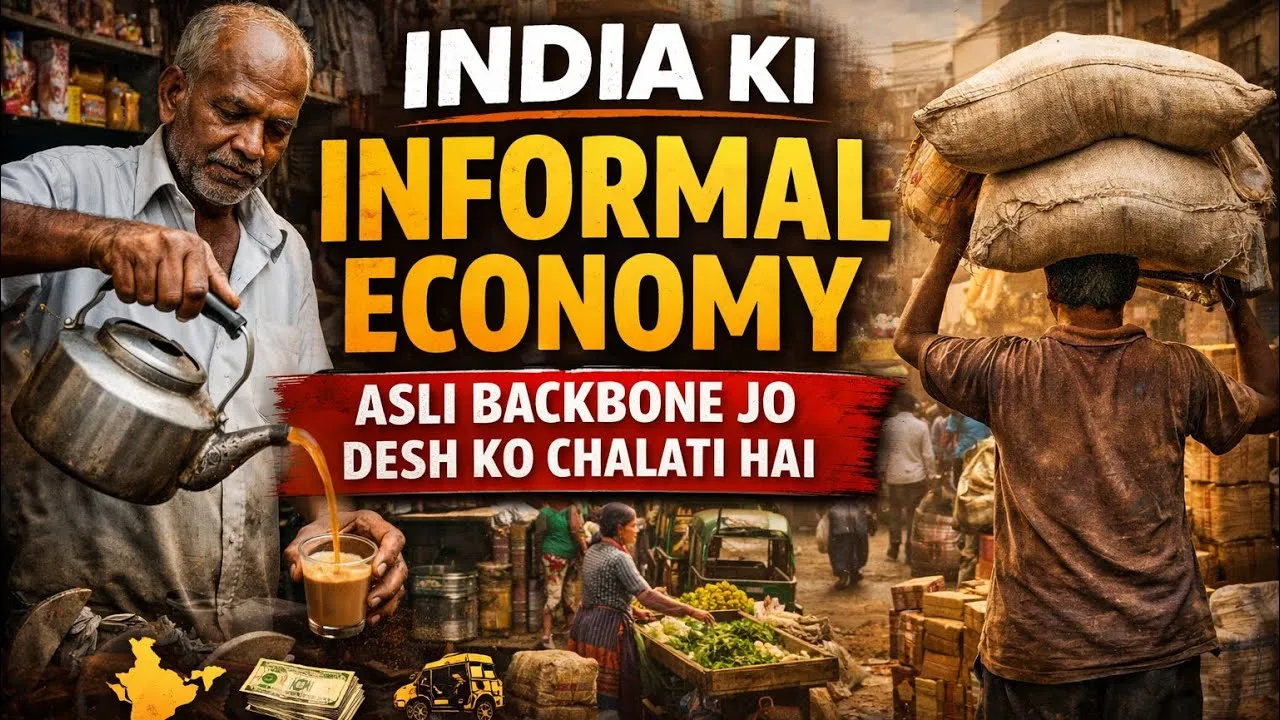
India wants to be a $5 trillion economy. Every budget speech repeats the number. Every investor deck has a slide on it. What almost nobody puts on that slide is this: the person selling vegetables outside the metro station, the child polishing shoes near the signal, the woman stitching garments from her one-room home, and the daily wage mason waiting at the labour ‘naka’ are the ones actually carrying a large share of that economy on their backs. They are not a footnote to growth. In many ways, they are the growth.

An economy cannot formalise its ambitions while keeping most of its workers informal. That is not a slogan, it is basic economics.

The size of the problem, in numbers

Start with scale. Roughly 9 out of every 10 working Indians earn their living in some form of informal arrangement, without a written contract, without provident fund, without health insurance tied to the job, and often without a fixed employer at all.

The Periodic Labour Force Survey for 2025 puts the labour force participation rate at 59.3%, with regular salaried employment, the most “formal” category, rising only slowly from 22% to 24% of workers. That means even after years of a formalisation push, roughly 3 in 4 working Indians are still outside regular salaried work.

Narrow the lens to non-agricultural informal enterprises, the small shops, workshops, and street businesses tracked separately by government surveys, and the number is 1096 lakh workers, about 18.8% of total employment, running unincorporated businesses with fewer than 10 people and no social security cover. Add agriculture, casual daily wage labour, and unregistered home-based work, and the informal share of the total workforce climbs far higher, closer to the 90 percent figure that labour economists have used for two decades.

This is not a rounding error in the GDP calculation. It is the GDP calculation.

Why economics has a name for this: dualism, and its limits

Development economics has a classic model for what India is going through, the Lewis dual economy model, named after Nobel laureate Arthur Lewis. The idea is simple: a poor country has two sectors, a modern high-productivity sector and a traditional low-productivity sector, and growth happens as labour moves from the traditional sector to the modern one, raising average productivity along the way.

India’s problem is that this transition has stalled. Large enterprises, those employing more than 20 workers, account for only about 13.7% of the workforce, even after a recent uptick from 10.8% the year before. The traditional, informal sector has not been shrinking fast enough to fit the Lewis story. Instead, informality has become a permanent structural feature rather than a temporary waiting room before formal jobs arrive.

Economists studying informality broadly fall into three camps, and it is worth simplifying each one because policy depends on which story you believe.

The dualist view treats informal workers as excluded, people who would gladly take formal jobs if those jobs existed, but there simply are not enough of them.

The structuralist view, associated with economists in the Latin American tradition, argues that formal firms deliberately keep informal work alive because it is cheaper, subcontracting to unregistered units to avoid labour law costs, effectively using informality as a subsidy to formal capital.

The legalist view, most associated with the Peruvian economist Hernando de Soto, argues that informal workers are entrepreneurs trapped by bad regulation, people who would register and formalise readily if the paperwork, fees, and bureaucratic friction were not so punishing.

India’s reality contains all three: 1) A street vendor priced out of the formal retail lease market is dualist exclusion, 2) A garment unit outsourcing stitching to home-based women workers to dodge minimum wage and safety law is structuralist subcontracting, 3) A small trader who cannot navigate GST filing and licensing across three separate municipal departments is a legalist case waiting for de Soto’s solution: simplify the paperwork and formality follows.

Any serious plan to reach $5 trillion must work on all three fronts at once. You cannot fix informality with a single lever.

The politics of urban space

This is where economics runs into geography and politics. Urban space in Indian cities is never neutral. Every pavement, every market corner, every railway underpass is contested territory, and the contest has rules that are political long before they are economic.

The scholarship on the politics of urban space describes this well. Cities plan for a “formal” citizen who parks a car, shops in an enclosed mall, and pays fixed municipal taxes. The informal worker, the vendor, the rickshaw puller, the waste picker, is treated as a temporary irritant to be tolerated, taxed informally, or periodically removed, never as a permanent stakeholder in how the city is designed. Urban theorists have called this the difference between civil society, which has legal standing and formal claims on the state, and what has been termed political society, groups who survive the city through negotiation, patronage, and informal bargaining rather than legal right.

This matters economically because it determines who gets to invest in their own productivity. A vendor who does not know if she will be evicted next month has no reason to buy a cart with refrigeration, take a loan to expand stock, or build a customer base beyond daily survival. Insecure tenure over urban space is, in economic terms, a tax on long-term investment. It caps productivity growth for tens of millions of people before they even start.

The corruption nexus that keeps informality profitable for everyone except the worker

Informality persists not despite weak governance but because weak governance is profitable to a specific set of actors. Public choice theory, the branch of economics that studies how self-interested behaviour shapes political and bureaucratic decisions, explains this well. When a rule is unclear or unenforced, the people who control access to enforcement can extract rent from the gap.

In most Indian cities, a familiar nexus operates on the ground. The local municipal official who is supposed to allocate vending zones instead allows encroachment in exchange for a cut. The beat constable who could clear an illegal stall instead collects a weekly informal payment, commonly called ‘hafta’, in exchange for looking away. Local strongmen, sometimes tied to a political party’s local unit, control which vendor gets which spot on the pavement, effectively privatising public space and charging rent for access to it. And the elected local politician benefits twice over, first from a cut of the collection chain, and second from the vendor’s vote and gratitude come election time, since the politician is the one who can, selectively, protect a vendor from the very eviction drive the same system enables.

This is not a moral failing of individuals so much as an equilibrium. Each actor is responding rationally to the incentives in front of them. The vendor pays because the alternative, formal registration, is slower, costlier in bribes anyway, and offers no guarantee of security. The constable collects because his own pay and promotion structure gives him no reward for strict enforcement and real risk if he refuses informal income that peers are already collecting. The municipal officer benefits from discretion because discretion, not a fixed rule, is what generates a payment. Everyone in the chain has a reason to keep the system exactly as unclear as it is.

The economic cost of this nexus is enormous even though it never appears on a balance sheet. It taxes the poorest workers the most heavily, since a fixed daily bribe is a much larger share of a vendor’s income than of a shopkeeper. It blocks formalisation, since the whole extraction chain depends on workers staying outside the legal system. And it corrodes trust in the state, which is itself an economic input, because firms and workers who do not trust institutions invest less, save less formally, and route more of their activity through cash and informal channels that stay outside the tax net the $5 trillion target depends on.

Child labour, the sharpest edge of informality

Nowhere does the human cost of this system show up more starkly than in child labour. According to the 2011 Census, the most recent full count, 10.1 million children aged 5 to 14 in India were working as main or marginal workers, out of a total child population of 259.6 million in that age group. More recent survey-based estimates, using broader definitions that include hazardous household chores and long working hours, put the real figure considerably higher, with some researchers suggesting the true number could run into tens of millions once informal, unregistered, and home-based work is properly counted.

The pattern matters as much as the number. Children in informal work cluster overwhelmingly in agriculture, small workshops, domestic work, and street-level trade, precisely the sectors where regulatory oversight is weakest and enforcement is most easily bought off by the same corruption nexus described above. India’s own labour law adds a structural loophole here. The Occupational Safety, Health and Working Conditions Code only applies fully to establishments with ten or more employees, and since many India’s informal units are smaller than that, most child labour sits in a zone the law barely reaches even on paper.

Economically, child labour is not just a moral emergency, it is a long-run productivity trap. Human capital theory, the economic idea that education and skills are investments that raise future earnings, tells us plainly that a child pulled out of school today becomes a lower-productivity adult worker tomorrow. A country trying to reach $5 trillion by 2030 needs precisely the opposite, a generation with more years of schooling, not fewer.

Why has formalisation failed to keep pace?

India has not ignored this problem on paper. Schemes like PM SVANidhi have tried to extend small collateral-free loans to street vendors. GST simplification, the Udyam registration portal for small enterprises, and the four labour codes passed by Parliament were all designed, at least in intent, to lower the cost of becoming formal. Yet the informal share of employment has barely moved in real terms.

The reason is governance capacity, not policy design. India has one labour inspector for tens of thousands of establishments in many states, nowhere close to what would be needed to monitor, let alone enforce, minimum wage, safety, or child labour rules across the informal sector. Municipal bodies that are supposed to survey and license street vendors under the Street Vendors Act (2014), a law that explicitly recognises vending as a legitimate livelihood requiring town vending committees and identity cards, have in most cities never completed the vendor survey the law requires. Without the survey, there is no legal list of who is entitled to vend where, and without that list, the corruption nexus fills the vacuum the state left behind.

What needs to change?

Three shifts would matter more than any single scheme.

First, treat urban space allocation as an economic policy tool, not just a law-and-order issue. Cities that map vending zones, issue enforceable identity cards, and give vendors security of tenure directly raise those workers’ incentive to invest in their own productivity, exactly the kind of formal-sector convergence the Lewis model describes.

Second, break the discretion that fuels the corruption nexus. Public choice theory is clear that rent-seeking shrinks when rules are simple, transparent, and enforced by a system with independent oversight, not when enforcement is left to the same local actors who profit from the current mess. Digitised, publicly visible vending registers and rotating, audited enforcement teams would take away the discretion that ‘hafta’ collection depends on.

Third, fund labour and child protection enforcement at a scale that matches the size of the informal workforce, not the size of last year’s budget line. A $5 trillion economy can afford enough inspectors to make its own labour laws real rather than symbolic.

Last but not least,

GDP targets are, in the end, an accounting exercise, but growth is a human one. India’s informal workers are not a drag on the $5 trillion story, they are large parts of the story’s cast, cooking the food, building the homes, running the small trade, and in far too many cases, doing the work as children who should be in school.

An economy that keeps counting them as invisible in policy while depending on them completely in practice is not building toward $5 trillion. It is building a number on top of a foundation it refuses to look at directly.

Views of the author are personal and do not necessarily represent the website’s views.

Dr. Jaimine Vaishnav is a faculty of geopolitics and world economy and other liberal arts subjects, a researcher with publications in SCI and ABDC journals, and an author of 6 books specializing in informal economies, mass media, and street entrepreneurship. With over a decade of experience as an academic and options trader, he is keen on bridging the grassroots business practices with global economic thought. His work emphasizes resilience, innovation, and human action in everyday human life. He can be contacted on jaiminism@hotmail.co.in for further communication.

Long or Short, get news the way you like. No ads. No redirections. Download Newspin and Stay Alert, The CSR Journal Mobile app, for fast, crisp, clean updates!

App Store –  https://apps.apple.com/in/app/newspin/id6746449540 

Google Play Store – https://play.google.com/store/apps/details?id=com.inventifweb.newspin&pcampaignid=web_share

Latest News

Popular Videos