


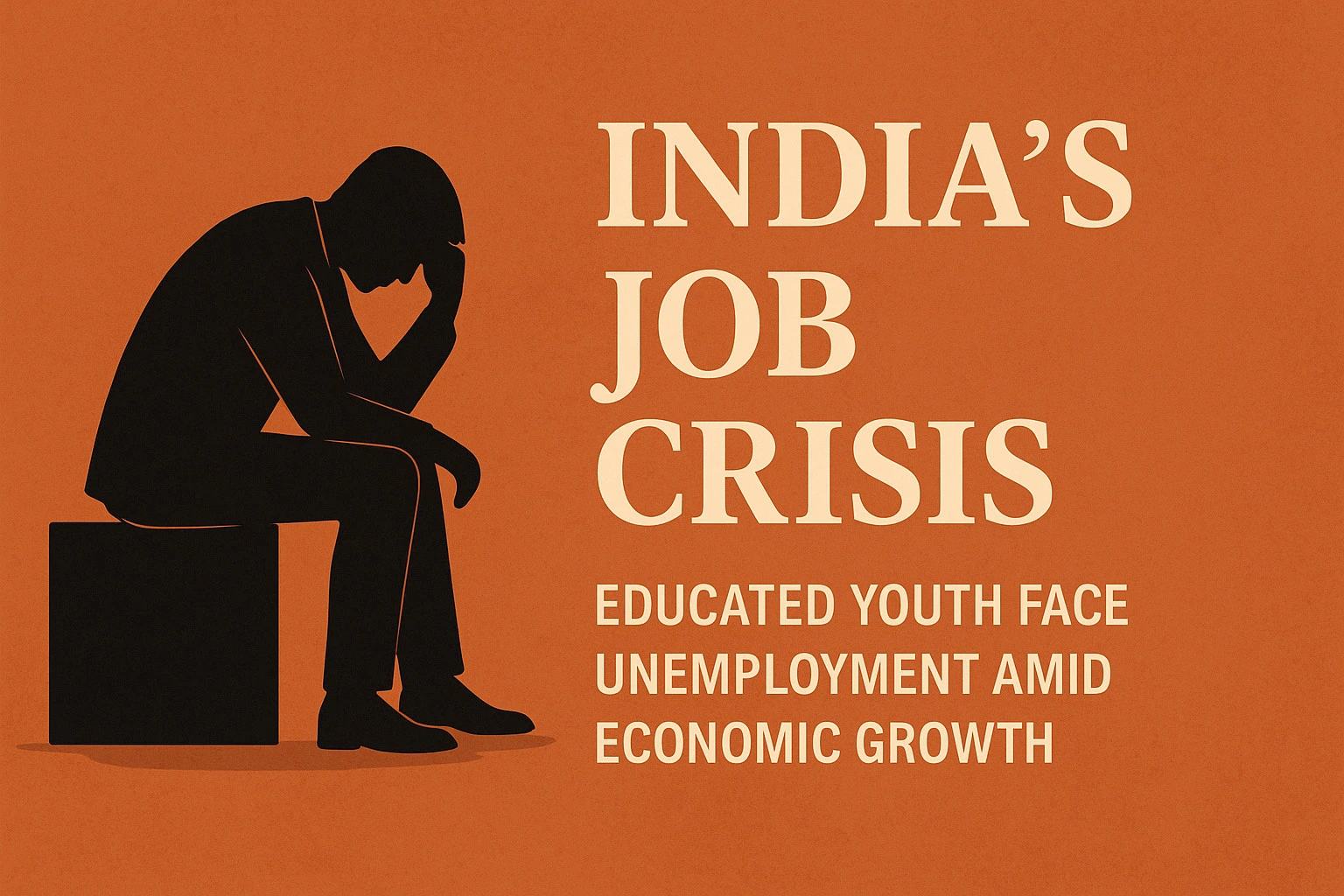

India loves to call itself the world’s fastest growing large economy. It loves the phrase “demographic dividend” even more. But a recent NITI Aayog report, titled Reimagining Skilling for Viksit Bharat@2047, has quietly put a number on the other side of that story, and it is not a small one. An estimated 8.7 crore Indians between the ages of 15 and 29 are, in the language of policy, NEET: not in education, employment or training. In plainer words, 87 million young citizens, roughly the population of Germany, are neither studying, nor working, nor being trained for any job at all.
That number deserves to sit uncomfortably with anyone in power.
The NITI Aayog analysis, based on the 78th round of the National Sample Survey conducted in 2021, sorts of India’s youth and working-age population into 5 broad buckets: those still in school, those in higher education, those in formal or informal work, women managing unpaid domestic responsibilities, and the NEET (not in education, employment, or training) category. It is this last group, alongside a large share of women outside the workforce, that the report flags as most financially and structurally stranded.
The report does not stop at the headline figure. It notes that even among those who do make it through the education system, only about 8.25% of graduates end up working in jobs that match their qualifications. Read that again. Out of every 100 Indian graduates, fewer than 9 are doing work connected to what they studied. The rest are either underemployed, working in unrelated informal jobs, or unemployed altogether.
The report’s own diagnosis is telling. It says NEET youth are held back by a lack of income and by the sunk cost of the education they already have, meaning that many cannot afford to pay for additional skilling on top of existing financial pressure. Students from low-income households, it notes, often cannot layer paid training onto degree expenses they are already stretched to cover. So, they either grab the first stable paycheck available, however low it pays, or they fail to enter the workforce at all and drift into the NEET category.
This is not laziness. This is arithmetic. A young person with no savings, no family safety net, and a degree that taught them theory, but not employable skill has almost nowhere to go.
Whose Children Are These, Really?
It is worth asking, gently but firmly, who exactly makes up these 8.7 crore people. Independent academic research on India’s NEET population, including work published through the Institute for Human Development, has consistently found that young women, rural residents, and individuals from lower income and socially marginalised backgrounds are disproportionately represented in this group. This is not a coincidence. It is the predictable result of a system where quality schooling, private tuition, English fluency, internships, and professional networks are still, in practice, gated by privilege.
The children of the well-connected rarely become NEET statistics. They have access to coaching centres, family businesses to fall back on, and social capital that opens doors even when merit alone would not. The 8.7 crore are overwhelmingly the sons and daughters of farmers, daily wage workers, small shopkeepers, and first-generation learners who did everything they were told to do, stayed in school, tried to get a degree, and still found no door open on the other side.
When a nation’s ladder of opportunity only reaches the already privileged, the rest are not failing the system. The system is failing them.
The China Comparison Nobody Wants to Make?
China is not without its own labour market troubles. Its youth unemployment rate for 16- to 24-year-olds, excluding students, has swung wildly in recent years, spiking past 21% in mid-2023 before easing to figures still hovering around 16 to 18% through 2025 and early 2026. That is a real problem, and Chinese policymakers have openly acknowledged it.
But there is a structural difference that changes everything.
-
China built the manufacturing base, vocational training pipelines, and infrastructure first, and then let its population growth slow down almost by design. India inherited a much younger, much larger population and has not yet built an equivalent industrial and skilling base to absorb it.
-
China’s youth unemployment is a cyclical, macroeconomic headache layered on top of decades of factory floors, apprenticeship systems, and an education pipeline tightly wired into manufacturing demand. India’s NEET crisis is structural. It is the result of a schooling system that was never redesigned for employability, a vocational training ecosystem introduced far too late, and an economy that has grown in value without growing proportionately in jobs.
 Dr. Jaimine Vaishnav is a faculty of geopolitics and world economy and other liberal arts subjects, a researcher with publications in SCI and ABDC journals, and an author of 6 books specializing in informal economies, mass media, and street entrepreneurship. With over a decade of experience as an academic and options trader, he is keen on bridging the grassroots business practices with global economic thought. His work emphasizes resilience, innovation, and human action in everyday human life. He can be contacted on jaiminism@hotmail.co.in for further communication.