


Chandrayaan-2 Mission Uncovers Water Ice in Moon’s Unique Craters
The CSR Journal Magazine

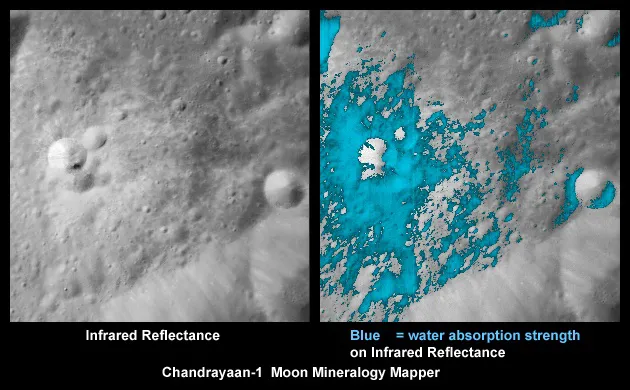
Researchers associated with India’s Chandrayaan-2 mission have uncovered new evidence indicating the presence of subsurface water-ice in the Moon’s south polar region. This finding has occurred within what are termed as “doubly shadowed craters,” which are now viewed as crucial areas for impending lunar exploration. The data was collected using the Chandrayaan-2 Orbiter’s Dual Frequency Synthetic Aperture Radar (DFSAR), unveiling the potential significance of these unique crater formations.

Understanding Doubly Shadowed Craters

Doubly shadowed craters are small depressions situated within larger craters characterized by permanent shadows. These areas around the Moon’s poles do not receive any direct sunlight due to the Moon’s minimal axial tilt. Consequently, the interiors of these deep polar craters experience continuous darkness, remaining unlit for billions of years. The term “doubly shadowed” reflects the fact that these craters exist within already shadowed regions, thereby preventing exposure to both sunlight and thermal radiation reflected from adjacent illuminated zones.

This unique environment results in some of the coldest temperatures detected in the Solar System, with figures falling to nearly 25 Kelvin, equivalent to roughly minus 248 degrees Celsius. Scientists assert that such frigid conditions render these craters ideal as cold traps, where water molecules introduced by comets, asteroids, or solar wind interactions can remain frozen beneath the surface for extended periods, potentially lasting millions or even billions of years.

Utilising advanced radar polarimetric analysis, a team from the Physical Research Laboratory (PRL) in Ahmedabad has successfully detected radar signatures indicative of subsurface ice located under the floors of four identified craters in the lunar south polar area. The DFSAR instrument aboard the Chandrayaan-2 orbiter stands out as the first fully polarimetric synthetic aperture radar designated for lunar studies, which allows for an in-depth examination of how radar waves interact with concealed materials beneath the lunar surface.

Significance of the Findings

The implications of this discovery are profound, especially concerning future lunar missions. Water-ice has the potential to be an indispensable resource, facilitating various aspects of space exploration. It can be converted into potable water, breathable air, and even rocket propellant, making the lunar south pole a focal point for nations intent on maintaining a human presence on the Moon over the long term.

One particular crater located within the Faustini basin, measuring approximately 1.1 kilometres in diameter, provided notably robust evidence of this subsurface ice. Researchers furthermore identified a unique “lobate-rim” structure within the crater, which may have originated from an impact that penetrated ice-rich ground below the surface. The presence of such features raises intriguing questions about the geological history of the area.

As space agencies around the world prepare for a renewed focus on lunar exploration, the findings from the Chandrayaan-2 mission serve to highlight the Moon’s potential as a vital resource hub. The research not only contributes to the scientific understanding of the Moon’s composition but also marks a significant step toward sustainable lunar habitation and exploration goals.

Long or Short, get news the way you like. No ads. No redirections. Download Newspin and Stay Alert, The CSR Journal Mobile app, for fast, crisp, clean updates!

App Store –  https://apps.apple.com/in/app/newspin/id6746449540 

Google Play Store – https://play.google.com/store/apps/details?id=com.inventifweb.newspin&pcampaignid=web_share

Latest News

Popular Videos
