


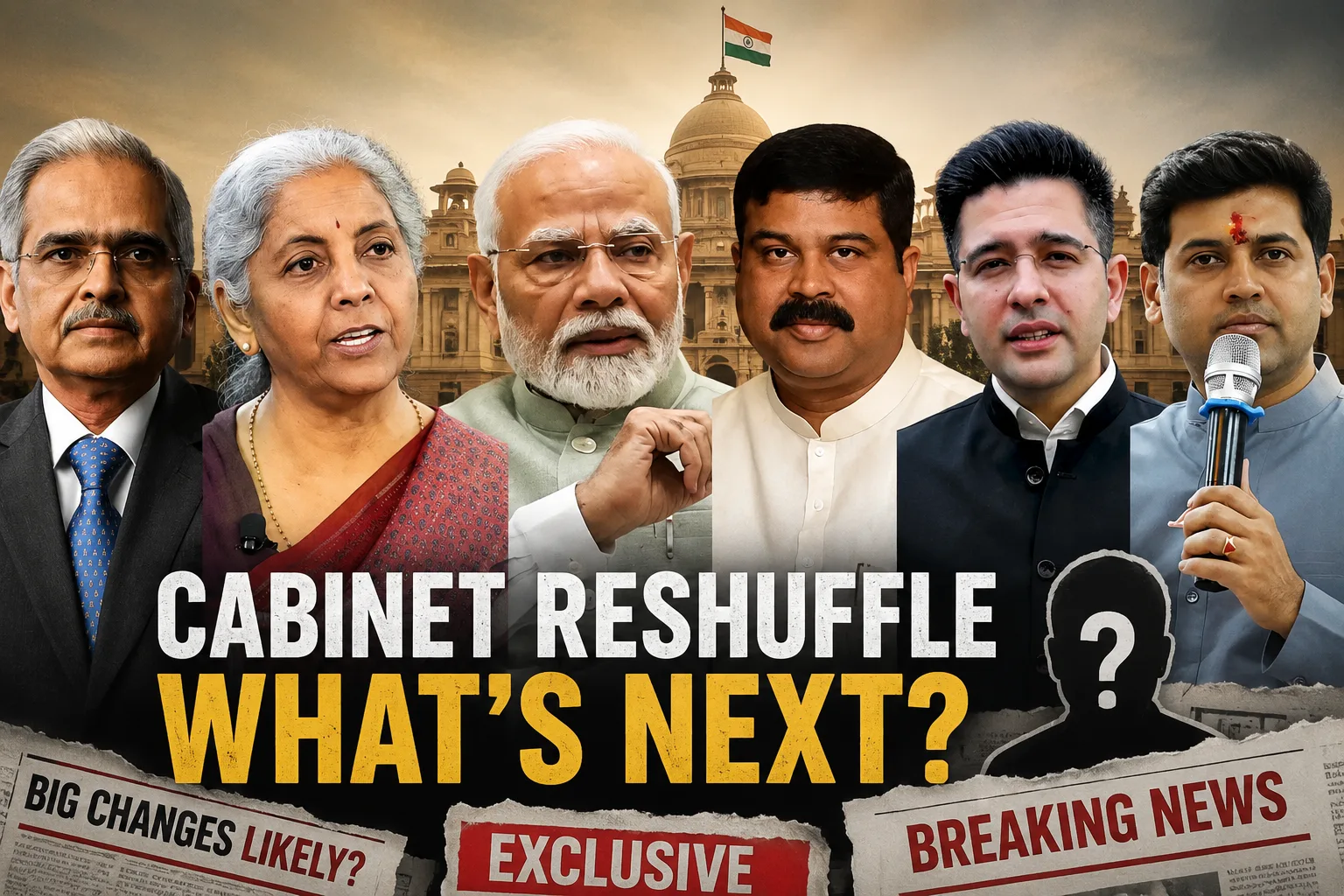

Cabinet Reshuffle or Content Reshuffle? How India’s Media Is Turning Speculation Into ‘Breaking News’

The CSR Journal Magazine

Every time whispers of a possible Union Cabinet reshuffle emerge, something entirely predictable happens. Not inside the corridors of power—but inside television studios, YouTube channels, websites and social media feeds. Suddenly, everyone becomes an “insider.” One channel claims Minister A is certain to be dropped, another confidently says Minister A is absolutely safe, a third claims Minister B is getting promoted, a fourth predicts Minister B is heading for the exit. By the end of the day, every possible combination has been published somewhere. If one prediction eventually turns out to be correct, it is celebrated as “exclusive journalism.” Everything else quietly disappears into the internet’s memory hole. This is not reporting. It is probability masquerading as journalism.

The Great Guessing Competition

The latest round of speculation over a possible Modi cabinet reshuffle has produced a flood of headlines and social media posts:

  • “Big Cabinet Reshuffle Likely Before the Monsoon Session.”

  • “Cabinet Expansion Delayed?”

  • “Who May Enter, Who Could Exit?”

  • “Amit Shah Set for a Bigger Role?”

  • “New Faces from Bihar?”

  • “Major Changes Coming Soon.”

Many of these stories openly acknowledge that they are based on “sources,” “buzz,” “expectations,” or “likely scenarios.” Yet the headlines are often written with a certainty that the underlying reporting simply does not support. Different outlets have projected different timelines, different ministers, and different political calculations—often contradicting one another. Social media has amplified the cycle even further. Posts confidently announce that the reshuffle is happening “this week,” then “next week,” then “after Parliament,” then “later in the year”—all with equal confidence and little accountability when the prediction changes.

The reality is that only a very small circle around Prime Minister Narendra Modi is likely to know the final decision on a cabinet reshuffle. Everything else is speculation. Political discussions, internal assessments and consultations may indeed take place. But until an official announcement is made, nobody outside that small decision-making circle can honestly claim to know the complete picture. Yet the competition for clicks, TRPs, YouTube views and social media engagement often rewards certainty over honesty. Why say “we don’t know” when “BIG BREAKING” attracts millions of views?

There is nothing wrong with analysing political possibilities, there is nothing wrong with discussing electoral arithmetic or governance challenges, there is nothing wrong with explaining why certain ministries may need attention but presenting speculation as near certainty crosses a line. When news becomes a guessing contest, the public loses.People begin confusing rumours with facts. Markets react, political workers become anxious, government employees start believing unverified claims. Most importantly, public trust in journalism erodes a little more each day.

Today’s digital economy rewards attention. The algorithm does not ask whether a headline was accurate. It only measures whether people clicked. In that race, sensational predictions become profitable even when they prove wrong. If ten different predictions are published and only one eventually comes true, the successful prediction is promoted endlessly while the nine incorrect ones quietly vanish. This creates the illusion of extraordinary accuracy when, in reality, it may simply be a numbers game.

If journalism’s purpose is to inform citizens, should it flood the public with contradictory claims that nobody can independently verify? Should every political whisper become a breaking-news alert? Should viewership become more important than credibility? Every incorrect “exclusive” may earn temporary clicks but it also weakens the long-term trust that journalism depends upon. Credibility is built slowly and lost quickly.

Political reporting is one of journalism’s most important responsibilities. That  responsibility demands restraint. If something is confirmed, report it. If something is under discussion, say it is under discussion. If something is only speculation, clearly label it as speculation. And if nobody truly knows, the most honest headline may simply be: “We’ll know when the official announcement comes.” In an era overflowing with information, accuracy is more valuable than speed. The public deserves facts—not an endless parade of predictions designed to maximise clicks. When journalism becomes a guessing game, everyone loses except the algorithm.

Latest News

Popular Videos