


Why You Should Not Seek Shelter Under a Tree During Lightning and Thunderstorm? 
The CSR Journal Magazine

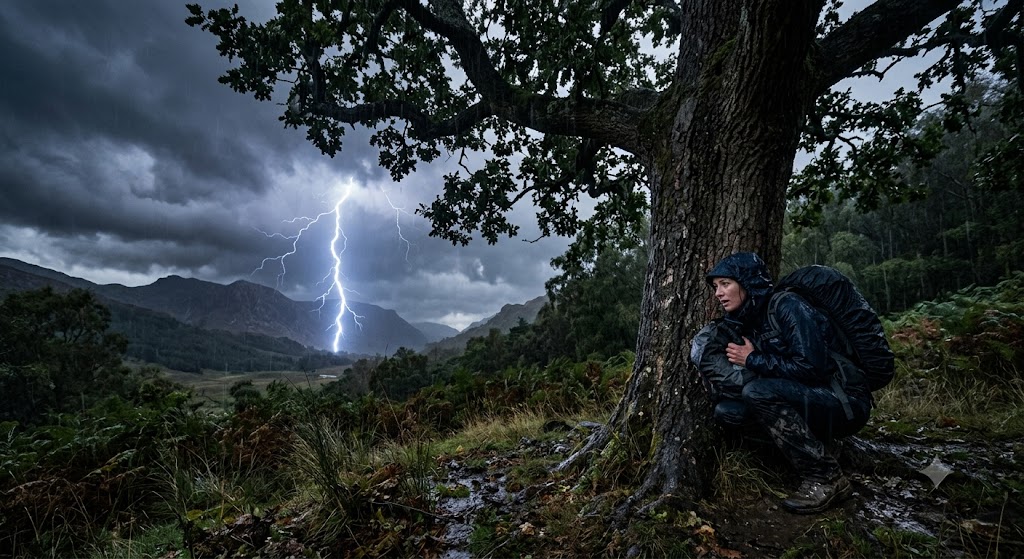
The tree you run towards for protection during a storm could be dangerously misleading. When thunderstorms develop, humans instinctively seek out the tallest visible shelter, usually a tree. This impulse, though ancient, can lead to significant risk during such weather events. The science behind lightning explains why this behaviour can be fatal.

Lightning is not merely a downward discharge from the sky; it forms from a complex interaction within thunderstorm clouds. Inside these clouds, countless ice crystals and hail pellets collide, resulting in the separation of electrical charges similar to static electricity from a balloon. As the storm progresses, the lower section of the cloud accumulates a negative charge, which induces a corresponding positive charge on the Earth’s surface, particularly on tall structures like trees.

Trees are excellent conductors of electricity, as they are tall, tapering structures with abundant sap and moisture. This moisture increases their conductivity, drawing electrical charges towards themselves. When lightning strikes, a channel of charge, termed the stepped leader, descends from the cloud, seeking the quickest route to the ground. Trees, being prominent in the landscape, often become targets, inviting lightning to connect with the ground.

Risks for People Seeking Shelter Under Trees

Individuals seeking refuge under a tree during a lightning storm face significant hazards. The risk primarily arises not from the direct strike itself, but from the aftermath. When lightning hits a tree, the electric current can leap sideways, known as side flash. This happens because a tree, being a poor conductor compared to a human body, judges the person beneath to be an easier pathway for the current.

The electric charge may enter a person’s body from the head or shoulders, following the path of least resistance. If someone is standing close to the tree, they become part of a circuit, which can lead to serious injury or death. The most common cause of fatalities in this scenario is step voltage, where the voltage from the strike spreads through the soil, creating a lethal gradient that extends considerable distances from the tree.

This phenomenon is especially dangerous for large animals like cattle, which have legs spaced far apart, increasing the likelihood of lightning-related injuries. They can be struck even if they are not directly beneath the tree when lightning strikes due to the ground voltage difference.

Explosive Effects of Lightning on Trees

When lightning strikes a tree, the intense heat generated can cause the tree to explode. A living tree contains water in its sap, which can rapidly turn into steam due to the thermal energy from the lightning strike. This expansion happens almost instantaneously, resulting in violent ruptures, stripping bark, and scattering debris.

During such an explosion, being in proximity to the tree can turn hazardous. Wooden shrapnel can be propelled outward at high speeds, causing injury to anyone nearby. The destructive force is not merely from the initial lightning strike, but from the tree’s reaction to the incoming current.

Historical accounts illustrate that surviving a lightning strike can be a matter of chance. Roy Cleveland Sullivan, a park ranger from Virginia, was struck by lightning seven times but lived to tell the tale. His experiences underscore that the physics surrounding lightning strikes are unpredictable and can vary based on multiple factors, including moisture and the angle of the strike.

Long or Short, get news the way you like. No ads. No redirections. Download Newspin and Stay Alert, The CSR Journal Mobile app, for fast, crisp, clean updates!

App Store –  https://apps.apple.com/in/app/newspin/id6746449540 

Google Play Store – https://play.google.com/store/apps/details?id=com.inventifweb.newspin&pcampaignid=web_share

Latest News

Popular Videos
