


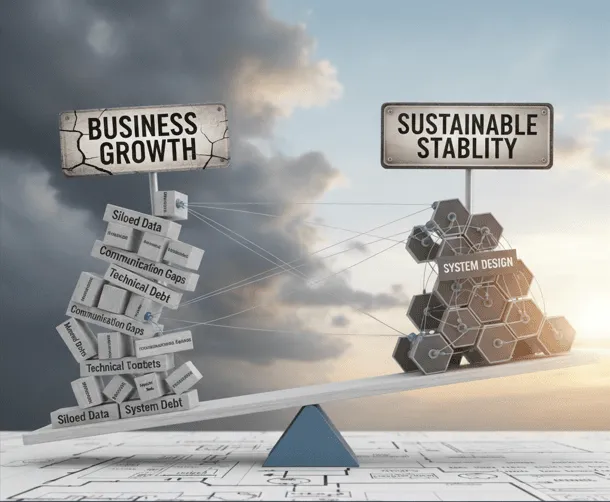

Growth feels good at first.
More customers. More revenue. More activity. It looks like progress.
Then things start to slip. Calls get missed. Deadlines get pushed. Employees get confused. Customers notice.
Growth did not break the business. Lack of structure did.
Growth Exposes Weak Systems Fast
Small teams can run on memory and effort. Everyone knows what to do. Communication is easy.
That stops working when the business grows.
More people means more handoffs. More work means more chances for mistakes.
According to the U.S. Small Business Administration, about 50 percent of small businesses fail within five years. A large share of those failures link back to operational breakdown.
One service company owner described his experience:
“We doubled our jobs in six months. Revenue looked great. Then everything started falling apart. We had no system for tracking work. Jobs got lost.”
Growth did not create the problem. It revealed it.
What Happens When Structure Is Missing
Without structure, work becomes unpredictable.
Common signs include:
-
Missed deadlines
-
Duplicate work
-
Confused roles
-
Customer complaints
-
Team frustration
Harvard Business Review reports that poor workflow design can reduce productivity by up to 30 percent.
That loss comes from confusion, not effort.
One manager explained it clearly:
“My team worked harder than ever. We just worked on the wrong things.”
Effort without structure wastes energy.
Why Leaders Delay Building Structure
Many leaders wait too long to fix systems.
They focus on growth first. They assume structure can come later.
That delay creates risk.
Reasons leaders avoid structure:
-
It feels slow
-
It requires planning
-
It forces hard decisions
A founder shared a common mistake:
“I kept saying we’d fix the process next month. Then next month came with more work and the same problems.”
Structure feels like extra work until the business breaks.
Structure Creates Control
Structure does not mean rigid rules. It means clear direction.
Good structure answers key questions:
-
Who owns each task?
-
What steps must happen?
-
What does success look like?
When these answers exist, work flows better.
A construction company fixed repeated delays by assigning clear ownership for each project phase. The owner explained the change:
“Before, everyone thought someone else was handling it. After we assigned ownership, tasks got done on time.”
Clarity reduces confusion.
Fixing Growth Problems Starts With Systems
The first step is identifying where the system breaks.
Look for the most common issues:
-
Tasks that get repeated
-
Questions asked daily
-
Steps that cause delays
These areas need structure first.
A business leader once said:
“If I answer the same question three times, it becomes a system.”
That mindset creates progress.
Build Simple Systems That Scale
Complex systems slow teams down. Simple systems move faster.
Start with basic workflows.
Step 1: Map the Core Process
Write down the steps from start to finish.
Example:
-
Customer request
-
Job scheduled
-
Work completed
-
Payment processed
-
Follow-up
Keep it simple.
Step 2: Assign Ownership
Each step needs one owner.
No shared responsibility. No confusion.
Step 3: Create Checklists
Turn each step into a checklist.
Short lists work best.
One HVAC company reduced missed tasks by introducing a four-step closing checklist. The manager said:
“We stopped relying on memory. Everything got done the same way every time.”
Checklists reduce errors.
Train Teams on Systems, Not Just Tasks
Employees need more than instructions. They need understanding.
Training should focus on:
-
Why the system exists
-
How each step connects
-
What happens if steps are skipped
One manager changed training after repeated mistakes:
“I stopped showing people what to do. I showed them why it mattered. Mistakes dropped after that.”
Understanding improves execution.
Track the Right Metrics
Metrics show if systems work.
Focus on a few key numbers:
-
Completion rate
-
Response time
-
Customer complaints
-
Rework levels
McKinsey reports that companies with clear metrics improve decision speed by 25 percent.
Speed matters during growth.
Too many metrics create noise. Few metrics create clarity.
Listen to the Team Closest to the Work
Employees see problems before leaders do.
They know where systems fail.
Leaders must listen.
One business owner learned this lesson the hard way:
“I assumed scheduling was fine. The team told me it wasn’t. Fixing that solved half our problems.”
Feedback reveals hidden issues.
This approach reflects the thinking of operators like Stephanie Woods, who emphasise listening to frontline teams to identify system gaps early.
Avoid Overbuilding Systems
Structure matters. Overbuilding creates new problems.
Too many rules slow work.
A simple test helps:
“If this step disappeared, what breaks?”
If nothing breaks, remove it.
A retail company reduced its approval process from five steps to two. The owner explained the result:
“We thought we needed control. We needed speed.”
Structure should support work, not block it.
Actionable Steps to Add Structure Quickly
Business owners can take immediate action.
-
Identify the most common task in your business
-
Write a simple step-by-step process
-
Assign one owner to each step
-
Create a short checklist
-
Test the process with your team
-
Track one performance metric
-
Ask employees where confusion exists
-
Remove unnecessary steps
-
Repeat for the next task
-
Review systems monthly