


Tsunami Strikes Japan Following 7.7 Magnitude Earthquake
The CSR Journal Magazine

The tsunami that recently hit Japan was a direct consequence of a powerful earthquake that registered at 7.7 on the Richter scale. This natural disaster occurred on Monday, April 20, 2026, at 1:23 pm IST, off the coast of Iwate Prefecture, located on Japan’s Pacific coastline. The seismic activity prompted the Japan Meteorological Agency (JMA) to swiftly issue a tsunami warning, predicting waves could reach heights of up to three metres.

In response to the imminent threat, Japan’s disaster management agency ordered evacuations for nearly 1.72 lakh individuals across five prefectures. Reports indicated that approximately 200 instances of power outages were recorded in the affected regions. Although assessments were still ongoing, by Monday evening no injuries or damages to properties had been reported.

Understanding Tsunami Formation

To grasp the gravity of the situation in Japan, it is essential to clarify what a tsunami is. It is not merely a single massive wave, as is commonly believed. Unlike ordinary ocean waves, tsunamis consist of vast volumes of water and manifest as a continuous flood rather than an isolated crashing wave, making them particularly hazardous.

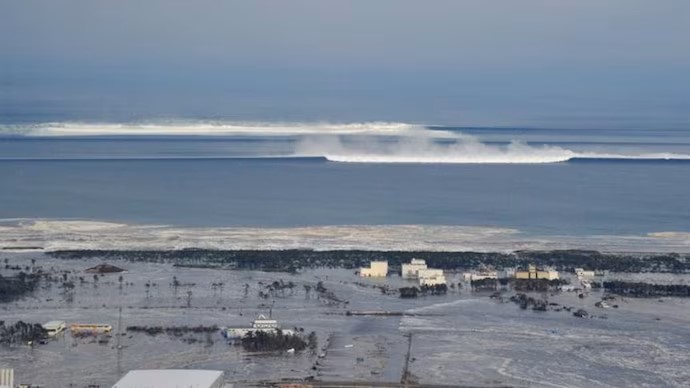
Tsunamis originate from significant underwater disturbances. When an earthquake occurs beneath the ocean floor, it can abruptly alter the seabed either by rising or sinking. This sudden shift displaces an immense amount of water above, causing energy to propagate in waves across the ocean surface. Initially, these waves may not be easily noticeable, often measuring just 30 centimetres in height, yet they can travel at speeds comparable to a jet aircraft.

As the waves approach shallower coastal regions, they slow down due to friction with the ocean floor, resulting in a dramatic increase in height before reaching the shore. This phenomenon was observed during the recent tsunami in Japan, exacerbated by the earthquake’s shallow depth of approximately 19 kilometres.

Japan’s Susceptibility to Tsunamis

Japan is particularly vulnerable to tsunamis due to its geographical features and previous experiences with seismic events. The recent tsunami was generated as the earthquake occurred at a sufficiently shallow depth, leading to significant displacement of water toward the coast in a matter of minutes. The JMA issued warnings indicating that initial tsunami waves could arrive at the northern coastline almost immediately, urging residents to seek higher ground swiftly.

Local officials emphasised that even a small wave of just 30 centimetres possesses enough energy to displace a person, potentially sweeping away debris, including fallen trees and overturned vehicles. Furthermore, a retreating wave could be equally dangerous by dragging individuals back into the ocean.

The intricate geography of Japan, characterised by its deeply indented coastline and narrow bays, heightens the risk associated with tsunamis. This topography concentrates the incoming waves into smaller areas, resulting in significantly increased wave heights. It is this very geography that has transformed prior earthquakes, such as the catastrophic event in 2011, into some of the most devastating disasters in recent history, leaving millions of residents in a perpetual state of caution.

Long or Short, get news the way you like. No ads. No redirections. Download Newspin and Stay Alert, The CSR Journal Mobile app, for fast, crisp, clean updates!

App Store –  https://apps.apple.com/in/app/newspin/id6746449540 

Google Play Store – https://play.google.com/store/apps/details?id=com.inventifweb.newspin&pcampaignid=web_share

Latest News

Popular Videos
