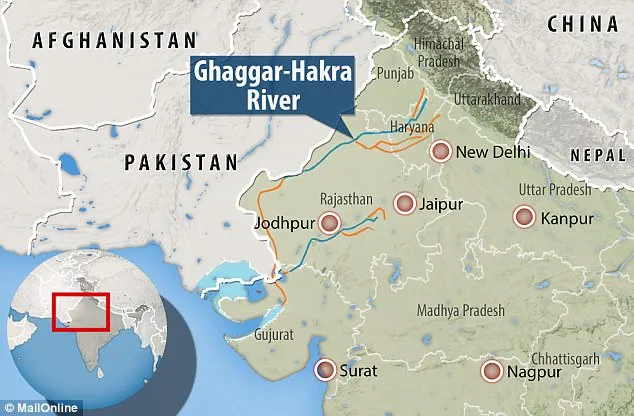

The ongoing discussion surrounding the Sutlej River has garnered attention due to its connection to significant historical narratives in India. Recently, geological evidence has led researchers to propose that the Sutlej did not always flow westward into the Indus River. Instead, it is believed to have once flowed southeast, merging into the ancient Ghaggar-Hakra river system, which many researchers associate with the fabled Saraswati River.
The Saraswati occupies an important role in ancient Indian texts, specifically in the Rig Veda, where it is depicted as a grand river situated between the Yamuna and the Sutlej before it faded into the desert. This relationship has sparked extensive debate over the centuries regarding whether the river was a real entity, a metaphor, or a collective representation of several rivers.
Technology has played a pivotal role in this inquiry. The advent of satellite imaging has uncovered traces of a vast, dried-up river channel extending through Haryana, Punjab, and Rajasthan, reaching into present-day Pakistan, identified as the Ghaggar-Hakra palaeochannel. Researchers are now diligently exploring the relationship between this geological feature and the legendary Saraswati.
Evolution of the Sutlej’s Path
Rivers are dynamic entities, influenced by natural occurrences over millennia. Earthquakes, floods, and gradual alterations in the landscape can redirect their flow entirely. Recent studies into ancient sediment deposits have provided insights suggesting that the Sutlej once contributed water to the Ghaggar-Hakra system. Researchers analysed sediment layers, zircon minerals, mapped underground channels, and utilised optically stimulated luminescence to date ancient deposits, leading to the conclusion that remarkable natural shifts occurred.
Evidence indicates that the Sutlej began to shift westward into the Indus River basin over a period spanning approximately 15,000 to 8,000 years ago, ultimately adopting the course it follows today. This shift raises questions about the relationship between geographic changes and the human settlements that developed in conjunction with water sources.
The discovery of numerous archaeological sites from the Indus Valley Civilisation along the now-dry Ghaggar-Hakra channel further amplifies this interest. Proximity to water has historically been a significant factor in settlements, leading to speculation about whether ancient cities could have thrived beside a robust river originating in the Himalayas.