


Scientists Find Massive Ancient Ocean on Mars—Did Water Once Cover One-Third of the Planet?
The CSR Journal Magazine

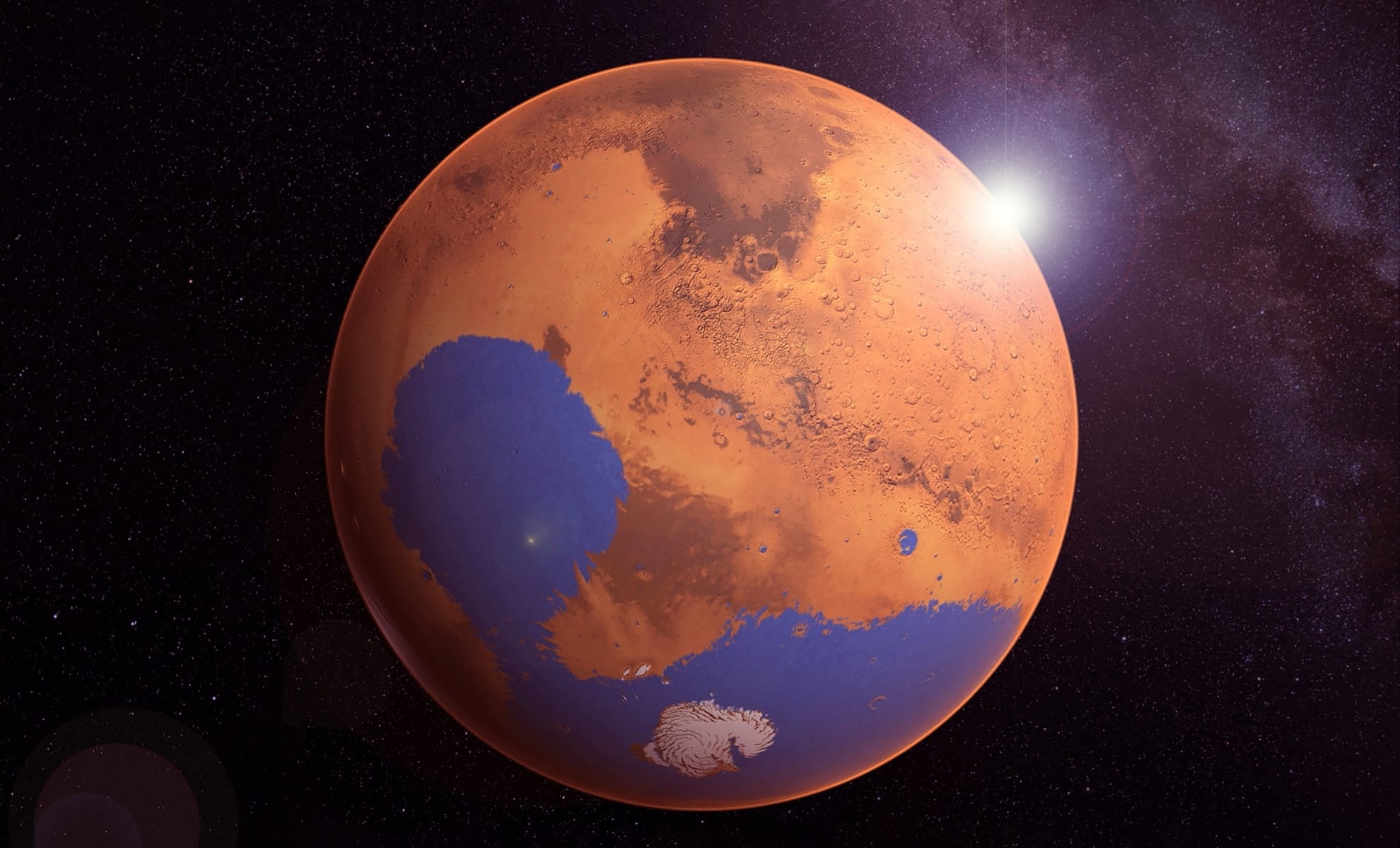
A recently identified geological formation on Mars may be the most compelling evidence to date that the planet once harboured a vast and enduring ocean. Researchers from the California Institute of Technology (Caltech) characterised this feature as resembling a bathtub ring, comprising a broad and flat segment of terrain that could delineate the boundary of a significant ancient ocean. This finding is central to an ongoing discussion regarding the scope of water that may have existed on Mars.

Implications for Mars’ Hydrological History

It has long been established that Mars was once home to liquid water. However, whether this aqueous presence manifested solely as lakes and rivers or as extensive oceans remains a contentious issue. Previous missions to Mars have identified features that mimic shorelines, yet these observations have shown inconsistencies in elevation. Unlike Earth, where sea levels are relatively stable, these Martian formations complicate the confirmation of a permanent oceanic body.

To investigate further, researchers Abdallah Zaki and Michael Lamb, who led the study published in the journal Nature, drew parallels with Earth. By employing computer simulations, they effectively “removed” Earth’s oceans to highlight lasting geological markers. Their findings indicated that the most persistent feature is the continental shelf, which encircles continents and resembles a ring left behind after a bathtub is drained.

Utilising this information, the team examined topographic data gathered from orbiting Mars spacecraft. They identified a similar flat band of terrain located in the planet’s northern hemisphere. This particular formation aligns closely with what would be anticipated from an enduring ocean and incorporates a sufficiently extensive area that could have once held substantial quantities of water.

Support for the Ocean Hypothesis

Significantly, the researchers also discovered ancient river deltas—sediment deposits created at the juncture where rivers flow into larger water bodies—positioned in a manner that corresponds with the aforementioned “bathtub ring.” This alignment bolsters the hypothesis that the feature denotes a genuine ocean boundary rather than disparate water bodies.

The research reveals that the formation of such a landform would necessitate millions of years, indicating that the ocean was both stable and long-lasting before it ultimately vanished billions of years ago. Over time, Mars has undergone extensive modifications, including wind erosion, volcanic activity, and other geological processes, which have diminished many ancient characteristics.

The results not only transform our perception of Mars’ historical landscape but also highlight potential targets for future exploration. Coastal sediments, akin to those found on Earth, could hold vital clues regarding the possibility of ancient life on the Martian surface.

Future Exploration and Research Directions

While additional research is required, especially in the form of rover-based studies, this discovery presents enticing new evidence suggesting that Mars may have once possessed much greater water content and perhaps, conditions more conducive to life than currently observed. These findings may drive a renewed focus on exploring the red planet’s watery past.

Long or Short, get news the way you like. No ads. No redirections. Download Newspin and Stay Alert, The CSR Journal Mobile app, for fast, crisp, clean updates!

App Store –  https://apps.apple.com/in/app/newspin/id6746449540 

Google Play Store – https://play.google.com/store/apps/details?id=com.inventifweb.newspin&pcampaignid=web_share

Latest News

Popular Videos
