


Rockets Use Curved Trajectories for Efficiency and Safety
The CSR Journal Magazine

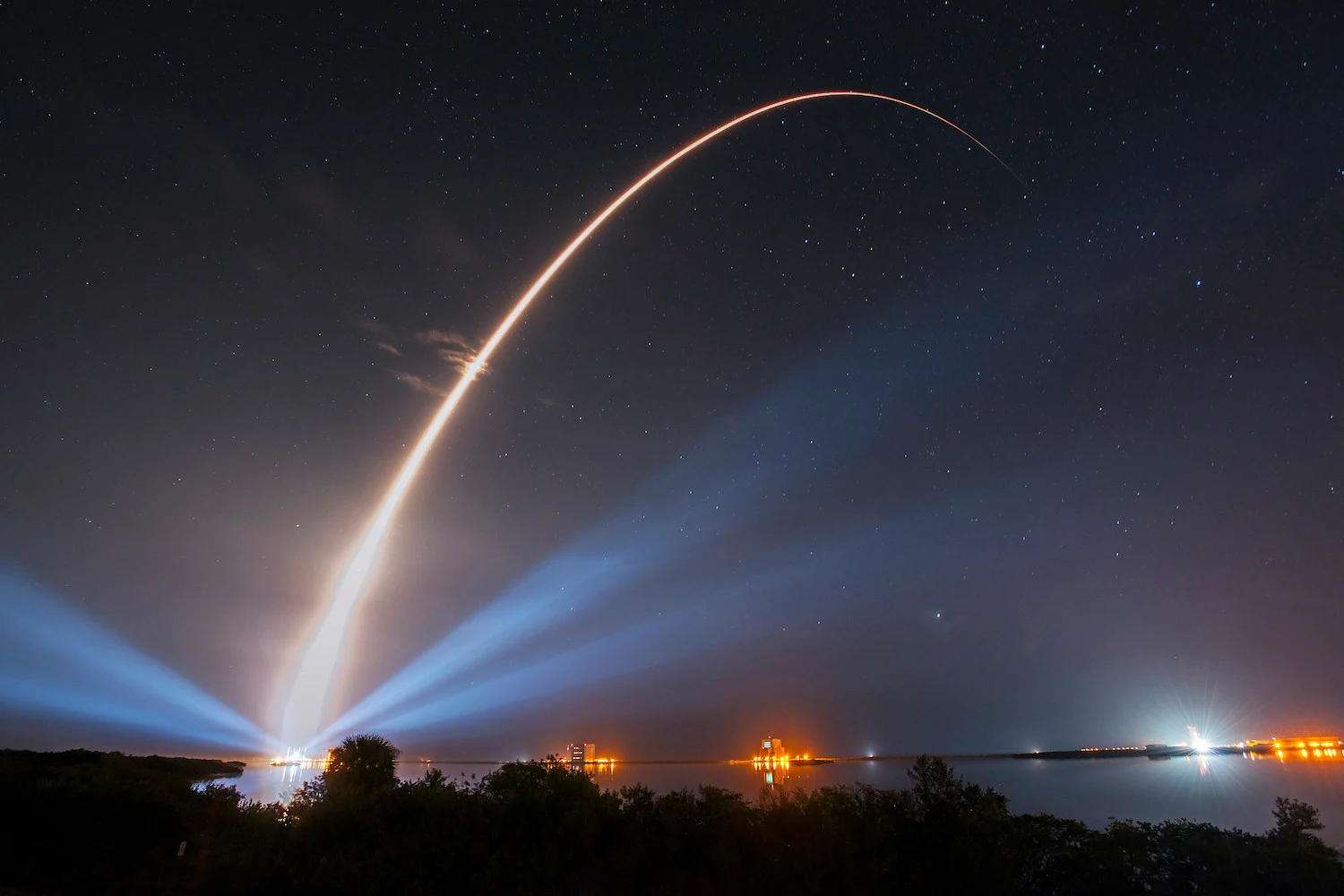
Rockets do not ascend directly upwards due to several factors influencing their trajectory. This phenomenon is primarily designed to ensure optimal efficiency and safety during flight. The curved path, known as a gravity turn, allows rockets to adjust their orientation as they ascend in order to minimise atmospheric resistance and ensure they achieve their desired orbital velocity.

When a rocket is launched, it initially travels vertically to escape the dense lower atmosphere. As it gains altitude, the vehicle begins to gradually tilt or curve. This manoeuvre serves to align the rocket’s trajectory with the curvature of the Earth, thereby conserving fuel and resources and facilitating a smoother entry into space.

Additionally, the flight path is engineered to account for the gravitational pull exerted by the Earth. By curving the rocket’s ascent, engineers are able to leverage gravitational forces to aid in the acceleration needed to achieve orbit, ultimately contributing to the rocket’s overall stability and performance during its journey.

Gravity Turns in Rocket Design

The gravity turn technique is a crucial aspect of rocketry that is used by space agencies around the world. This method involves decreasing the amount of force required to propel the rocket into space by leveraging the natural gravitational forces at play. When a rocket follows this path, it reaches a point where the required speed for orbit is achieved more efficiently than through a straight ascent.

As the rocket climbs, it must overcome atmospheric drag and gravity. The early vertical climb minimises atmospheric resistance, while the subsequent curve optimises the rocket’s velocity. This balance allows launches to be conducted with better fuel efficiency, which is vital for carrying payloads and satellites into orbit.

Moreover, a gravity turn provides a safer flight profile by reducing stress on the rocket’s structure. A direct ascent could expose the vehicle to undue aerodynamic forces that may lead to mechanical failures. The gradual curve mitigates such risks and facilitates a more stable path through the atmosphere.

Principles of Aerodynamics and Its Implications

Aerodynamic principles play a fundamental role in the reason rockets follow a curved trajectory. The forces acting on a rocket during launch include thrust, drag, lift, and weight. Adjusting the angle of ascent helps in managing these forces optimally, allowing the vehicle to maintain stability and speed as it rises through the atmosphere.

As a rocket ascends, changes in air density and pressure must also be considered. Lower atmospheric layers are denser, and a straight ascent would increase drag, which slows the craft down. By curving, rockets can find a balance between speed and fuel consumption, essential for successful missions.

Ultimately, the design of a rocket launch is meticulously planned and executed to adhere to physical laws while achieving the desired mission objectives. The strategic use of a curved path not only promotes energy efficiency but also ensures the safety and integrity of the vehicle as it embarks on its journey into outer space.

Long or Short, get news the way you like. No ads. No redirections. Download Newspin and Stay Alert, The CSR Journal Mobile app, for fast, crisp, clean updates!

App Store –  https://apps.apple.com/in/app/newspin/id6746449540 

Google Play Store – https://play.google.com/store/apps/details?id=com.inventifweb.newspin&pcampaignid=web_share

Latest News

Popular Videos
