



Neuralink Develops Robot for Precise Brain Access and Treatment

The CSR Journal Magazine

Neuralink, founded by Elon Musk, has announced a significant advancement in its mission to connect human cognition with technology. The latest update shared on X showcases a highly sophisticated surgical robot capable of reaching all regions of the human brain. This development indicates a potential shift towards a future where a singular device could manage various neurological ailments.

Functionality of the Surgical Robot

The newly developed surgical robot is engineered for precision. It operates similarly to a micro sewing machine, capable of inserting ultrathin threads into brain tissue. These threads are considerably thinner than human hair and house electrodes, which act as minuscule sensors. These sensors detect and transmit electrical signals generated by neurons, the essential cells responsible for communication within the brain and with the body.

Due to the brain’s delicate nature, which shifts slightly with each heartbeat or breath, the robot utilises advanced imaging technology and sensors. These tools help it navigate around blood vessels, thereby minimising the risk of bleeding or scarring during the procedure.

Another pivotal aspect of the surgery is the precision tools, which give the robot the ability to manoeuvre through complex structures in the brain. Recent footage from clinical trials has shown individuals using the implant to control computer cursors and navigate digital interfaces solely through thought, demonstrating a remarkable application of this technology for individuals with mobility impairments.
Potential Applications of the Brain Chip

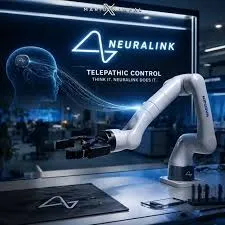
The function of the Neuralink device can be classified as a brain-computer interface (BCI). This type of system enables users to control external equipment, such as robotic limbs or computer systems, through their thoughts alone. By recognising the electrical patterns generated by the brain when one contemplates physical actions, the device captures these signals and converts them into digital commands.

While earlier iterations of this technology predominantly targeted the motor cortex, the newest robot aims to establish a more comprehensive neural interface. The ability to access various areas of the brain opens the possibility of treating conditions like epilepsy, characterised by unexpected electrical discharges, and Parkinson’s disease, which impacts motor functions.

Additionally, this surgical robot may hold promise for mental health disorders such as depression and post-traumatic stress disorder. By targeting specific deep brain regions associated with mood and memory, the device could potentially provide new treatment avenues. Despite these possibilities, the devices remain in investigative stages and have yet to receive approval from the FDA for public use, bringing us closer to a future with improved management of brain-related disorders.

Long or Short, get news the way you like. No ads. No redirections. Download Newspin and Stay Alert, The CSR Journal Mobile app, for fast, crisp, clean updates!

App Store –  https://apps.apple.com/in/app/newspin/id6746449540 

Google Play Store – https://play.google.com/store/apps/details?id=com.inventifweb.newspin&pcampaignid=web_share

Latest News

Popular Videos