


Indian Firm Announces Launch Date for First Private Communication Satellite
The CSR Journal Magazine

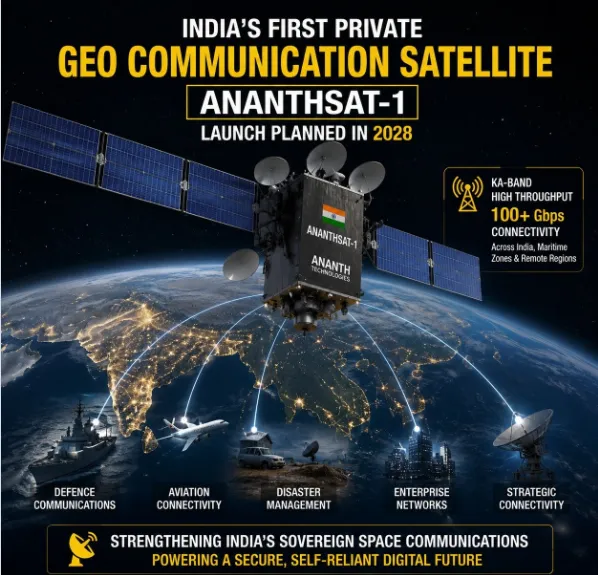
Ananth Technologies, based in Hyderabad, has revealed plans to launch India’s first privately developed communication satellite, AnanthSat-1. This marks a significant shift, as all previous satellites for communication services in India were engineered by the government. The company has been building satellites and launch vehicles since 1992, contributing to over 109 satellites and 89 launch vehicles in that time.

Details of the Satellite’s Specifications

The satellite will be positioned in geostationary orbit at 89 degrees east, approximately 36,000 kilometres above the Earth’s equator. This orbit allows it to remain fixed relative to a specific point on the surface, providing consistent communication. It is planned to operate in the high-capacity Ka-band, enabling faster data transmission compared to traditional satellite communication methods.

AnanthSat-1 is classified as a high-throughput satellite, enabling it to transmit more than 100 Gbps (gigabits per second) of data. Given the growing demand for satellite bandwidth in India, Dr Pavuluri cited government estimates indicating that the country needs over 1,000 Gbps, highlighting the opportunity for private firms to help bridge this gap.

Applications of AnanthSat-1

The key purpose of AnanthSat-1 is to provide reliable broadband services to remote areas, where conventional communication infrastructure poses challenges. The satellite aims to facilitate tele-education and telemedicine, enabling specialists to connect with patients in distant regions and providing access to educational resources in under-served classrooms. This marks a pivotal step toward addressing inequalities in access to vital services.

In addition to civilian applications, AnanthSat-1 will cater to the needs of the Indian Navy, Air Force, and Army, indicating its strategic importance beyond commercial uses. This dual functionality aligns with India’s broadening ambitions in space technology and services.

Ananth Technologies plans to conduct the assembly, integration, and testing of the satellite within India before it is launched aboard an Indian rocket. Potential launch vehicles include the heavy-lift LVM3 or the smaller PSLV and SSLV, depending on the satellite’s final specifications. AnanthSat-1 will participate in a collaborative mission, potentially accompanying other satellites into orbit.

Significance of the India Space Congress

The India Space Congress, a prominent annual event attracting stakeholders from the space industry, has become a platform for discussing advancements and opportunities in space technology. It draws policymakers, startups, and researchers from around the globe, fostering collaboration and innovation in the Indian space sector. Dr Pavuluri, whose career began at ISRO, expressed his long-held dream of positioning India as a leading satellite manufacturer on the global stage.

As the satellite industry evolves, the launch of AnanthSat-1 represents a crucial milestone for India, reflecting the growing role of private enterprises in an arena once dominated by government entities. With increasing demands for satellite services, initiatives like AnanthSat-1 play a pivotal role in shaping the country’s technological landscape and enhancing communication capabilities. This project could redefine the future of private sector involvement in space exploration in India.

Long or Short, get news the way you like. No ads. No redirections. Download Newspin and Stay Alert, The CSR Journal Mobile app, for fast, crisp, clean updates!

App Store –  https://apps.apple.com/in/app/newspin/id6746449540 

Google Play Store – https://play.google.com/store/apps/details?id=com.inventifweb.newspin&pcampaignid=web_share

Latest News

Popular Videos
