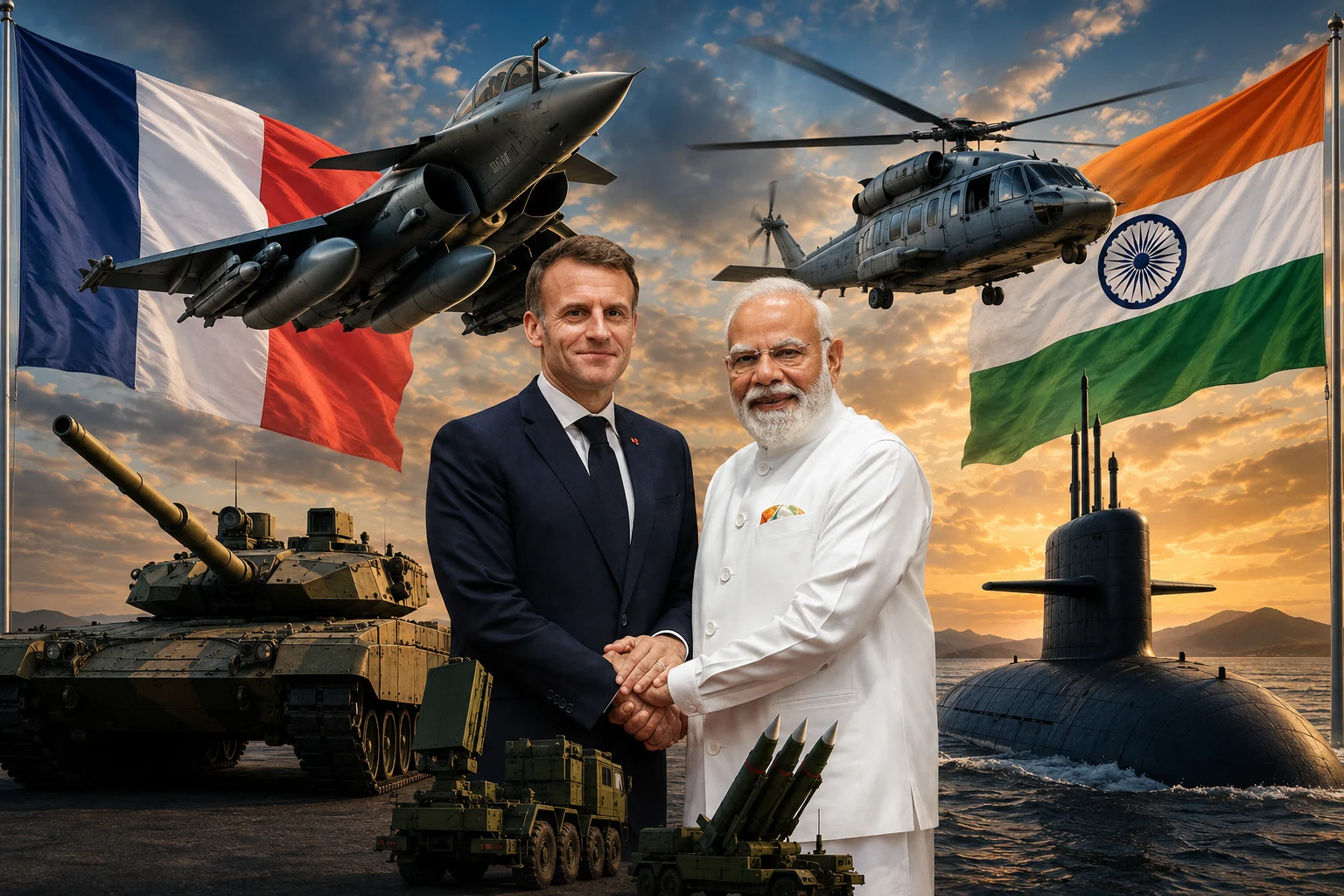
History rarely changes in a single moment. Sometimes it changes through a series of decisions that quietly alter a nation’s destiny. The rapidly deepening India-France strategic partnership may well be one such moment. For decades, India carried the burden of being one of the world’s largest importers of defence equipment. We bought aircraft from one country, submarines from another, missiles from a third, and technology from wherever we could get it. India was a military power, but not a defence power.
That distinction matters. Military powers buy weapons, Defence superpowers build them. Today, for the first time since Independence, India is beginning to make that transition. And much of the credit belongs to the strategic vision of Narendra Modi. The numbers are impossible to ignore. In 2014-15, India’s indigenous defence production stood at approximately ₹46,429 crore. By 2023-24, it had surged to ₹1.27 lakh crore—an increase of nearly 174%. The momentum continued, with total defence production crossing a record ₹1.5 lakh crore in FY 2024-25.
Even more striking is the story of defence exports. A decade ago, India’s defence exports were less than ₹1,000 crore. Today, they have reached record levels of ₹23,622 crore in FY 2024-25, representing a dramatic transformation in India’s ability to manufacture and sell military equipment to the world. Indian defence products are now reaching more than 80 countries.
These are not merely statistics. They are evidence of a fundamental shift in national thinking. For years, India talked about self-reliance, Under Modi, India started measuring it. The India-France partnership has emerged as one of the most important pillars of this transformation.
During Prime Minister Modi’s recent engagement with French President Emmanuel Macron, both countries elevated their relationship to what they described as a “Special Global Strategic Partnership,” with a focus on co-design, co-development and co-production of advanced military technologies. Discussions have increasingly moved toward next-generation defence systems rather than simple procurement deals.This is where the story becomes bigger than Rafale jets.
For decades, India’s defence relationships were largely transactional.
Buy. Import. Depend.
The France partnership is increasingly becoming transformational.
Build. Develop. Collaborate.
In 2025, India signed a major agreement for 26 Rafale Marine fighter aircraft for the Indian Navy. More importantly, the agreement includes technology transfer and the strengthening of domestic industrial capabilities. Even more significant, Tata Advanced Systems and France’s Dassault Aviation have agreed to manufacture Rafale fighter aircraft fuselages in India—the first time these critical structures will be produced outside France. That single development should make every Indian pause and reflect.
For generations, India imported advanced aerospace technology. Today, the world’s most sophisticated defence manufacturers are bringing production lines to India. That is not a routine business decision. That is a vote of confidence in India’s future. Critics often accuse governments of exaggerating achievements but no amount of political rhetoric can manufacture a 174% rise in indigenous production, no speech can create a defence export industry that has grown from less than ₹1,000 crore to over ₹23,000 crore, no slogan can convince global defence companies to shift production to India.
Those outcomes require policy, persistence, and political will. Of course, India is not yet a defence superpower. Anyone claiming otherwise is getting ahead of reality. The country still depends on imports in critical areas such as jet engines, advanced semiconductors, certain propulsion systems, and cutting-edge defence electronics but history is not about where a nation stands today, History is about the direction in which it is moving and India’s direction has changed dramatically.
The world is witnessing an India that is investing in indigenous fighter aircraft, missile systems, warships, drones, artificial intelligence, cyber capabilities, and space-based defence assets. It is witnessing an India that is increasingly viewed as a strategic partner rather than merely a strategic market. Most importantly, it is witnessing an India that has stopped thinking small.
The India-France partnership is not just a defence relationship, It is a symbol of India’s growing confidence. It reflects a nation that no longer wants to be protected by global powers but wants to stand among them. Future historians may debate many aspects of Narendra Modi’s legacy but if India’s defence transformation continues at its current pace, one conclusion may become difficult to dispute: The Modi years were the period when India stopped being one of the world’s largest defence buyers and began its journey toward becoming one of the world’s most influential defence powers.
And the India-France strategic partnership may ultimately be remembered as one of the defining chapters in that remarkable transformation.