


China’s JUNO Observatory Achieves Precision Neutrino Breakthrough in Major Scientific Milestone
The CSR Journal Magazine

Scientists have announced groundbreaking results from China’s Jiangmen Underground Neutrino Observatory (JUNO), a facility designed to explore the mysteries of neutrinos. This development signifies an important milestone in the field of particle physics at a global level. The research findings were revealed through data collected in the initial 59 days of the detector’s operation from August to November 2025. The results have been published in the reputable journal Nature.

Located 650 metres beneath a hill near Kaiping in Guangdong province, the JUNO facility employs advanced technology to study neutrinos, which are considered one of the most plentiful yet least understood particles in the universe. These particles are produced in various cosmic events, such as solar reactions and supernova explosions, and can pass through matter without interaction, making their detection challenging.

Nuances of Neutrino Behaviour and Measurement Precision

The measurements obtained from JUNO offer the most accurate predictions to date regarding two crucial parameters associated with neutrinos as they travel through space. According to Yifang Wang, a physicist at the Chinese Academy of Sciences and spokesperson for the JUNO Collaboration, these results are pivotal not only for the data they provide but also for validating the operational effectiveness of the new detector system. Wang expressed that the findings indicate a strong start for the experiment.

One of the most pressing inquiries in neutrino physics pertains to the mass ordering of these particles. While it is established that neutrinos possess mass, determining the lightest and heaviest among the three states remains unresolved. Although the latest findings do not answer this question, they affirm that the observatory can deliver highly precise measurements, giving researchers greater confidence in future analyses.

JUNO’s findings have demonstrated the ability to measure neutrino oscillation parameters with approximately 1.6 times greater precision compared to earlier experiments. The oscillation phenomenon entails the conversion of neutrinos between three different “flavours” as they traverse different mediums.

Future Prospects of Neutrino Research

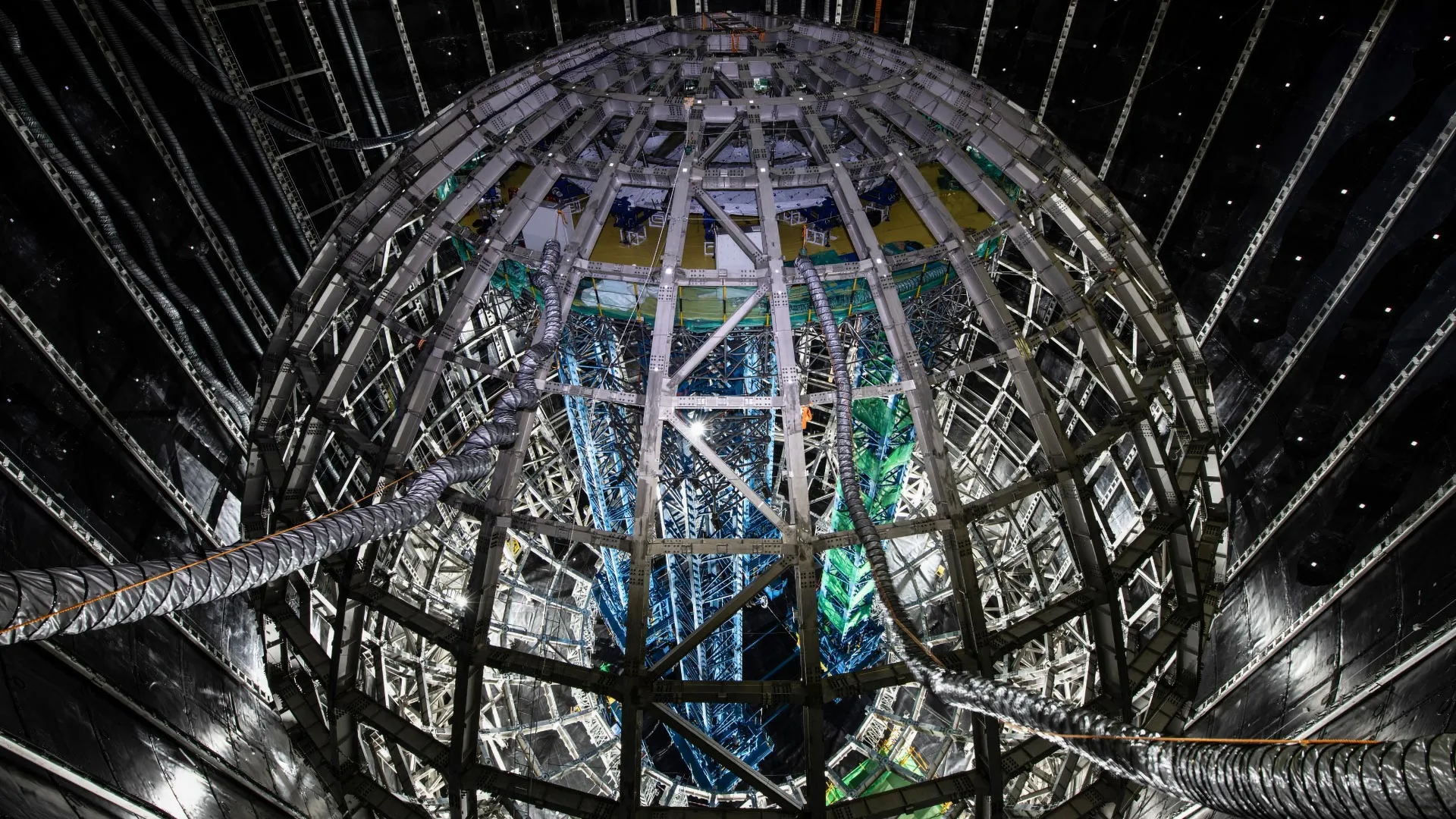
The JUNO facility features a massive spherical detector containing 20,000 tonnes of a special organic liquid. This setup is integral to observing antineutrinos emitted from the Yangjiang and Taishan nuclear power plants, situated roughly 52 kilometres away. The interaction of these antineutrinos with the liquid results in tiny flashes of light, which can be captured by advanced instrumentation.

As one of three flagship projects in the global neutrino research landscape, along with the Deep Underground Neutrino Experiment (DUNE) in the United States and Japan’s Hyper-Kamiokande, JUNO is expected to significantly advance our understanding of foundational questions in physics. Researchers aim to gain insights into critical issues such as the dominance of matter over antimatter, the nature of dark matter and dark energy, and the complexities behind supernova mechanisms.

With a budget exceeding $300 million and engagement from scientists across the globe, JUNO is poised to study neutrinos originating from various sources including the Earth, the Sun, and the atmosphere, as well as in forthcoming stellar explosions. This extensive research will potentially unravel some of the universe’s most profound mysteries, advancing knowledge in fundamental physics.

Long or Short, get news the way you like. No ads. No redirections. Download Newspin and Stay Alert, The CSR Journal Mobile app, for fast, crisp, clean updates!

App Store –  https://apps.apple.com/in/app/newspin/id6746449540 

Google Play Store – https://play.google.com/store/apps/details?id=com.inventifweb.newspin&pcampaignid=web_share

Latest News

Popular Videos
