


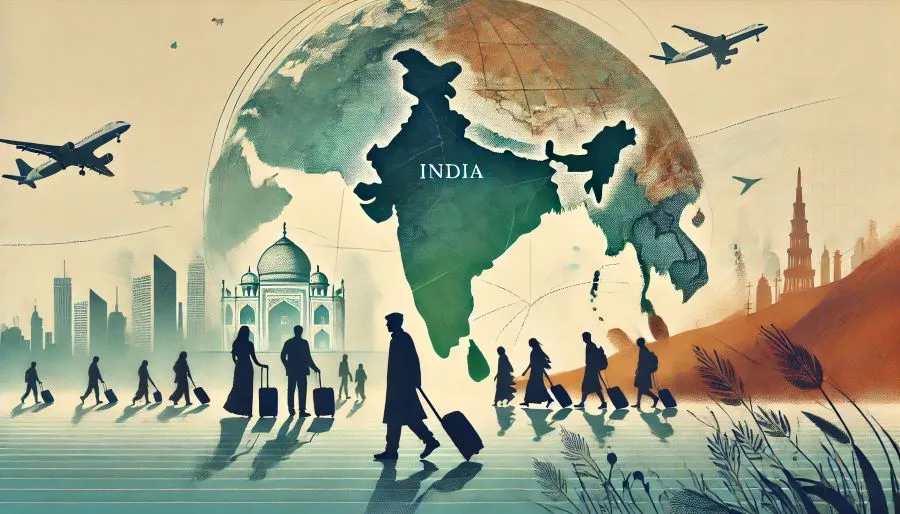


4,300 Millionaires Left India Last Year. Nobody Wants to Talk About It

The CSR Journal Magazine

Every year, roughly 2.5 million Indians pack their bags and leave. Some go for a graduate degree. Some go for a job offer they simply could not refuse. Some go because their spouse already left years ago. And some go because they have quietly made up their minds that home, for all its familiarity and warmth, is just not working for them anymore.

The numbers are not small. According to the United Nations Department of Economic and Social Affairs, the Indian emigrant population tripled from 6.5 million in 1990 to 18.5 million by mid-2024. The Ministry of External Affairs puts the total overseas Indian community, including people of Indian origin who may be second or third generation, at 35.4 million as of November 2024, making it the world’s largest diaspora by a considerable margin.

What is striking, however, is not the size of the diaspora. India has always had people living abroad. What is striking is the pace at which that number has grown since 2014, and the kind of people who are now choosing to leave.

In 2014, around 1.29 lakh Indians formally renounced their Indian citizenship. That itself was not a small number. But by 2022, that figure had jumped to 2.25 lakh, the highest in at least a decade. In 2023, it was 2.16 lakh. In 2024, 2.06 lakh more Indians gave up their passports, according to data tabled in the Lok Sabha by the Ministry of External Affairs. Between 2020 and 2024 alone, nearly 9 lakh Indians renounced their citizenship. Over the last 14 years, the total has crossed 20 lakhs.

To understand why this is significant, one needs a point of comparison. In 2011, 1.22 lakh Indians renounced citizenship. In 2012, 1.20 lakh. The numbers between 2011 and 2019 ranged between 1.20 lakh and 1.44 lakh per year. Then, from 2021 onwards, the figure crossed 1.6 lakh and kept climbing. This is not a blip, and it is not a pandemic correction. The 2022 spike may have included some backlog from COVID-era delays, but the continued high numbers in 2023 and 2024 confirm, as analysts have noted, that this is now a new baseline.

For those who prefer a quieter signal, consider the students. The number of Indian students going abroad for higher education went from around 3.7 lakh in 2016 to 8.9 lakh in 2023, an increase of nearly two and a half times in seven years, according to India’s Bureau of Immigration. Over 1.33 million Indian students were enrolled in foreign universities as of 2024, per Ministry of External Affairs data. In 2024, for every one international student who came to India, about 28 Indian students went abroad, according to a NITI Aayog report released in December 2024.

Families in India spent roughly 2.9 trillion rupees, or approximately $44 billion, on overseas education for their children in 2023-24. That figure is projected to reach $91 billion by 2030.

And,

No honest conversation about why Indians are leaving can avoid the rupee. When Narendra Modi took office in May 2014, one US dollar bought approximately Rs 58. A decade later, that same dollar buys close to Rs 84 to 87, depending on the week. That is a depreciation of roughly 27 to 30 percent in ten years, as recorded by data analysed by the Indian Express and confirmed by the Reserve Bank of India’s own exchange rate figures.

For someone earning in rupees and thinking about the future, that depreciation is not abstract. It means savings lose real value every year. It means overseas education, which is priced in dollars or pounds or euros, becomes incrementally more expensive. It means that a job offer from a company in London or Toronto does not just represent a salary increase. In purchasing power terms, it represents an enormous structural advantage that no Indian employer can easily match.

The rupee’s fall against the dollar since 2014 is, by some estimates, among the steepest over any comparable ten-year period. By 2025, the rupee had touched record lows close to Rs 88 per dollar, and the Reserve Bank of India reportedly spent close to $80 billion in foreign exchange reserves trying to slow the decline.

A weaker rupee raises import costs, which feeds inflation. Higher inflation eats into real incomes. And when real incomes feel stagnant even as GDP growth headlines make the news, many professionals start doing the math on what their life might look like if they moved abroad.

What has been especially uncomfortable for policymakers to acknowledge is that it is not just struggling workers who are leaving. It is the successful ones too.

The Henley Private Wealth Migration Report 2024 estimated that around 4,300 Indian millionaires would leave the country in that year alone. In 2023, the number was 5,100. According to data cited by former PMO adviser Sanjaya Baru, who has described the current phase as a “secession of the successful,” approximately 23,000 Indian millionaires have left the country since 2014, quoting Morgan Stanley figures.

These are people who could afford to stay. They chose not to.

The reasons they give, when they give them at all, cluster around a few familiar themes: a complex and unpredictable tax environment, concerns about regulatory stability, the difficulty of protecting wealth across generations in an environment where rules can change abruptly, and the simple matter of quality of life. Dubai and Singapore are the preferred destinations for India’s wealthy emigrants, with Dubai’s zero-income-tax regime particularly attractive. Australia leads among those seeking a permanent new home, partly because of its points-based immigration system that favours professionals and business owners.

So,

The pull factors are at least as important as the push ones.

Indian nationals received 71 percent of all H-1B visas in the United States in fiscal year 2024, according to Migration Policy Institute figures. One in three engineers in Silicon Valley is of Indian origin. In the 2024-25 academic year, India was the leading source of international students in the United States, most of them enrolled in STEM programmes. Indians are the largest immigrant group in Canada and the second largest in the United States after Mexicans.

These are not people fleeing failure. They are people whose skills are in high demand everywhere, and who have increasingly concluded that those skills will be better used, better compensated, and more fairly recognised abroad.

In Germany, for instance, Indian-origin employees earn a median salary of approximately 5,359 euros per month, compared to the German national median of 3,945 euros. The number of Indian students in Germany rose by 68 percent between 2022 and 2024 alone. Germany’s post-study work opportunities and transparent immigration pathways have made it quietly popular with Indian professionals who previously might have focused only on the US or UK.

Canada, despite a diplomatic row with India and a cap on study permits, still hosted around 4.27 lakh Indian students in 2024. The US hosted 3.37 lakh. The UK, 1.85 lakh. These countries have their own problems, of course. But the ability to build savings in a hard currency, access publicly funded healthcare, send children to schools that do not require a decade of coaching classes, and live in cities where air is occasionally breathable, is a trade many Indians are increasingly willing to make.

Also,

India is home to 39 of the world’s 50 most polluted cities in terms of PM2.5 particulate matter, according to research published in peer-reviewed journals and cited by the World Health Organization. An estimated 18 percent of all deaths in India are attributable to air pollution. The Energy Policy Institute at the University of Chicago has estimated that air pollution is likely to reduce the life expectancy of roughly 40 percent of Indians by more than nine years.

Delhi has been ranked the most polluted capital city in the world four consecutive times. Mumbai’s air quality, while somewhat better, deteriorates sharply in winter months. Bengaluru, where much of India’s tech industry is based, has its own issues with traffic, infrastructure, and environmental quality.

For young professionals weighing job offers, clean air is no longer a trivial consideration. The idea of raising children in cities where school authorities routinely suspend outdoor activities because the air is unsafe has become, for many educated Indians, a genuine grievance, and one that is increasingly factored into emigration decisions.

And,

India’s corporate work culture has attracted a fair amount of attention in recent years, not all of it flattering. A survey by Genius Consultants found that 48 percent of Gen Z employees cited toxic work culture as the primary reason for quietly disengaging from their jobs. Over half of India’s workforce still works at least 49 hours per week, placing India among the countries with the longest working hours globally. Burnout reportedly affects more than 62 percent of Indian employees, according to research cited by Policy Circle.

The issue reached a public breaking point in late 2024 when a 26-year-old chartered accountant, Anna Sebastian Perayil, died just four months into her job at a major accounting firm. Her mother’s letter, which went viral, described a work culture in which her daughter was working until the early hours of the morning, often past midnight, and felt unable to speak up about it. The letter prompted a national conversation, though it is fair to say that conversation has produced more LinkedIn posts than structural change.

“I could finish my work efficiently by 6 PM,” one marketing professional told Outlook Business, “but it’s considered more impressive to stretch the same work until 9 PM.” This culture, where presence is valued over output, and where speaking about work-life balance is taken as a sign of insufficient commitment, has driven many younger professionals to seek employment in countries where output is measured differently.

Governance and What Goes Unspoken

Governance concerns are harder to quantify, but they are not invisible. The Henley Private Wealth Migration Report listed “prohibitive tax legislation” and “complex rules related to outbound remittances” as major factors behind the trend of investment migration from India. The Indian passport, ranked 70th globally, requires visas for travel to 125 countries, limiting the mobility that educated professionals increasingly take for granted as a basic professional need.

There is also the matter of institutional predictability. Businesses and professionals need to be confident that rules will not change overnight, that contracts will be enforced, and that success will not attract unwanted attention. India’s ranking on global indices for ease of doing business has improved in recent years, but the experience on the ground, particularly for small and medium businesses, often tells a different story.

India does not allow dual citizenship. Section 9 of the Citizenship Act, 1955 states clearly that an Indian citizen who voluntarily acquires citizenship of another country ceases to be an Indian citizen. This means that for the many Indians settled abroad who wish to vote, access social security, or secure long-term residency rights in their adopted country, there is no middle path. The choice must be made, and increasingly, it is being made.

A Nation Worth Leaving?

None of this is to say that India is without promise. The economy has been among the fastest growing in the world for much of the past decade. India’s startup ecosystem is real, its young population is enormous, and the ambition of its people is not in question.

But ambition needs a system that supports it. It needs universities that rank among the world’s best, not a situation where 28 Indian students go abroad for every foreign student who comes here. It needs cities where you can breathe, and hospitals where you can be treated without selling a piece of land. It needs workplaces where staying until midnight is an exception, not a cultural expectation. It needs a currency that holds its value. And it needs a political environment where citizens feel that the rules apply equally to everyone.

The people leaving India are not, by and large, unpatriotic. Nationalism, as many of them would quietly point out, does not pay school fees in dollars. It does not filter PM2.5 from the morning air. It does not guarantee a promotion based on merit rather than who you know or which community you belong to.

What is being witnessed in the emigration data is something simpler than betrayal. It is the accumulated decision of millions of ordinary, educated, capable people, many of them deeply fond of India, who have looked at what home is currently offering and decided that somewhere else is offering more.

Whether India chooses to hear that message, or continues to call it a matter of personal choice best not discussed in public, will say a great deal about what comes next.

Sources: United Nations Department of Economic and Social Affairs (mid-2024 estimates); Ministry of External Affairs, India (Lok Sabha data, 2024; diaspora data updated November 2024); Migration Policy Institute (Indian immigrants in the United States, 2024 ACS); Henley Private Wealth Migration Report 2023 and 2024; NITI Aayog, Internationalisation of Higher Education in India (December 2024); Bureau of Immigration, Ministry of Home Affairs (student emigration data 2016-2023); Policy Circle (burnout and work culture data, October 2024); Energy Policy Institute, University of Chicago (air quality and life expectancy data); World Health Organization (PM2.5 pollution rankings); National Centre for Biotechnology Information, study on air quality in India; Indian Express and Vajiramandravi (rupee depreciation analysis, 2014-2024).

Views of the author are personal and do not necessarily represent the website’s views.

Dr. Jaimine Vaishnav is a faculty of geopolitics and world economy and other liberal arts subjects, a researcher with publications in SCI and ABDC journals, and an author of 6 books specializing in informal economies, mass media, and street entrepreneurship. With over a decade of experience as an academic and options trader, he is keen on bridging the grassroots business practices with global economic thought. His work emphasizes resilience, innovation, and human action in everyday human life. He can be contacted on jaiminism@hotmail.co.in for further communication.

Long or Short, get news the way you like. No ads. No redirections. Download Newspin and Stay Alert, The CSR Journal Mobile app, for fast, crisp, clean updates!

App Store – https://apps.apple.com/in/app/newspin/id6746449540

Google Play Store – https://play.google.com/store/apps/details?id=com.inventifweb.newspin&pcampaignid=web_share

Latest News

Popular Videos