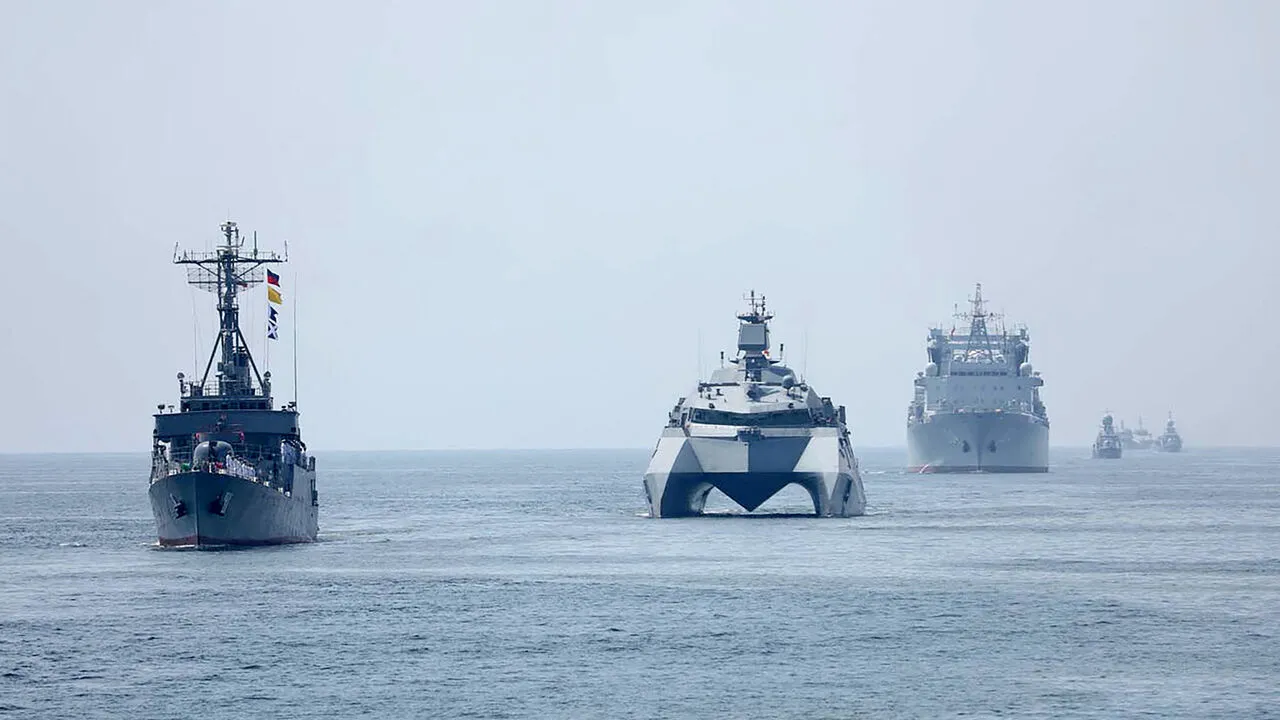
The United States Navy has established a presence of at least 15 vessels in the Middle East, which includes the aircraft carrier USS Abraham Lincoln and eleven destroyers. This deployment aligns with directives from President Donald Trump, as reported by CNN on April 14, 2023. The naval forces are potentially poised to participate in a maritime blockade aimed at Iranian ports, although specific vessel assignments for this operation remain unclear.
The fleet consists of the USS Abraham Lincoln alongside multiple destroyers, such as the USS Bainbridge, USS Thomas Hudner, USS Frank E. Petersen Jr., and USS Delbert D. Black, among others. Additionally, the Tripoli Amphibious Ready Group, which includes the USS Tripoli, USS New Orleans, and USS Rushmore, is active in the region to augment overall maritime capabilities.
The dispersion of naval assets occurs throughout the area of operations under US Central Command, complicating the logistics of any potential blockade. The naval formation is supported by various escort and supply vessels that would require movement through either the Suez Canal or around the African continent to reach strategic positions for blockade support.
Recent Diplomatic Developments
The US administration has recently imposed a naval blockade following lengthy discussions in Pakistan over the past weekend that failed to reach a conclusive agreement. The increased military posture follows the breakdown of diplomatic negotiations aimed at addressing unresolved issues in the region.
President Trump expressed that Tehran’s nuclear ambitions are the primary obstacle in the current talks. He insisted, “Iran will not have a nuclear weapon,” which highlights the core issue in ongoing discussions. The president reflected that, although there was progress in various areas, Iran did not agree to halt its nuclear programme, stating he remained confident that they would eventually concede.
Trump has issued a firm ultimatum regarding diplomatic moves, indicating that failure to reach an agreement would result in no deal being achieved. He has also expressed the goal of retrieving enriched uranium presently held within Iran, declaring, “We’re going to get the dust back.” This assertion underscores the urgency behind US actions and diplomatic aims in the region.
Implications of Ongoing Tensions
In light of a two-week ceasefire announced by Trump, the failure of the peace talks has raised concerns over the future of diplomacy with Iran. Vice President JD Vance has confirmed that Iran is hesitant to forgo its nuclear weapon plans, putting additional pressure on the talks. Trump has warned that if an agreement is not finalised by the end of the ceasefire period, the consequences will be severe.
When asked if his previous warnings of catastrophic outcomes still apply should negotiations falter, Trump opted not to clarify his stance but reiterated that “it won’t be pleasant for them.” This rhetoric illustrates the potential for escalated conflict if a resolution is not achieved.
Despite the unilateral US military activities, Trump has indicated that unnamed nations have offered assistance with the blockade of Iranian ports. He maintained, however, that the US possesses the capability to uphold maritime pressure independently, adding that details of any international cooperation would be disclosed in the near future.
Long or Short, get news the way you like. No ads. No redirections. Download Newspin and Stay Alert, The CSR Journal Mobile app, for fast, crisp, clean updates!
US President Donald Trump stated on Monday that dialogue between Washington and Tehran has been productive, indicating a potential for an agreement. He expressed...
US President Donald Trump on Sunday dismissed concerns that American military stockpiles are being depleted amid the ongoing conflict with Iran, insisting that the...