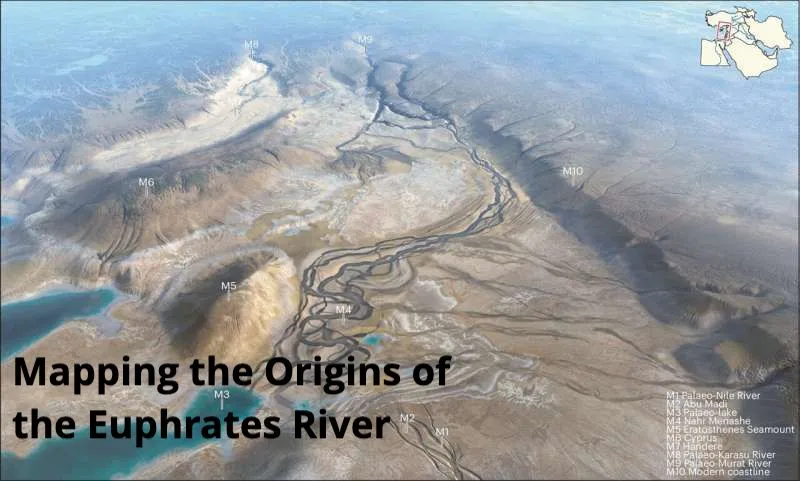

The Euphrates River, a crucial waterway for early human civilisations, has been traced back to its origins much earlier than previously thought. A new study indicates that the river may have formed between 3.6 million and 1.6 million years ago. This discovery reshapes our understanding of one of the longest rivers in Southwest Asia, which extends approximately 2,800 kilometres across Turkey, Syria, and Iraq before emptying into the Persian Gulf.
Historically significant, the Euphrates has been vital for the sustenance of ancient cities like Uruk, Babylon, Mari, and Ur. These civilisations flourished on its fertile floodplains, which played a key role in the development of agriculture, urban life, and early writing systems. The implications of this recent research highlight the river’s extensive historical context.
Published in Nature Geoscience, the study presents new findings based on advanced seismic imaging techniques that were employed while researchers were investigating buried sediments and ancient river channels beneath the eastern Mediterranean. This investigation was initiated during geological explorations for potential natural gas reserves.
Formation of the Euphrates Through Tectonic Activity
Researchers have identified that the Euphrates River was created as a result of the merging of two distinct river systems influenced by significant tectonic activity. Over five million years ago, during the Messinian Salinity Crisis, substantial parts of the Mediterranean Sea underwent desiccation. During this period, two substantial rivers flowed separately through Turkey and Syria into what is now the Mediterranean basin.
Evidence indicates that intense tectonic changes in eastern Anatolia gradually transformed the landscape. One of these ancient rivers was diverted toward the Gulf region, while the other was integrated into this new system, eventually giving rise to the Euphrates as it is known today.
The researchers suggest that these foundational rivers may have transported greater water volumes than the present-day Nile and the joint flow of the Tigris and Euphrates. This aspect not only illuminates the geological history of the area but also offers insights into the environmental conditions that favoured the emergence of some of humanity’s earliest city-states.