


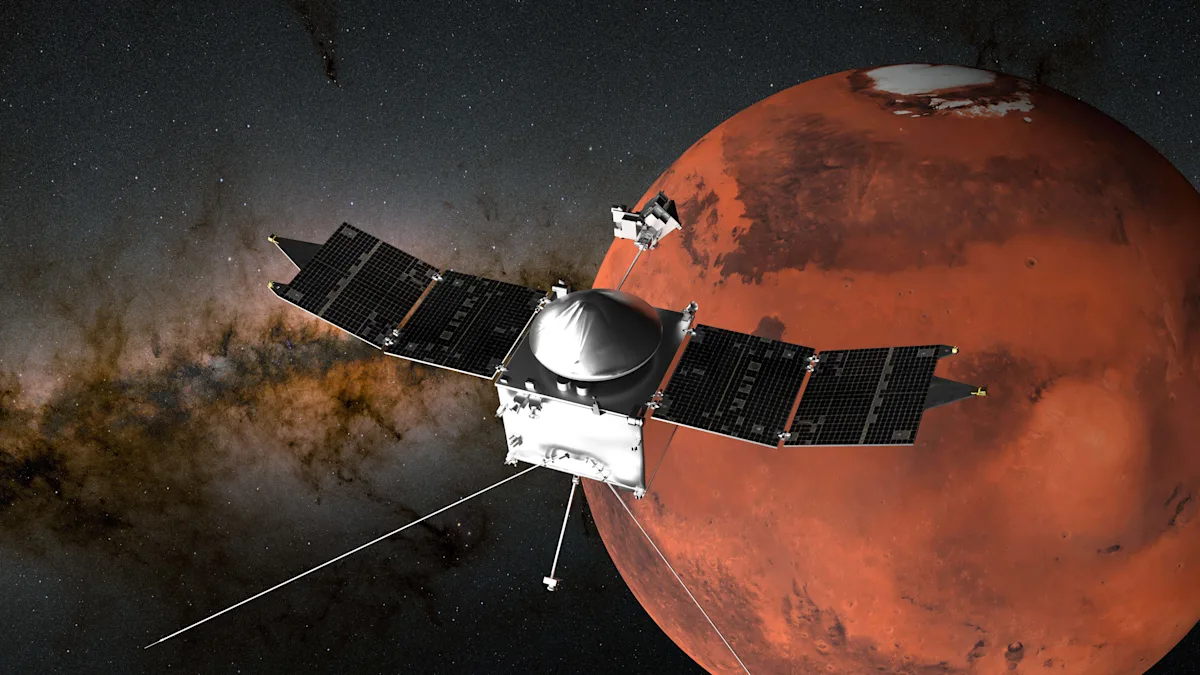

NASA has officially declared the end of its MAVEN (Mars Atmosphere and Volatile Evolution) mission after losing contact with the spacecraft in December 2025. Following months of recovery efforts, an anomaly review board concluded that the spacecraft is no longer recoverable and can no longer perform its scientific observations or communications relay duties around Mars.
What Happened to MAVEN?
The last communication from MAVEN was received on December 6, 2025, shortly after the spacecraft passed behind Mars from Earth’s perspective. Telemetry data transmitted before the maneuver indicated that all onboard systems were functioning normally. However, when the spacecraft emerged from behind the Red Planet, NASA’s Deep Space Network failed to detect any signal.
Subsequent analysis of a small fragment of tracking data suggested that MAVEN had entered safe mode and was rotating at an unusually high rate. Investigators believe the unexpected spin disrupted the spacecraft’s orbit and eventually drained its batteries, causing a complete loss of power to its communications systems. The anomaly review board determined that the spacecraft had entered an unrecoverable state.
A Mission That Far Exceeded Expectations
Launched in November 2013, MAVEN entered orbit around Mars in September 2014. The mission was originally designed to operate for just one year but ultimately continued for more than 11 years, becoming one of NASA’s most successful Mars orbiters.
MAVEN was the first mission dedicated to studying the Martian atmosphere and understanding how Mars transformed from a planet that may once have supported liquid water into the cold, dry world seen today. By examining interactions between the atmosphere and the solar wind, the spacecraft helped scientists better understand how Mars gradually lost much of its atmosphere over billions of years.
Key Scientific Contributions
During its decade-long mission, MAVEN made several important discoveries. It observed different types of Martian auroras, helped scientists understand the impact of solar storms on the planet, and worked alongside the Perseverance rover to capture the first visible-light observations of an aurora on Mars. The spacecraft also observed the interstellar comet 3I/ATLAS during its final year of operations.
Beyond science, MAVEN played a crucial role as a communications relay for NASA’s Mars rovers, including Curiosity and Perseverance, helping transmit data back to Earth.
Mars Exploration Continues
NASA officials said the loss of MAVEN will not significantly impact ongoing Mars operations. Four other orbiters remain available to support communications and scientific activities around the planet. MAVEN itself is expected to remain in orbit around Mars for another 50 to 100 years before eventually descending toward the planet’s surface.
Although the mission ended unexpectedly, MAVEN leaves behind a remarkable scientific legacy that reshaped humanity’s understanding of the Red Planet and its atmospheric evolution.