


Massive Sunspots Hidden on Sun Are Altering Solar Vibrations
The CSR Journal Magazine

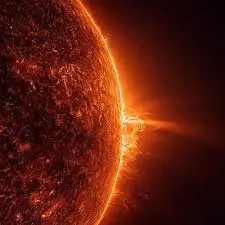
Recent research has revealed that enormous sunspots located on the far side of the Sun are impacting solar vibrations detectable from Earth. While these sunspots remain obscured from direct observation, their presence has been inferred through the disturbances they create in solar acoustic waves. Helioseismic maps provided by solar observers indicate that at least three significant active regions are currently situated beyond the Sun’s eastern limb.

These sunspots have been identified to affect the internal vibrations of the Sun, generating what scientists describe as “dark echoes” beneath the solar surface. Such disturbances suggest a substantial magnetic influence, which can be monitored even though the regions are not visible directly.

Sunspots are cooler, darker areas caused by intense magnetic fields that inhibit heat rise, making them less luminous compared to their surroundings. They are often associated with solar flares and various space weather phenomena that can impact communication systems and satellites.

Detection Techniques and Scientific Monitoring

The closest among these concealed sunspots is anticipated to become visible to Earth observers beginning on May 22, as the Sun completes its approximately 27-day rotation. The significant observation lies in the fact that these regions were identified prior to their visibility. Scientists employed helioseismology, the study of wave patterns within the Sun, to detect these regions.

This technique mirrors how seismic waves help illuminate the Earth’s internal structure. Researchers can utilise solar vibrations to gain insights on the unseen areas of the Sun. Large sunspots create strong magnetic fields, altering the movement of the internal waves, and producing identifiable signatures within the helioseismic maps.

The identification of “dark echoes” highlights notably strong magnetic activities shielded from direct view. As such, solar researchers are vigilantly tracking these areas, especially in light of the Sun nearing the peak phase of Solar Cycle 25, noted for a heightened volume of sunspots and solar storms.

Potential Effects on Solar Activity and Earth

Over the past year, the Sun has exhibited numerous powerful eruptions, including geomagnetic storms that have generated striking auroras across Europe, North America, and parts of Asia. Scientists speculate that the emergence of additional large sunspot regions may further amplify solar activity in the near future.

If these active regions maintain stability as they rotate into view, they could become focal points for ongoing observation by various observatories and space agencies around the globe. The monitoring efforts concentrate on the concealed side of the Sun, listening for vibrations that may signal potential developments as they move into view.

Researchers aim to analyse these phenomena comprehensively to enhance their understanding of the Sun’s behaviour and its implications for space weather. The increased solar activity may have significant consequences for technological systems on Earth, making this observational period particularly crucial for scientists and the broader community.

Long or Short, get news the way you like. No ads. No redirections. Download Newspin and Stay Alert, The CSR Journal Mobile app, for fast, crisp, clean updates!

App Store –  https://apps.apple.com/in/app/newspin/id6746449540 

Google Play Store – https://play.google.com/store/apps/details?id=com.inventifweb.newspin&pcampaignid=web_share

Latest News

Popular Videos
