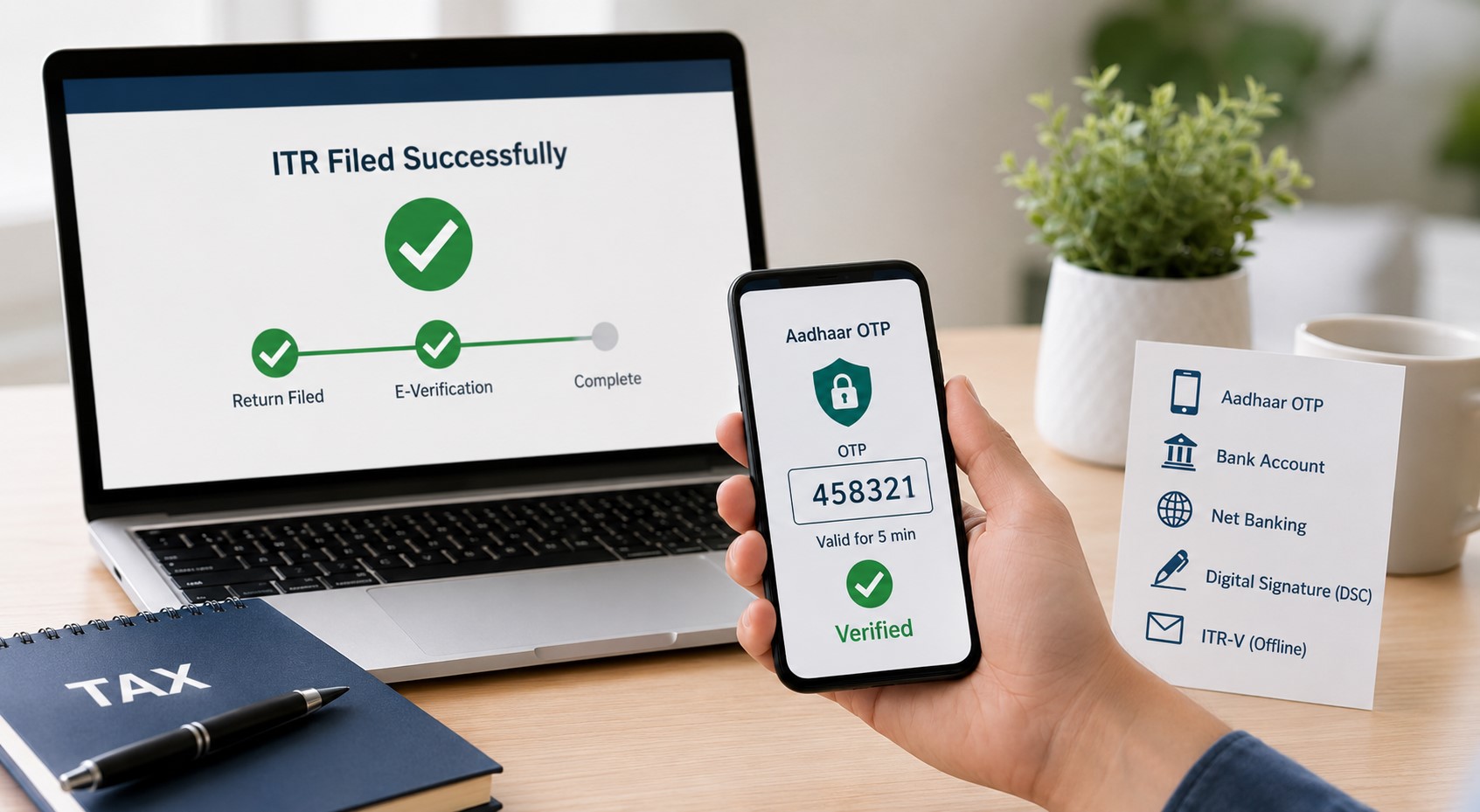
Five Easy Methods to E-Verify Your ITR

The CSR Journal Magazine

The process of filing Income Tax Returns (ITRs) for Assessment Year 2026–27 is currently active, with taxpayers preparing their submissions. It is essential for taxpayers to understand that the filing process is not complete once the return is submitted. After filing an ITR, the next crucial step is e-verification, which is necessary for the return to be considered officially finalised.

Without completing the e-verification, the ITR might be regarded as incomplete by the Income Tax Department. This could lead to complications that may delay refunds or create compliance issues. Therefore, filing the return is merely the first part of the process; e-verification finalises it.

Methods for E-Verification of ITR

Among the various methods of e-verifying an ITR, using Aadhaar OTP is one of the simplest and most widely used approaches. Taxpayers who have linked their Aadhaar with their PAN and have a registered mobile number can opt for this method. After selecting the Aadhaar OTP choice on the income tax portal, a one-time password is generated and sent to the registered mobile number. Once the OTP is entered, the verification is completed within minutes.

Another option for verification is through a bank account or demat account. Taxpayers need to pre-validate the account on the income tax portal to use this method. An OTP is then sent to the mobile number or email associated with the account, allowing for a straightforward verification process.

For specific categories of taxpayers, such as businesses or those whose accounts require an audit, using a Digital Signature Certificate (DSC) may be necessary. In such cases, attaching a digital signature acts as verification proof and securely completes the e-verification process.

Net banking serves as another hassle-free method to verify ITRs. Many banking institutions offer the option to verify the ITR directly from the customer’s online banking account. After logging in, taxpayers can navigate to the tax filing or e-verification section, which will redirect them to the income tax portal to complete the process instantly.

Option for Offline Verification Through ITR-V

For individuals who are unable to use digital methods for verification, the offline option remains available. Taxpayers can download the ITR-V acknowledgement form, sign it, and mail it to the Centralised Processing Centre in Bengaluru. However, this should be completed within 30 days post-filing the ITR to ensure compliance.

It is important for taxpayers to maintain up-to-date contact details on the income tax portal, as the OTP-based verification relies on these particulars. Additionally, refunds are processed only after the ITR has successfully undergone verification. To ensure security, taxpayers should exclusively utilise the official income tax portal or recognised banking channels, avoiding suspicious links or messages.

While e-verifying an ITR usually takes just a few minutes, neglecting this final step can lead to unnecessary issues in the future. Therefore, it is crucial for all taxpayers to take the e-verification process seriously to avoid complications later on.

Long or Short, get news the way you like. No ads. No redirections. Download Newspin and Stay Alert, The CSR Journal Mobile app, for fast, crisp, clean updates!

App Store –  https://apps.apple.com/in/app/newspin/id6746449540 

Google Play Store – https://play.google.com/store/apps/details?id=com.inventifweb.newspin&pcampaignid=web_share

Latest News

Popular Videos