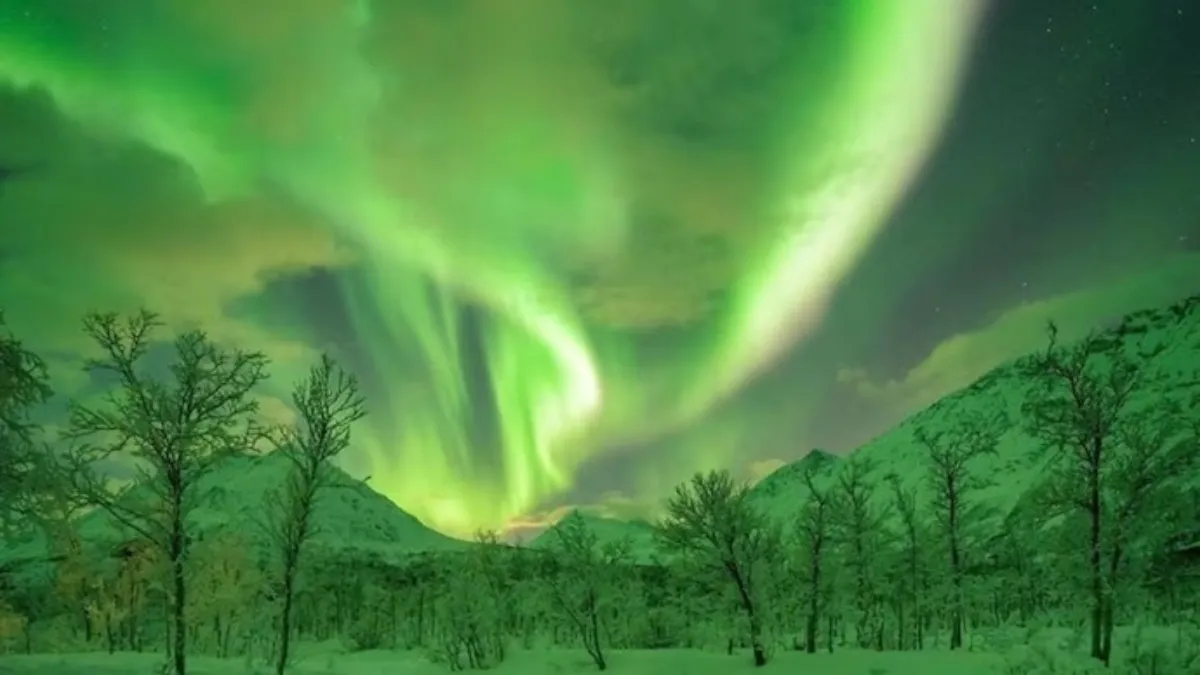
Initial expectations of witnessing the Northern Lights in certain parts of India have diminished following a significant solar eruption that was supposed to reach Earth on June 8. This event involved a coronal mass ejection (CME), which is a large expulsion of plasma and magnetic field from the Sun. Originally, this CME was predicted to instigate a G3 geomagnetic storm.
The classification of geomagnetic storms ranges from G1 to G5. A G1 storm is labelled as minor, whereas a G3 storm is deemed strong enough to produce more extensive auroras and increased effects on Earth’s magnetic field. Consequently, many enthusiasts had anticipated a chance to see auroras, typically found at polar regions, making their way further south into India.
Despite the excitement surrounding the solar activity, forecasters have reported that the CME did not reach Earth on the anticipated date, indicating an unexpected delay or the possibility that it missed the planet entirely. This adjustment in expectations has led to a significant reduction in the likelihood of seeing auroras in Indian skies.
CME and Its Importance in Space Weather
A coronal mass ejection signifies a momentous release of magnetised plasma that can impact Earth’s magnetosphere upon collision. Such interactions can lead to geomagnetic storms and produce vivid auroras, primarily at polar latitudes. The potential for this CME to create auroras visible from northern Indian regions, notably high-altitude areas like Ladakh and Jammu & Kashmir, had generated substantial anticipation.
In recent years, increased sightings of auroras over Ladakh during periods of heightened solar activity have spurred interest in such phenomena across India. These occurrences have affirmed that auroras can be observed considerably further south than their traditional Arctic and Antarctic confines under specific conditions.
The prospect of a vibrant display of auroras captivating the night sky had excited many, fostering hope among sky-watchers. However, as the event did not transpire as forecasted, the situation has shifted significantly.
Current Predictions for Aurora Visibility in India
For those hoping to view the enchanting waves of light, disappointment appears unavoidable with forecasts now indicating reduced chances for auroral sightings. Generally, auroras in India necessitate a substantially robust geomagnetic storm alongside clear, dark skies located at high northern latitudes.
As the anticipated CME has not yet materialised and predictions have downgraded from a potentially strong G3 storm to merely minor G1 conditions, the probability of witnessing visible auroras in India has decreased significantly. The latest assessments suggest an extremely slim chance for any auroral events.
Only under exceptional circumstances might there be a brief instance of visibility in the elevated terrains of Ladakh, should the CME arrive unexpectedly. Nonetheless, the consensus among experts remains cautious, leading them to conclude that widespread auroras across India tonight are unlikely.
Long or Short, get news the way you like. No ads. No redirections. Download Newspin and Stay Alert, The CSR Journal Mobile app, for fast, crisp, clean updates!