


Purchasing Power of Rs 100 Drops Significantly from 2000 to 2026
The CSR Journal Magazine

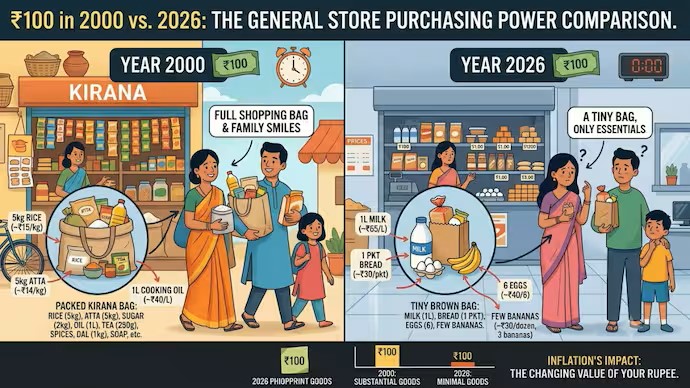
The purchasing capacity of Rs 100 in the year 2000 was significantly greater than it is today. For many who shopped at local kirana stores, this amount could cover a substantial portion of their weekly grocery needs. Data from that era illustrates the affordability of everyday items, which are now priced at a premium.

At that time, Rs 100 could purchase approximately 8.3 kilograms of rice, 14.3 kilograms of wheat, and a variety of other essentials. For example, the prices for various commodities were as follows: rice was priced at Rs 12 per kilogram, wheat at Rs 7 per kilogram, and milk at Rs 14 per litre. Such rates allowed households to meet their basic dietary requirements without overspending.

Many families relied heavily on this budget, with Rs 100 covering a significant portion of their grocery lists. The low cost of staples rendered grocery shopping much more manageable than it has become in recent years.

Current Purchasing Power in 2026

In contrast, as of 2026, the same Rs 100 has lost substantial buying power due to inflation. Rising costs have forced consumers to make difficult decisions regarding their grocery purchases. Current prices reflect this shift dramatically; for instance, rice now costs Rs 43.65 per kilogram, which means that Rs 100 will only secure around 2.3 kilograms.

Moreover, significant increases have been noted across other staples as well. Wheat is priced at Rs 30.79 per kilogram, allowing only 3.2 kilograms to be purchased for Rs 100. This illustrates a stark decline in the quantity of goods that can be acquired compared to 2000, suggesting that consumers are increasingly receiving less for their money.

Items such as milk and sugar have also seen drastic price hikes, making basic groceries considerably more expensive. For example, milk now costs Rs 60.45 per litre, enabling the purchase of just 1.65 litres for Rs 100. This scenario highlights the challenges families face in managing their food budgets amid rising inflation.

Inflation and Its Impact on Households

The comparison of purchasing power from 2000 to 2026 reveals the broader implications of inflation on household economics. Notably, what Rs 100 could buy has plummeted dramatically, with estimates indicating that the current value provides only about 22.5 per cent of the purchasing capacity it held over two decades ago.

While inflation figures might seem abstract, the tangible effects are felt every time consumers shop for groceries. Items that were once staples in a modest household budget now account for a much larger share of monthly expenditures. Families that managed to spend Rs 500 on groceries in 2000 would need to allocate roughly Rs 2,220 or more today to secure a similar array of products.

Even as salaries and earnings have generally increased over the years, the associated costs—ranging from food to healthcare, housing, education, and transport—have risen proportionately. This environment prompts many shoppers to reflect on their purchasing habits and the increasing strain on their budgets, marking a significant change in the cost of living in India.

Long or Short, get news the way you like. No ads. No redirections. Download Newspin and Stay Alert, The CSR Journal Mobile app, for fast, crisp, clean updates!

App Store –  https://apps.apple.com/in/app/newspin/id6746449540 

Google Play Store – https://play.google.com/store/apps/details?id=com.inventifweb.newspin&pcampaignid=web_share

Latest News

Popular Videos
