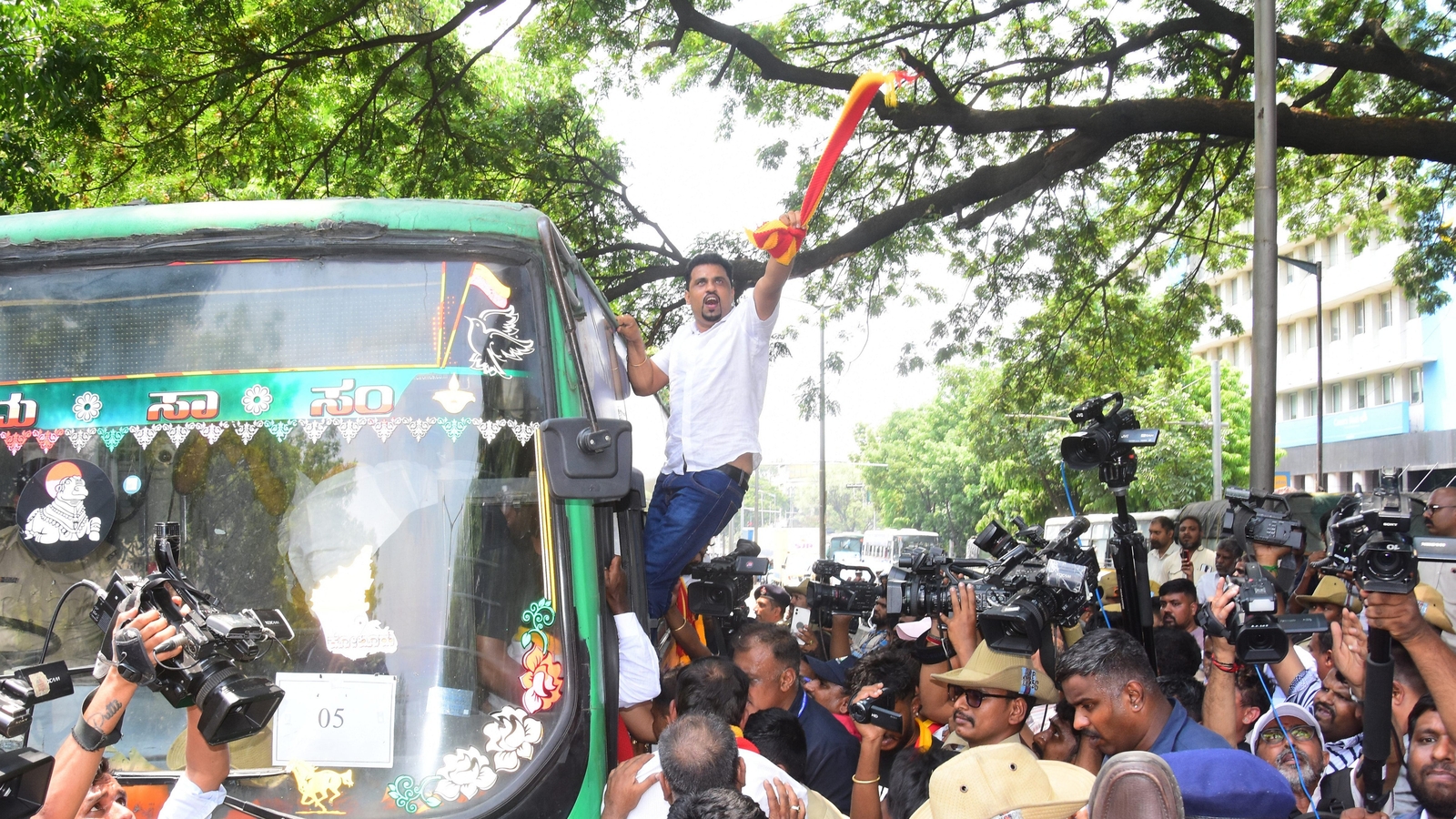
Bengaluru: Pro-kannada activists raise slogans during their protest at Town Hall amid statewide bandh, in Bengaluru, Saturday, March 22, 2025. A 12-hour statewide bandh called by the pro-Kannada groups to protest the alleged assault on a state-run bus conductor in Belagavi last month for not knowing Marathi began in Karnataka on Saturday morning amid tight security. (PTI Photo) (PTI03_22_2025_000107B)
The recent bandh in Karnataka, observed on August 13, featured a distinctive protest in Koppal where demonstrators offered roses to lorry drivers from Tamil Nadu. This act was a means to convey a message of peace while highlighting tensions surrounding the Cauvery water-sharing dispute. Protesters gathered at the Hitnal Toll Gate on the National Highway, led by Kerave Yuva Sene leader Vijayakumar, who insisted on a non-confrontational approach during this contentious time.
As drivers approached, protesters handed them roses alongside messages aiming to mitigate any provocation against Karnataka. “We are peace-loving people. Do not provoke us,” Vijayakumar was heard advising the lorry drivers, emphasising harmony over hostility.
Despite the peaceful intent, the demonstration saw slogans raised against the Tamil Nadu government and the Cauvery Water Regulation Committee’s (CWRC) directive requesting 12,000 cusecs of water from Karnataka for a fortnight. Protesters chanted, “Take the flowers, don’t ask for water,” clearly articulating their discontent while focusing on their floral gesture.
Police Intervene in Demonstration
Following the demonstration, police intervention led to the detention of the protest leaders, although the exact number of individuals taken into custody remains undisclosed. This action reflected the authorities’ efforts to manage the situation amidst rising tensions between the two states regarding the Cauvery water allocation.
The Koppal protest was part of a larger statewide bandh called by Karnataka Okkuta, with participation expected from various organisations across the region. According to the Koppal district unit, this bandh was called under the leadership of Vatal Nagaraj, the Karnataka Okkuta State President, reflecting widespread discontent over the CWRC’s recent directives.
The protests aimed to be coordinated by leaders including B.J. Rajanna and T.K. Nayak, who directed demonstrations at toll gates and highways throughout Karnataka. These organisations expressed concerns for the state’s water requirements, especially as many districts are facing acute shortages in both drinking water and irrigation supplies.
Concerns Over Water Allocation
Advocacy for adequate water security was a primary focus during the protests. While the organisations did not outright oppose water sharing with Tamil Nadu, they stressed the necessity for Karnataka’s long-term water management needs to be prioritised. One of the critical demands highlighted was the prompt implementation of the Mekedatu project, which proponents argue is essential for addressing water shortages.
Protesters maintained that infrastructure development, including the proposed dam on the Krishna River, is vital for ensuring the state’s water needs are met. Demonstrators represented a coalition of various Kannada organisations and youth groups, including the Karnataka Rakshana Vedike Youth Wing and Suvarna Karnataka Yuva Sene, all keen on advocating for Karnataka’s water interests.
Despite the bandh, public transport operations persisted, with Tamil Nadu government buses operating to Karnataka via Hosur. The Karnataka State Transport Corporation also continued its services, albeit with a low passenger turnout, suggesting that transportation remained functional in some areas even amid the protests.
Political Context of the Protests
The Cauvery water dispute hails as a long-standing issue, marked by competing claims from both Karnataka and Tamil Nadu regarding water utilisation. The latest protests were catalysed by the CWRC’s directive that prompted Karnataka to release a considerable volume of water. Karnataka-based groups contend that their concerns for water shortages must not be overlooked.
The Koppal demonstration signalled a symbolic approach, opting for the distribution of roses instead of engaging in confrontational actions against Tamil Nadu drivers. This gesture was accompanied by continued criticism of the Tamil Nadu government and the water release directives. Authorities are closely monitoring the ongoing situation across Karnataka, particularly at key locations where protests have been established.
As the bandh continues to unfold, Kannada organisations are likely to uphold their stance on Karnataka’s water interests while simultaneously demanding expedited implementation of crucial water infrastructure projects. The unique nature of the protest in Koppal, which underscored a message of peace, serves as a poignant aspect of this ongoing and politically sensitive water-sharing conflict.
Long or Short, get news the way you like. No ads. No redirections. Download Newspin and Stay Alert, The CSR Journal Mobile app, for fast, crisp, clean updates!
The Mising community has imposed an indefinite economic blockade on vital road routes connecting Assam and Arunachal Pradesh, following a shooting incident that left...
The Supreme Court has announced that it will hear Tamil Nadu's petition urging Karnataka to comply with the Cauvery Water Management Authority's (CWMA) order...
Karnataka Congress MLA Dr Ranganath has stated that the state government is encountering significant challenges regarding the release of Cauvery water to Tamil Nadu,...