The Islands India Ignored for 70 Years Are Now Its Most Strategic Asset
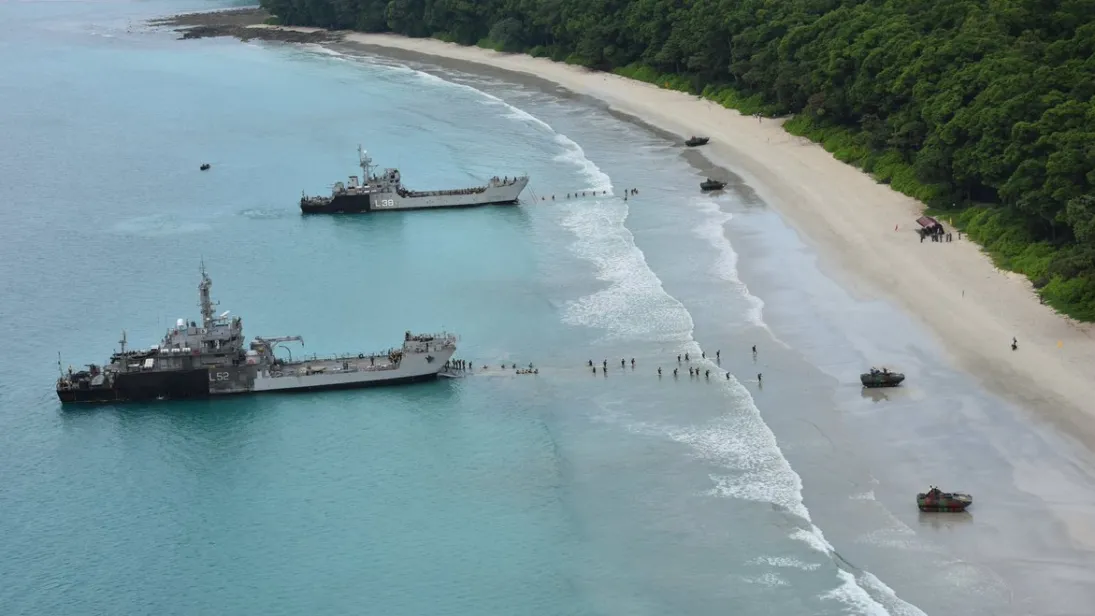
The CSR Journal Magazine

There is a string of islands sitting roughly 1,200 kilometres southeast of the Indian mainland, deep in the Bay of Bengal. They are Indian territory. They straddle one of the busiest shipping lanes on earth. They sit within touching distance of the Strait of Malacca, through which nearly 40% of global freight trade passes every single year. They add 30% of India’s entire exclusive economic zone to the country’s maritime estate.

For most of independent India’s history, New Delhi essentially ignored them.

That is beginning to change, and the reasons why are becoming impossible to overlook.

What These Islands Actually Are

The Andaman and Nicobar archipelago is a chain of 836 islands, islets, and rocky outcrops running north to south for about 750 kilometres. Fewer than 40 are inhabited. The southernmost point, Indira Point on Great Nicobar Island, sits just 145 kilometres from Indonesia and about 40 nautical miles from one of the world’s most important east-west shipping corridors. Over 94,000 merchant vessels cross the nearby waters every year, carrying trade destined for China, South Korea, Japan, and every major economy in East Asia.

The islands command three critical channels within Indian territory: the Six Degree Channel in the south, the Ten Degree Channel between the Andaman and Nicobar groups, and the Preparis Channel in the north. Every ship coming out of the Strait of Malacca heading toward the Indian Ocean, and every vessel making the journey in the other direction, passes through waters that fall within India’s sphere of influence from these islands.

For a country that likes to call the Indian Ocean its own lake, India spent a remarkable amount of time not actually guarding the gate.

When India gained independence in 1947, the Andaman and Nicobar Islands came with the deal. The British had used them primarily as a penal colony. The Japanese had occupied them during the war. Netaji Subhas Chandra Bose had visited Port Blair and symbolically planted the Indian flag there in 1943 in what became the first territory of India to be “liberated” during the nationalist movement. The islands carried enormous historical meaning and almost no strategic investment.

For the first 15 years after independence, the islands were left largely to themselves, their remoteness and difficult symbolism as a former prison keeping them off the priority list. It took the shock of the 1962 war with China for India to establish even a basic naval garrison there. A Chinese submarine had been detected in the region, and alarm bells briefly rang in New Delhi.

The alarm bells were then largely ignored again for the next four decades.

The reasons were many, and some of them were legitimate. India was a continental power by instinct, with its security thinking dominated by land borders. The two major wars of 1965 and 1971 were fought on the plains of Punjab and the jungles of East Pakistan. The country’s defence budget was always under pressure. The islands were expensive to develop, far from the mainland, and surrounded by complex environmental regulations and tribal protection laws that made construction difficult. Successive governments accepted the situation as a given rather than treating it as a problem that needed solving.

The Indian Navy was also historically the junior service, consistently underfunded compared to the Army and Air Force. Maritime thinking was treated as a niche concern rather than a national priority. The concept of projecting power from island territories, of using geography as a force multiplier, barely registered in the national strategic conversation.

K.M. Panikkar, one of independent India’s most far-sighted naval thinkers, had argued decades ago that the defence of India’s long coastline and the active control of the Indian Ocean was only possible through island cover as advanced bases. He said the possession of the Andamans and Nicobars gives protection to the east coast and secures adequate control of the Bay of Bengal. His warnings were recorded, cited in think-tank papers, and largely set aside.

The Andaman and Nicobar Command, India’s first and only tri-service integrated command, was finally established in 2001. It was a step forward, but for years it remained understaffed, underequipped, and underfunded. Runways were too short for large patrol aircraft. Jetties couldn’t accommodate meaningful warships. Storage and logistics were minimal. The command had the right idea and almost none of the tools.

While India’s gaze was fixed on the Himalayas, China was quietly building a maritime empire.

Beijing understands something that took New Delhi too long to absorb: in the modern era, the sea is where power is projected, sustained, and contested. China began deploying naval vessels into the Indian Ocean in 2008, initially under the cover of international anti-piracy operations in the Gulf of Aden. What started as a mission of convenience became a permanent strategic presence?

By 2013, China had its first reported nuclear-attack submarine operating in the Indian Ocean. By 2017, the deployment of Chinese survey ships and research vessels into Indian Ocean waters had become routine. These ships, formally described as scientific research vessels, are operated by state-affiliated organisations with direct links to the People’s Liberation Army. The US-based Centre for Strategic and International Studies found that at least 80% of 64 such vessels operating globally since 2020 showed clear indicators of military objectives. More than half operated in the South China Sea, but their growing presence in the Indian Ocean had become a matter of deep concern in New Delhi.

The pattern was deliberate. Chinese research vessels would arrive in the Bay of Bengal or the Arabian Sea, conduct extensive ocean floor surveys collecting bathymetric data about water depth, temperature, and salinity, then depart. That kind of data has research applications, certainly. It is also exactly what a navy needs to manoeuvre submarines effectively, plan underwater operations, and build the knowledge base for future conflict.

In March 2024, India issued a notice to airmen over the Bay of Bengal ahead of planned tests of two nuclear-capable ballistic missiles. A Chinese research vessel, the Xiang Yang Hong 01, entered the Bay of Bengal just days before the tests. This was not the first time a Chinese vessel had appeared in Indian waters immediately before a planned missile test. The timing was not considered a coincidence.

In August 2024, the Indian Navy was placed on alert after a Chinese survey ship was detected in the Bay of Bengal roughly 120 kilometres from where India had announced plans to conduct a subsurface firing exercise. The ship was there to watch, to listen, and to learn.

China operates around 60 submarines today, with the number expected to rise toward 80 by 2035. The PLA Navy is the largest naval force in the world by ship numbers. It is commissioning new vessels at a pace that no other country can match. And unlike the Western Pacific, which is thick with American and Japanese anti-submarine assets tracking Chinese submarine movements, the Indian Ocean has historically been relatively open territory for Chinese undersea operations.

If China’s research vessels in Indian waters are a slow-burn concern, Myanmar’s Coco Islands are a more immediate one.

Great Coco Island sits just 55 kilometres north of India’s Andaman and Nicobar Islands. The Coco channel that separates them is barely 40 kilometres wide. For three decades, there have been persistent allegations that China has used the island as a signals intelligence listening post, pointing its arrays southward at India’s naval and missile facilities.

In January 2023, satellite imagery from Maxar Technologies revealed renewed construction activity on Great Coco Island: two new aircraft hangars, a freshly lengthened 2,300-metre runway, a new causeway, and what appeared to be accommodation blocks. The runway has since been extended to around 2,400 metres. Reports from Indian defence sources allege that personnel from China’s PLA Strategic Support Force are present on the island, using it to monitor radar emissions, radio frequencies, and missile telemetry data from Indian facilities.

China’s position on Myanmar was cemented by the military coup of 2021, which drove the country firmly into Beijing’s embrace. Beijing had already invested heavily in the China-Myanmar Economic Corridor, building roads and pipelines designed to give Chinese trade and energy supplies access to the Indian Ocean while bypassing the Strait of Malacca entirely. A military junta dependent on Chinese support and diplomatic cover has little incentive to accommodate Indian concerns about what happens on Coco Island.

When India’s Defence Secretary visited Myanmar in September 2025, he was told there were no Chinese nationals on the islands. Myanmar then refused India’s long-standing request to allow an inspection visit, citing sovereignty concerns. The refusal said more than any denial could.

The strategic logic of Coco Island as a Chinese listening post is hard to argue with. It sits at roughly the same latitude as India’s Rambilli naval base in Andhra Pradesh, where India’s nuclear-powered ballistic missile submarines operate. A functioning signals intelligence facility there could theoretically track India’s submarine communications, monitor missile telemetry from test ranges, and watch the movements of India’s naval assets in the eastern Indian Ocean. That would directly undermine India’s nuclear deterrent, which depends on the credibility of a submarine-based second-strike capability.

What India Is Now Actually Doing

India is finally treating the Andaman and Nicobar Islands like what they are: the most consequential piece of real estate the country possesses in the maritime domain.

The infrastructure transformation underway since roughly 2022 is the most significant in the islands’ history as Indian territory.

Runways at INS Kohassa in the north and INS Baaz at the southern tip of Great Nicobar are being extended to accommodate larger aircraft. The runway at the Air Force station at Car Nicobar has been upgraded, and Chief of Defence Staff General Anil Chauhan inaugurated the improved facility last year. Sukhoi-30MKI jets can now be based there, each capable of carrying the BrahMos supersonic cruise missile with a 500-kilometre range. That single development extends India’s strike envelope across an enormous area of the eastern Indian Ocean and the Malacca approaches.

INS Utkrosh in Port Blair received a precision approach radar system in 2024, allowing aircraft to land in low-visibility conditions, alongside an Integrated Underwater Harbour Defence and Surveillance System. Naval Communication Network centres have been established at INS Kohassa, INS Baaz, and INS Kardip. Jetties are being expanded to accommodate larger warships. Logistics and storage capacities are being built up. A surveillance system covering the 55 inhabited islands is being upgraded through the National Remote Sensing Centre.

The P-8I Poseidon, India’s primary long-range maritime patrol aircraft, is among the aircraft being planned for deployment. The P-8I is purpose-built for anti-submarine warfare, surface surveillance, and intelligence gathering. Basing P-8Is at the Andamans puts them at the doorstep of the Malacca Strait and within range of most Chinese naval activity in the eastern Indian Ocean.

Then there is the Great Nicobar Project, which is the most ambitious single development initiative the islands have ever seen.

The project involves constructing an international container transshipment terminal at Galathea Bay, a greenfield international airport capable of handling dual civilian and military use, a 450 megavolt ampere power plant, and a planned township. The total investment runs to around 8 to 10 billion dollars, rolling out in three phases from 2025 to 2047. The transshipment terminal, with natural water depth exceeding 20 metres at Galathea Bay, is designed to handle up to 14.2 million twenty-foot container equivalents at full capacity.

The economic case is real: India currently routes a significant portion of its transshipment cargo through foreign ports like Colombo, Singapore, and Klang in Malaysia. Colombo handles enormous volumes of Indian cargo simply because India lacked a comparable deep-water port at the right location. Galathea Bay changes that equation. The port sits about 40 nautical miles from the east-west international shipping corridor, close enough to be genuinely competitive for transshipment traffic.

But the strategic purpose of the airport and the port, a dual-use facility that can support military operations, is not subtle. An airport at Great Nicobar with a 3-kilometre runway and full military facilities at the southern tip of the chain would close a gap that China’s strategists have noticed for years.

China imports about 80% of its oil through the Strait of Malacca. Roughly 60 percent of its total trade passes through the same narrow waterway. Beijing’s strategists call this the Malacca Dilemma: the recognition that in any serious conflict, the strait could be closed or monitored, strangling China’s energy supplies and trade flows. That vulnerability is not hypothetical. It is the single greatest structural weakness in China’s strategic position.

India’s Andaman and Nicobar Islands sit directly at the northern end of the Malacca approaches. The Six Degree Channel at the southern tip falls within India’s exclusive economic zone. Every ship exiting the Strait of Malacca heading for the Indian Ocean passes through waters India can, in principle, dominate militarily.

A fully developed Andaman and Nicobar Command, with long-range patrol aircraft, strike-capable jets armed with BrahMos missiles, submarines operating from forward bases, a deep-water port capable of sustaining major naval operations, and comprehensive underwater surveillance systems, does not need to actually block the Malacca Strait to have strategic effect. Its existence changes the calculus in any confrontation. China would need to plan for the contingency. India would be sitting at the throat of China’s economic lifeline.

This is the most powerful lever India has in its maritime competition with China, and it is only now beginning to be developed.

Why India Did Not See This Earlier

The honest answer is a combination of continental bias, budgetary neglect, bureaucratic inertia, and a failure of strategic imagination that lasted decades.

India’s military culture has always tilted toward the Army. The border wars of 1962, 1965, and 1971 were land conflicts. The Kargil war of 1999 was a land conflict. The mental model of national security in India has been shaped by the Himalayas and the Punjab plains, not the Bay of Bengal or the Strait of Malacca. The navy remained, for most of independent India’s history, the service that got what was left after the army and air force had made their demands.

There was also a philosophical dimension. India spent much of the Cold War pursuing non-alignment, and the concept of power projection from forward island bases carried uncomfortable colonial overtones. The idea of using territory aggressively to dominate sea lanes did not sit easily with a country that had spent 200 years under a naval imperial power.

Environmental and tribal protection regulations, which were legitimate in intent, became in practice a reason to delay every proposed development on the islands for years. The Shompen and Nicobarese communities on the islands needed protection. But the regulations were applied without any mechanism for expediting genuinely strategic projects, creating a bureaucratic tangle that paralysed development.

The 2001 creation of the Andaman and Nicobar Command was a recognition of strategic reality, but it was not followed by the funding and political will needed to actually develop the command’s capabilities. The command existed on paper as India’s maritime flank in the east. In practice, it was chronically under-resourced.

The shift began, slowly, after the 2017 Doklam standoff with China and accelerated sharply after the 2020 Galwan Valley clash in Ladakh, in which Indian soldiers died in hand-to-hand combat with Chinese troops on the Line of Actual Control. Galwan did something to Indian strategic thinking that years of naval analysis papers had failed to do: it made the threat viscerally, undeniably real. After Galwan, India’s defence investment across every domain went up. The Andaman and Nicobar Islands became a priority.

Being late is not the same as being too late, but it does mean there is a great deal of catching up to do.

The islands are still dependent on the mainland for most supplies. The logistical chain that would sustain extended military operations from the Andamans remains incomplete. Underwater surveillance to track submarine movements through the channels is being developed but is not yet comprehensive. The planned fighter squadron presence at Car Nicobar needs to be permanent and well-supplied rather than rotational. The Great Nicobar Project’s first phase runs until 2035, which means full operational capability at Galathea Bay is still years away.

India also needs to think seriously about the Lakshadweep Islands in the Arabian Sea, which guard the western approaches and have received even less strategic attention than the Andamans. The Indian Ocean is not just an eastern problem.

The deepening of Quad partnerships with the United States, Japan, and Australia gives India real institutional backing. American P-8 Poseidons and Indian P-8Is can coordinate patrols. Australian and Japanese contributions to maritime domain awareness, the ability to know what is happening on the ocean at any given time, amplify India’s reach far beyond what it could manage alone. The Quad ministerial meeting in January 2025 was notably direct about the security benefits of the partnership, a departure from the group’s earlier tendency to describe itself primarily in terms of trade and connectivity.

The Bangladesh situation adds a layer of complexity. The submarine base BNS Pekua, formerly named after Sheikh Hasina before her government was overthrown in July 2024, could become a facility accessible to Chinese submarines for resupply and repair. A Chinese submarine logistics presence in Bangladesh’s Bay of Bengal coast, combined with whatever is happening on Coco Island to the north, would create a surveillance and potential operations envelope that presses on India’s eastern seaboard from multiple directions.

Better Late Than Never

India’s strategic position in the Indian Ocean was always stronger on paper than in practice. The geography was an advantage that sat unused for the better part of seven decades. The Andaman and Nicobar Islands are India’s natural forward operating position in the Indo-Pacific, a ready-made platform for exactly the kind of influence and deterrence that China has been building through artificial islands and leased port facilities across the region.

China has spent years, and enormous treasure, trying to construct what India already owns.

The Great Nicobar Project, the runway extensions, the fighter jet basing, the underwater surveillance systems, the new communication networks, and the expanded jetties are all overdue. But they are happening. The pace of development on the islands has accelerated in ways that would have seemed improbable even a decade ago. The political will that was absent for fifty years is now, under pressure of circumstances, present.

The Malacca Dilemma does not disappear because China builds ports in Djibouti or surveys the Indian Ocean seafloor. The geography has not changed. What has changed is that India is finally accepting the responsibility that comes with controlling it.

Views of the author are personal and do not necessarily represent the website’s views.

Dr. Jaimine Vaishnav is a faculty of geopolitics and world economy and other liberal arts subjects, a researcher with publications in SCI and ABDC journals, and an author of 6 books specializing in informal economies, mass media, and street entrepreneurship. With over a decade of experience as an academic and options trader, he is keen on bridging the grassroots business practices with global economic thought. His work emphasizes resilience, innovation, and human action in everyday human life. He can be contacted on jaiminism@hotmail.co.in for further communication.

Long or Short, get news the way you like. No ads. No redirections. Download Newspin and Stay Alert, The CSR Journal Mobile app, for fast, crisp, clean updates!

App Store – https://apps.apple.com/in/app/newspin/id6746449540

Google Play Store – https://play.google.com/store/apps/details?id=com.inventifweb.newspin&pcampaignid=web_share

Latest News

Popular Videos