The Island in the Crosshairs: Is the US Coming for Cuba, After Iran
The CSR Journal Magazine

90 miles. That is the distance between the Florida Keys and the Cuban coastline. In geopolitical terms, it is almost nothing — a puddle separating the world’s most powerful military from one of its oldest adversaries. For over 6 decades, that puddle has held.

But in 2026, it is beginning to look more like a fuse than a moat.

Fresh from the January 2026 intervention in Venezuela that toppled Nicolás Maduro, the Trump administration has pivoted with startling speed toward Havana. The playbook is recognizable: maximum economic pressure, public ultimatums, the language of regime change dressed up in the vocabulary of national security.

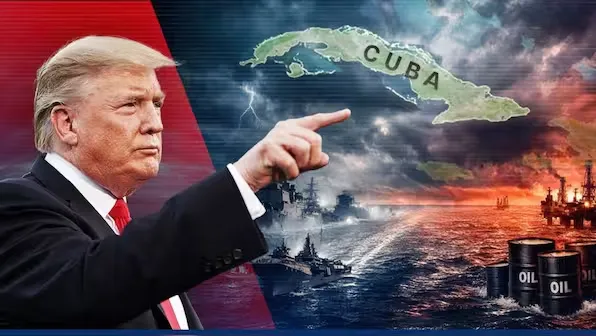
Cuba, which survived the Soviet collapse, the Special Period of the 1990s, and sixty years of American embargo, is now facing something qualitatively different — a siege that has left the island without oil, without power, and without easy friends.

The question is no longer whether Washington is applying pressure. It is whether that pressure is the prelude to something far more consequential.

To understand what is happening to Cuba, it helps to look at what happened to Iran.

The Trump administration’s approach to Tehran — re-designation as a state sponsor of terrorism, maximum economic sanctions, secondary sanctions on any country trading with the target, and finally military action against proxy forces — followed a clear escalation ladder.

Cuba is currently on the lower rungs of that same ladder, but the architecture is identical.

Within days of his January 2025 inauguration, President Trump declared Cuba an “unusual and extraordinary threat” to U.S. national security, invoking the International Emergency Economic Powers Act (IEEPA).

By January 29, 2026, that declaration was formalized through Executive Order 14380, which established a tariff system targeting any country that “directly or indirectly” supplies oil to the Cuban government. Mexico, which had been Cuba’s top oil supplier in 2025, halted shipments by January 27.

Venezuela’s supply had already been cut off when Maduro was removed. Cuba, which imports the vast majority of its energy needs, was left running on fumes — literally.

By late January 2026, Cuban officials confirmed the island had roughly fifteen to twenty days of oil remaining. By March, Díaz-Canel stated publicly that Cuba had received no oil shipments in three months. The country suspended airline refueling at José Martí International Airport.

Schools and universities were shut. Cuba had entered its three nationwide blackouts in March alone. This is not incidental suffering — it is engineered scarcity, the same instrument used against Iran before military escalation.

Secretary of State Marco Rubio has made the objective explicit. The goal, he has said, is “regime change.” Representative María Elvira Salazar, one of the most hawkish voices on Cuba in Congress, has acknowledged publicly that civilian suffering is “an unfortunate but necessary trade-off” in pursuing political transformation. The Council on Foreign Relations reported in March 2026 that senior U.S. officials have indicated the end goal includes the potential removal of President Díaz-Canel from power.

Beyond ideology and history, the U.S. case for pressure rests on a concrete — and genuinely alarming — intelligence foundation. Cuba is not merely a communist neighbour. It is, by any honest accounting, one of the most densely surveilled pieces of real estate on Earth, and almost all of that surveillance is pointed at the United States.

The White House fact sheet accompanying Executive Order 14380 stated that Cuba “hosts Russia’s largest overseas signals intelligence facility,” designed to steal sensitive national security information from the United States. This is not new — the Lourdes SIGINT complex near Havana, which covers 28 square miles and is situated less than 100 miles from Key West, was at its Soviet peak home to an estimated 1,500 operatives.

At that time, Cuban Defense Minister Raúl Castro acknowledged that Russia obtained 75 percent of its military strategic intelligence from Lourdes. Although Russia formally closed the facility in 2001, intelligence analysts note that a stay-behind contingent of roughly 3,000 Russian military and civilian technicians remained on the island, and the facility was partially revived following Putin’s 2014 visit to Havana.

The Russian threat, however, is now arguably secondary to the Chinese one. The Center for Strategic and International Studies (CSIS), using commercially available satellite imagery, has identified at least four active signals intelligence sites in Cuba with suspected links to China.

The largest, at Bejucal in the hills above Havana, has undergone continuous and accelerating modernization. By April 2025, imagery revealed major new construction underway, including the installation of a large Circularly Disposed Antenna Array (CDAA) — a Cold War-era system capable of detecting and tracing radio signals thousands of miles away. Two smaller facilities nearby, at Wajay and Calabazar, show expanding antenna fields and growing infrastructure. A fourth site at El Salao in eastern Cuba was under construction through 2024 before going quiet.

Ryan Berg, a Latin America security expert who testified before a House Homeland Security subcommittee, put the strategic exposure plainly: these facilities grant China signals intelligence coverage of approximately 20 key U.S. military bases and installations in Florida alone. The Bejucal complex is positioned with a direct line of sight on Cape Canaveral and Kennedy Space Center — and has equipment consistent with monitoring SpaceX rocket launches. CSIS noted that Cuba “lacks its own satellites or space program,” making the space-tracking equipment at these sites explicable only by reference to a foreign patron’s interests.

This is the intelligence argument in its starkest form: Cuba is not just an authoritarian neighbour. It is a forward operating base for two of America’s primary strategic competitors, positioned at the soft underbelly of the continental United States.

Now,

Think of the U.S. campaign against Cuba as a series of concentric rings, each tightening. The innermost ring is the direct bilateral embargo — now over six decades old, codified in the Helms-Burton Act, and recently reinforced with visa bans, financial restrictions, and re- designation as a State Sponsor of Terrorism for a third time.

The second ring is secondary sanctions — tariffs and financial penalties on any third country that keeps the Cuban economy alive. The third ring, now in effect, is the naval blockade.

By February 2026, the U.S. Coast Guard was actively intercepting oil tankers bound for Cuba — including vessels from Pemex, Mexico’s state-owned oil company. Foreign Policy noted in March 2026 that this constitutes America’s first effective blockade of Cuba since the Cuban Missile Crisis, and critically, it goes further than that crisis in one significant respect: President Kennedy’s 1962 “quarantine” barred only military equipment from reaching the island. The 2026 blockade cuts off food, fuel, and medicine. The United Nations Human Rights Office has confirmed the blockade threatens Cuba’s food supply and has disrupted water systems and hospitals.

The UN Secretary-General António Guterres stated he is “extremely concerned” about the humanitarian situation in Cuba, warning it will “worsen, or even collapse” without oil. UN human rights experts condemned Executive Order 14380 as “a serious violation of international law and a grave threat to a democratic and equitable international order.”

Cuba is trying to find alternatives. Russia confirmed in March 2026 that it was sending oil to the island, and a Russian tanker arrived on March 30 — though Trump said he had “no problem” with this particular delivery, suggesting the blockade’s enforcement remains selective.

China announced an aid package of approximately $80 million in January. Cuba’s government, meanwhile, has been quietly exploring whether its domestic heavy crude — dense, viscous, and high in sulfur — can be refined domestically. On April 25, Díaz-Canel celebrated the Cabaiguán refinery processing local oil as a “historic milestone,” though analysts noted the facility had been doing so since 2010.

These are the moves of a government playing for time, not winning.

Military analysts and geopolitical observers have outlined several distinct pathways through which U.S. pressure on Cuba could escalate beyond economic warfare. None requires the dramatic theatrics of an amphibious landing.

The Economic Strangulation Model. The preferred and current approach. By cutting off Cuban oil supply chains — including secondary sanctions on suppliers from Mexico to Russia — Washington bets that economic collapse will do the work that military force would do at much greater cost. The precedent is instructive: the Soviet Union’s withdrawal of economic support in 1989 triggered Cuba’s worst post-revolutionary crisis. The U.S. calculation is that Venezuela’s removal from the equation achieves something similar, and faster.

The Covert Regime Change Model. The CIA has a long history with Cuba — the Bay of Pigs being its most famous failure, but far from its only operation. A covert approach would involve funding, arming, or organizing internal opposition, cyberattacks on Cuban government infrastructure, and information operations through Radio and TV Martí to radicalize the population already demonstrating in the streets since 2024. The administration has provided some support to civil society organizations on the island and has explicitly said it wants political and economic liberalization, including Díaz-Canel’s removal. Some experts have been skeptical, however, noting that Cuba lacks a well-organized internal opposition capable of seizing a political window.

The Decapitation Strike Model. Following the Venezuela intervention's precedent — a swift military operation that resulted in Maduro’s capture — some analysts in Washington have floated the possibility of a targeted strike aimed at Cuba’s military leadership. This approach would involve special operations forces rather than conventional military invasion.

Cuba’s small armed forces, about 50,000 active personnel, would pose limited conventional resistance. The challenge is political blowback: Venezuela’s Maduro was isolated internationally; Cuba retains broader sympathy, particularly in Latin America and Europe.

The Naval Enforcement Escalation Model. The current blockade could escalate from passive interception to active military confrontation if Cuba or a partner nation challenges it.

A Russian or Chinese vessel forced to turn back, or fired upon, would trigger a different geopolitical crisis entirely — one that could pull Washington into a confrontation it does not want. Cuba’s proximity to Guantánamo Bay, still an active U.S. naval base, adds another layer of strategic complexity to any confrontational naval scenario.

The Internal Collapse Model. The least violent but perhaps most likely. Cuba’s economy, GAESA — the military conglomerate that controls tourism, finance, retail, and imports — holds an estimated $18 billion in dollar-denominated assets according to a 2025 Miami Herald investigation based on leaked internal financial documents. GAESA’s dominance means the military and the economy are structurally fused. If GAESA collapses under sanction pressure, so does the institutional backbone of the Cuban state. The military does not save the regime; it IS the regime. Strip the military of its business empire and you strip it of the means to maintain control.

The Counterweights: Russia, China, and the Limits of Pressure Washington’s campaign has real limits. Cuba is not Iran, a mid-sized power with a population of 90 million and meaningful energy reserves. It is a small island of 11 million people, which ought to make it more vulnerable. But Cuba’s vulnerability is also its most effective shield: it has nothing left to lose.

Russia has demonstrated it will supply oil despite sanctions, at least selectively. China has provided financial aid. Belarus, Iran, Vietnam, and the African Union have formally expressed support. The Progressive International’s Nuestra América Convoy — a humanitarian flotilla modelled on the effort to break Israel’s Gaza blockade — announced plans to attempt to reach Cuban ports. These are not merely symbolic gestures. They represent a counter-coalition forming around the principle that the United States cannot unilaterally determine who gets to eat.

More structurally, experts have noted that Cuba has survived worse. Between 1989 and 1992, the collapse of Soviet trade caused Cuba’s exports to fall by 61% and imports to drop by approximately 72%. The government adjusted and survived.

Cuba knows how to ration, manage scarcity, and project ideological resilience. The Trump administration’s bet is that 2026 Cuba is weaker than 1992 Cuba — that six decades of accumulated exhaustion, a failing electrical grid, mass emigration, and a leadership with less charisma than the Castros have all eroded the island’s capacity to hold on.

That bet may be right.

But as Díaz-Canel’s engagement in quiet diplomatic talks with Washington — publicly confirmed on March 13, 2026 — suggests, neither side wants the confrontation to become irreversible.

What History Tells Us

The United States has been trying to end the Cuban government since 1959. It has failed using assassination, invasion, embargo, isolation, détente, and now blockade. The record counsels humility about any prediction that this time will be different.

And yet something genuinely has changed. Venezuela, Cuba’s economic lifeline for the past two decades, has been removed from the equation by American military action. The oil is gone. The shelves are emptier. The lights go out nightly. And a U.S. administration has explicitly stated, in writing, on the White House website, that it seeks Cuba’s political transformation before the year is out.

The island ninety miles from Florida is not at war. But it is under siege. And the history of sieges teaches one uncomfortable lesson above all others: they end, one way or another. The only question is how.

Views of the author are personal and do not necessarily represent the website’s views.

Dr. Jaimine Vaishnav is a faculty of geopolitics and world economy and other liberal arts subjects, a researcher with publications in SCI and ABDC journals, and an author of 6 books specializing in informal economies, mass media, and street entrepreneurship. With over a decade of experience as an academic and options trader, he is keen on bridging the grassroots business practices with global economic thought. His work emphasizes resilience, innovation, and human action in everyday human life. He can be contacted on jaiminism@hotmail.co.in for further communication.

Long or Short, get news the way you like. No ads. No redirections. Download Newspin and Stay Alert, The CSR Journal Mobile app, for fast, crisp, clean updates!

App Store – https://apps.apple.com/in/app/newspin/id6746449540

Google Play Store – https://play.google.com/store/apps/details?id=com.inventifweb.newspin&pcampaignid=web_share

Latest News

Popular Videos