


Human Rights Allegations Rise in Pakistan-Occupied Jammu and Kashmir
The CSR Journal Magazine

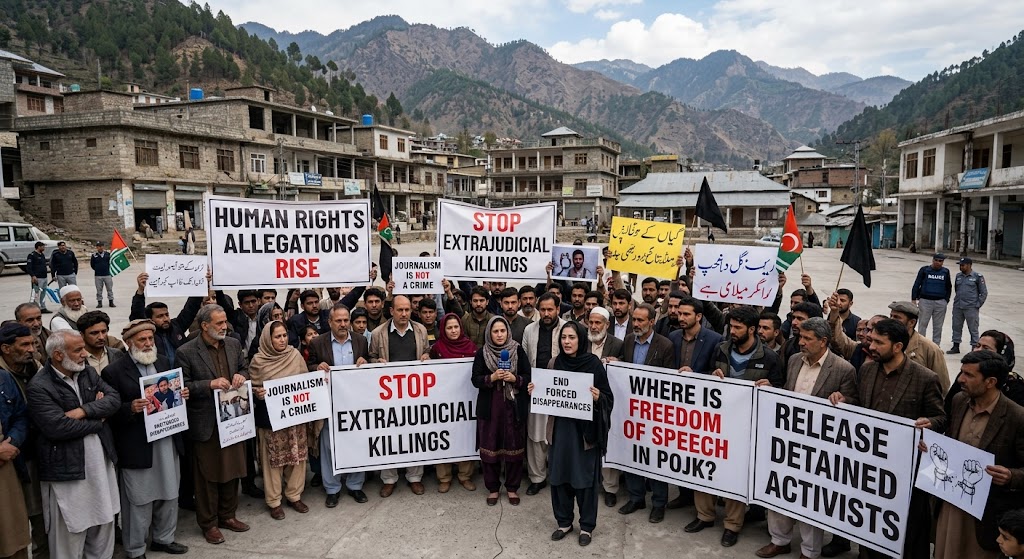
Sardar Shaukat Ali Kashmiri, the President of the United Kashmir People’s National Party, has raised serious allegations against Pakistani authorities, claiming a systematic crackdown on civilians in Pakistan-occupied Jammu and Kashmir (PoJK). Speaking at an event in Geneva, Kashmiri condemned the use of force against peaceful protesters, mass detentions, and enforced disappearances while highlighting the ongoing suspension of internet services which he asserts exacerbates the crisis.

Kashmiri indicated that the current unrest represents more than a mere reaction to escalating electricity prices or economic difficulties. He described it as a manifestation of a historical pattern of deprivation, repression of fundamental rights, political marginalisation, and deteriorating infrastructure. He characterised the movement led by the Jammu Kashmir Joint Awami Action Committee as fundamentally peaceful, representing a coalition of various societal groups, including traders, transporters, teachers, and lawyers.

Claims of Systemic Repression and Forced Disappearances

Kashmiri affirmed that the movement is devoid of violent intent, stating, “It is neither an armed struggle nor a part of any proxy war.” He expressed concern that Pakistani authorities have opted for force instead of opening a dialogue to resolve the grievances of the protesters. “But firing bullets at peaceful protesters and believing that they will not retaliate is, in my view, a dangerous approach,” he noted, warning that such sustained repression could incite further violence among the populace.

According to Kashmiri, the actions taken by security forces have resulted in severe civilian repercussions, including mass arrests and significant fatalities. He alleged that over 3,000 individuals have been detained, with around 1,100 reportedly subjected to enforced disappearances. Furthermore, he claimed that security forces have killed in excess of 150 people during the recent unrest, a figure he estimated based on a list of around 140 names but acknowledged the difficulty in confirming all casualties due to the ongoing internet shutdown.

Legal Violations and Humanitarian Concerns

The leader further criticised the lack of legal protections afforded to those arrested, noting that many detainees have not been presented in court to fulfil legal requirements for timely arraignment. The detention of prominent members of the Joint Awami Action Committee for about 70 days without legal representation was highlighted as a particularly concerning violation.

Kashmiri pointed out that the extended suspension of internet access has compounded these human rights issues by limiting communication, thereby making it challenging for families to ascertain the status of detained individuals or to comprehend the full scope of the current situation. He observed that hospitals and healthcare facilities in PoJK, already strained, have failed to adequately cater to the needs of those injured in protests, forcing patients to seek care farther afield in cities like Rawalpindi and Islamabad.

Historical Context and International Engagement

Kashmiri placed the recent protests within a broader historical narrative of political and economic grievances in the region, citing issues such as rising tariffs, food prices, and unemployment as critical catalysts. He conveyed that the Joint Awami Action Committee had presented a detailed 38-point Charter of Demands, many of which have only been addressed after extensive protests, casualties, and public unrest.

Kashmiri has engaged with international human rights organisations and mechanisms of the UN Human Rights Council to raise these issues. He expressed that the Kashmiri diaspora aims to present testimonies relating to the alleged human rights violations, injuries, and the urgent need for humanitarian support to the international community.

In conclusion, Kashmiri called for a cessation of confrontational tactics by Pakistani authorities and urged them to listen to the demands of PoJK residents. He advocated for peaceful engagement and negotiations to resolve the crisis while underscoring the need for urgent assistance for those injured and compensation for families who have lost loved ones during the unrest. He emphasised that the unfolding events are rooted in broader struggles for human rights and political representation rather than solely economic demands.

Long or Short, get news the way you like. No ads. No redirections. Download Newspin and Stay Alert, The CSR Journal Mobile app, for fast, crisp, clean updates!

App Store – https://apps.apple.com/in/app/newspin/id6746449540

Google Play Store – https://play.google.com/store/apps/details?id=com.inventifweb.newspin&pcampaignid=web_share

Latest News

Popular Videos
