




Why even a 10% bounce cannot save the Indian stock market

The CSR Journal Magazine

Picture a mid-sized auto-components unit on the outskirts of Pune.

Twelve years ago, it employed 40 skilled and semi-skilled workers. Today it runs with twenty-two. The proprietor is not a data point; he is the modal case. Cash vanished after demonetisation. GST compliance consumed an entire clerk’s week every month. Inspectors arrived with the regularity of monsoon and the expectations of a feudal court.

Last year a tender was lost…not on price, not on quality, not on delivery schedules…but on proximity to power. The critical precision-machined component in his highest-volume product now arrives in containers from Guangdong. He has become a final assembler of Chinese intermediate goods, paying Indian wages and Indian compliance costs while capturing only the residual margin.

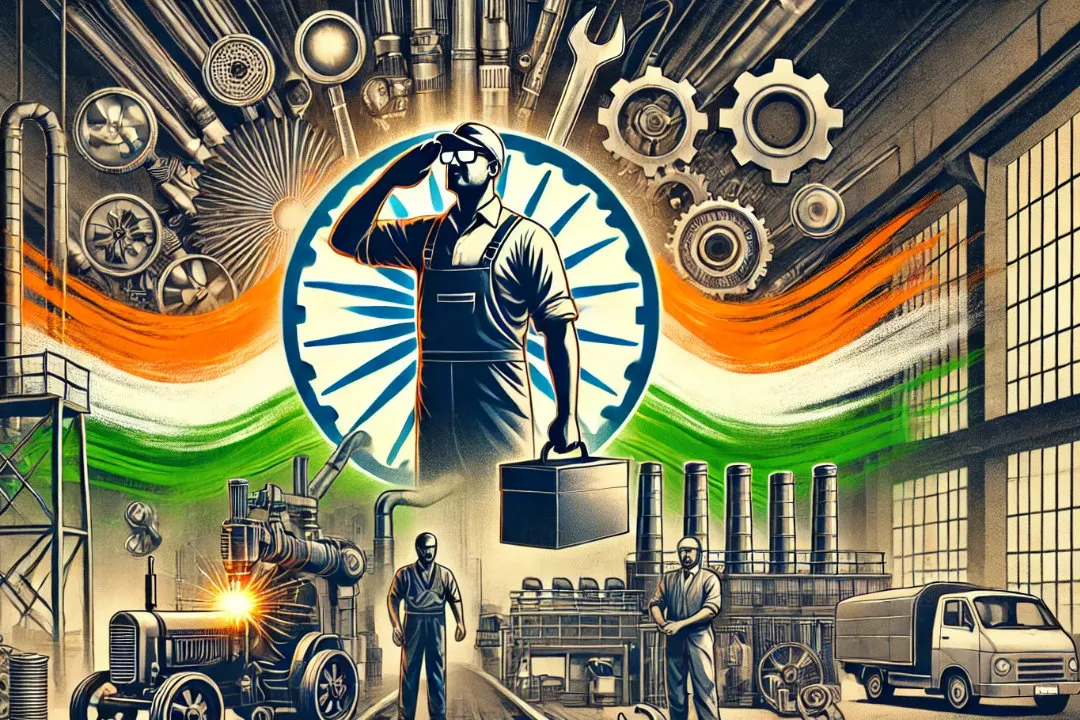
Walk any industrial estate from Chakan to Hosur, from Faridabad to Coimbatore, and the same silhouette appears. This is not anecdotal colour. It is the micro-foundation of India’s manufacturing stagnation.

Markets have already rendered their verdict.

On 8 October 2026, the Nifty closed at 22,231—its lowest level since April 2025 and more than 10% below the August peak. Inclusive of dividends, the index was down approximately 16.7% for the calendar year by early October. A partial recovery to 22,889 by 19 October changed little. Analysts now prescribe tax cuts as the remedy. A 10% technical bounce is possible. A bounce is not a recovery. Investors are not merely short of liquidity or animal spirits; they are reading the consolidated balance sheet of the Indian economy and finding structural weakness precisely where competitive capacity must reside.

The Arithmetic of Underperformance

India’s share of global manufacturing value added rose from roughly 1.5% in 1995 to 3.2% in 2023. China’s share moved from about 5% to nearly 32% over the same period. Manufacturing has remained locked between 16 and 18% of Indian GDP for two decades.

The “Make in India” programme, launched in 2014 with an explicit target of 25 percent, has not altered the trend line. India and China possess comparable populations; India accounts for approximately 2% of global goods exports while China accounts for 15 percent.

The official rejoinder is familiar. The Chief Economic Adviser notes that India’s global manufacturing share edged up from 2.4% in 2014 to 3% by 2025 and that manufacturing output expanded 73 percent against China’s 51 percent. The arithmetic is correct and almost entirely irrelevant.

Growing faster from a base one-tenth the size of the comparator does not close the absolute gap; it merely slows the rate at which the gap widens. Twelve years after the slogan was coined, India remains a statistical rounding error in the global production network.

Why a Weaker Currency Cannot Substitute for Capability?

A depreciating rupee is routinely offered as the automatic stabiliser. It is not. In the first nine months of 2026, imports from China rose 23.3% to $125 billion; the bilateral trade deficit crossed $105 billion. In multiple critical sectors more than 80% of key intermediate components continue to originate in China.

Currency depreciation can alter relative prices at the border. It cannot create the machine tools, the process engineers, the metallurgical know-how, or the dense supplier ecosystems that determine whether a component is manufactured domestically at competitive cost and quality.

Lower the exchange rate to ₹100 or ₹200 per dollar and the Pune manufacturer will still import the Chinese part. The decision is not ideological; it is technological and organisational. A currency adjustment cannot invent a missing production function.

Vietnam supplies the contrasting case. With roughly 100 million people—less than one-tenth of India’s population—Vietnam’s goods exports reached approximately $475 billion in 2025. It runs a surplus with India, exporting $10.3 billion while importing only $6.1 billion. The composition is revealing smartphones, semiconductors, machinery—precisely the high-value, high-complexity segments that India continues to import.

Vietnam achieved this by inserting itself into global value chains that enforce ruthless standards on cost, quality, and delivery. India’s manufacturing share of GDP stood below 15% in 2024, well beneath the levels recorded by South Korea, Taiwan, and China during their respective high-growth decades. Those economies did not industrialise on rhetoric. They industrialised on factory floors, cumulative engineering competence, and firms forced to survive open competition.

The Incentive Architecture of Stagnation

The deeper pathology is institutional. When procurement and licensing decisions systematically favour the connected over the competent, the rational firm stops investing in technology and process improvement.

Why purchase a five-axis machining centre if the tender is awarded since political access?

Capital deepening slows. Total factor productivity stagnates. Unit labour costs remain elevated relative to East Asian competitors even when absolute wages are lower. Small and medium enterprises shrink; a handful of large, politically adept conglomerates expand. Not every large Indian firm is a product of favouritism—many operate at genuine global standards—but a system in which outsiders cannot distinguish the two has already destroyed the informational value of market signals.

This is the classic lemons problem applied to industrial policy. When buyers cannot reliably separate high-quality from low-quality suppliers because non-market criteria dominate, the market for quality itself collapses. The honest manufacturer internalises the lesson: better machines do not win orders.

The result is a low-level equilibrium of mediocre quality, high compliance costs, and chronic dependence on imported intermediates.

The Political Economy of Distraction

Voters are entitled to anger. Real wages for large segments of the workforce have been stagnant. Formal job creation remains inadequate relative to the demographic surge. Relative prices of essentials continue to rise. That anger, however, is routinely redirected toward symbolic contests—mosques, menus, nomenclature—that generate heat without generating output. The Muslim shopkeeper and the Hindu machine operator lose the identical livelihood when the factory sheds workers. Identity politics is a free good for politicians; industrial capability is not.

The only question that matters are technical and temporal: what tangible production capacity has been created in the last 12 years that will still be generating employment and export earnings twelve years from now?

Governments that are never compelled to answer this question will continue supplying the cheaper narrative—the one that requires no capital expenditure, no skill formation, and no exposure to competitive pressure.

Tax cuts and further currency depreciation can buy time. They cannot purchase missing technological capability, missing supplier density, or missing competitive discipline.

Without those foundations, India will remain a competitive exporter of incense sticks, toys, and low-value textiles—where it already holds a respectable 4.1% of global trade—while the high-value nodes of the global production network continue to locate elsewhere.

The Pune manufacturer already knows this. The markets are beginning to price it.

The only open question is whether the political system will confront the arithmetic before the gap becomes irreversible.

Views of the author are personal and do not necessarily represent the website’s views.

Dr. Jaimine Vaishnav is a faculty of geopolitics and world economy and other liberal arts subjects, a researcher with publications in SCI and ABDC journals, and an author of 6 books specializing in informal economies, mass media, and street entrepreneurship. With over a decade of experience as an academic and options trader, he is keen on bridging the grassroots business practices with global economic thought. His work emphasizes resilience, innovation, and human action in everyday human life. He can be contacted on jaiminism@hotmail.co.in for further communication.

Long or Short, get news the way you like. No ads. No redirections. Download Newspin and Stay Alert, The CSR Journal Mobile app, for fast, crisp, clean updates!

App Store – https://apps.apple.com/in/app/newspin/id6746449540

Google Play Store – https://play.google.com/store/apps/details?id=com.inventifweb.newspin&pcampaignid=web_share

Latest News

Popular Videos