


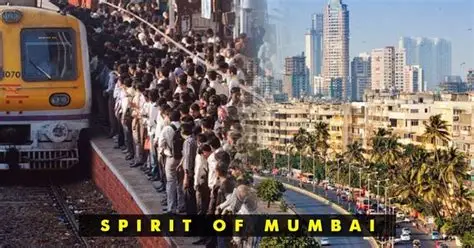

On Monday morning i.e yesterday, a wire was found hanging from overhead equipment between Mulund and Thane, and a signalling fire near Kanjurmarg did the rest. Packed locals stood halted between Thane and Mulund, with the disruption stretching toward Ghatkopar, and commuters were seen walking on the tracks between Mulund and Nahur. Colleges rescheduled papers after students were stranded. Scores of trains were cancelled, and passengers were trapped for up to 90 minutes. Commuters accused the Central Railway of taking passengers for granted, and some coverage noted a lack of timely, clear information
I expect the phrase “spirit of Mumbai” is already being drafted somewhere. I am tired of it. A city that walks along live tracks because nobody will say when the next train is coming does not have a spirit problem. It has a governance problem. This article is a “charge sheet” against the BMC, the Maharashtra government and the Union government, against every party that has held power in any of them, and against a comfortable class that has turned public suffering into a personality trait.
Money is not the excuse
Mumbai is not poor. The BMC tabled a budget of ₹80,952 crore for 2026-27, the highest in its history, and it keeps its status as the country’s richest civic body. In 2021-22 the figure was ₹35,962 crore, so it has more than doubled in five years. On the 2021 population estimate of about 1.29 crore, I calculate roughly ₹62,000 per resident, per year. That is a priorities problem, not a resource problem.
Data released just before the budget showed over half of the 2025-26 allocations unutilised, with the year nearly over, while the corporation plans to draw ₹36,623 crore from its fixed deposits for infrastructure. Roads are the biggest single capital expense. ₹13,990 crore goes to the Coastal Road and Goregaon-Mulund Link, ₹9,650 crore to bridges, and the bus system, BEST, gets a ₹1,000 crore grant. Meanwhile two-wheelers and cars make up nearly 88 percent of the city’s 50 lakh plus vehicles, and buses are under one percent. A budget tilted toward flyovers tells me whose commute the planners imagine. It is not the commute of the millions who cannot afford a car.
A colonial statute running a 2026 megacity
Nobody answers for Monday, and the law explains why. The Imperial Legislative Council passed the Bombay Municipal Corporation Act in 1888. Bombay then had fewer than a million people, and the horse-drawn tram was the height of urban mobility. Mumbai now has more than twelve times as many. We run a 21st century megacity on a framework drafted for a colonial port.
Executive power sits with an IAS Commissioner appointed by the Maharashtra government under Section 54. The elected mayor, by contrast, is a titular head whose main function is to preside over meetings. The mayor is indirectly elected and cannot write the Commissioner’s confidential report, a power only Kerala grants. The term is 2.5 years, barely enough to find the files. Follow the loop: the voter elects a councillor, the councillor picks a mayor, the mayor has no power over the person who runs the city, and that person answers to the state, not the voter. When a drain fails, the elected cannot act and the appointed cannot be voted out. Then came the first civic election in nearly nine years, and the city had barely changed in the meantime, which tells you how decorative the elected layer had become.
Reform has been tried and dropped. A Mayor-in-Council system was introduced in April 1998 and done away with in 1999. Experts keep asking for the obvious: a five-year term, executive authority over the Commissioner and direct election of the mayor. The state does amend the Act, through ordinances in 2010, 2011 and 2017, and bills in 2015 and 2026. I notice what gets tweaked: who becomes mayor and who loses the post. I see no one amending who answers for the city.
Add the fragmentation 1888 never imagined. The Act covers roads and drains. It does not cover the railway that failed on Monday, which belongs to the Union, or the metro and the MMRDA, which belong to the state. A commuter standing on a track near Nahur cannot name the authority responsible, and I suspect the authorities cannot either.
Voters know this. Turnout in January was 52.94%, so nearly half the electorate stayed home. The Shiv Sena (UBT) ruled the civic body for 25 years, and a BJP-led alliance now holds 118 of 227 seats. The name on the hoarding changes, and the trains still run late. The failure belongs to Congress-NCP state governments, the Sena-run BMC and the BJP at the state and the Centre alike.
The suffering that was priced in
According to the Government Railway Police, 29,970 people died and 30,214 were injured on the suburban network over 11 years. By my arithmetic that is about 2,700 deaths a year, 7 or 8 every day, and 8,416 of the dead remain unidentified. On 9 June 2025, 5 people died after falling from overcrowded trains near Mumbra, and only afterwards did the Railway Board announce automatic door closers for new rakes and retrofits for existing ones. Parties traded blame: the Mumbai Congress president demanded the railway minister resign. The Bombay High Court called the way Mumbaikars travel a matter of shame. The remedy was known, cheap against the budgets above, and came after the bodies. Monday is the same story with a different fault.
A city with no slack
Fragility is what you get when a system runs at full capacity every day with nothing in reserve. One fire in a signal room and millions stall.
Buses and metro. The BEST fleet fell from 4,657 buses in 2012 to 3,052 in 2023, while central benchmarks say Mumbai needs roughly 10,000. The rest of the metropolitan region overtook Greater Mumbai’s population in 2021, while the four big bus fleets shrank from 4,789 in 2016 to 3,911 in 2023. A plan for a 146 km metro by 2021 saw its first line open only in 2014, and the network sits near the 100 km mark today, against Shanghai’s 803 km.
Floods. On 26 May 2025 Mumbai had its wettest May day in over a century. Metro Line 3 services to Worli were suspended when an underground station was inundated, a station inaugurated two weeks earlier. The Commissioner admitted that only 55 percent of Mithi desilting was complete, while a BJP leader claimed about ₹1 lakh crore had been spent on flood management over 20 years and pointed to a police probe into an alleged ₹65 crore Mithi desilting scam. Both can be true at once: enormous spending, and a drain that fails. That is the signature of weak accountability. The 2026-27 climate budget has ₹20,730 crore in capital expenditure and ₹4,632 crore in revenue expenditure. I will judge it by the next monsoon.
Open space and air. Development Plan 2034 records 1.28 square metres of open space per person against an international standard of 11, and only 31% of the 1991 plan’s open-space provisions were implemented. In December 2025 the Bombay High Court condemned the BMC and the Pollution Control Board for inaction on air quality, and in January the BMC admitted 662 of 1,954 construction sites lacked mandated monitors. To be fair, the BMC now says 3,166 sites have installed monitors and 2026 has seen 231 good or satisfactory days so far, up from 218 in 2025. That is progress, after a court had to shout.
We know where such fragility ends: the 2017 Elphinstone footbridge stampede killed 23, and the 2024 Ghatkopar hoarding collapse killed 17.
What the developing world did, while we celebrated?
I will not compare Mumbai to London, Tokyo or Singapore. Compare us with cities that started poorer or comparable. Bogotá opened TransMilenio in 2000 and it now delivers about 2.3 million daily trips over 113 km. The old busway on its main avenue had 64 fatalities in 1998; the new BRT had 8 in 2001. The gain was institutional: a single city agency running the system and a restructuring of the fragmented bus market. Honest comparison requires me to add that Bogotá has security problems and overcrowding.
But look at the ambition and the speed. Mexico City’s Metrobús opened in 2005 and covers 105 km. Medellín links hillside neighbourhoods to its metro by cable car at about US$19 million per kilometre, and Guayaquil built a 4.1 km line in 24 months. São Paulo has fares integrated with its metro. Shanghai runs 803 kilometres carrying 2.83 billion trips a year.
The common thread is not wealth. Someone owned the problem, one authority held the mandate, timelines were public, and failure had a name attached. Mumbai has the money. It lacks the ownership.
Fourth in GDP, 144th in income
We were told, with great fanfare, that India overtook Japan. The IMF’s April 2025 projection put India at $4.187 trillion against Japan’s $4.186 trillion, a margin you could lose in a rounding error, or in a single Central Line delay. The claim was contested: India’s government projected just over $4 trillion for the year to March 2026, while official Japanese data showed about $4.4 trillion for calendar 2025. We celebrated a forecast, disputed, decided by a fraction of a percent.
Now the part the celebrations skip. World Bank data put India’s GDP per capita at $2,694 in 2024, against $32,487 for Japan, and India ranked 144th of 196 countries in nominal per capita income. A big pie…sliced very thin.
Offer the average Mumbaikar a swap, a Japanese passport for our GDP ranking, and watch the queue form before the sentence ends. I say this out of arithmetic, not disloyalty. In 2017 a Japanese rail operator apologised publicly because its train left 20 seconds early. Here the train leaves when nobody knows, and passengers wait inside it or walk beside it until it moves. I accept that no democracy becomes Tokyo in a year. Nobody is asking for Tokyo. We are asking for a signal room that does not stop a city. A trillion dollars of national output does not travel from Mulund to Thane. A commuter does, on foot, along a track.
Where “the spirit of Mumbai” came from, and why I refuse it
The phrase hardened around three moments: the floods of 26 July 2005, the train bombings of 11 July 2006 and the attacks of 26 November 2008. In those moments it was earned. Strangers opened doors and walked home together, and I will not sneer at that. But the phrase was then recycled for everything: a pothole, a cancelled train, a flooded underpass. Disasters caused by terror and monsoon were joined by failures caused by procurement, permissions and neglect, and the blurring suits those who administer.
Who says it loudest? Not the man on the footboard. It is the editor, the chairman, the celebrity wading through ankle-deep water for a photograph, the politician who needs a gentle word for a catastrophe. These are people who built private exits from public failure: the car and driver, the tower with its own water tank, the private hospital. Their bargain with this city has long been to leave public systems and then praise those who cannot. Praise is cheap, and it carries a message: do not complain, you are brave.
Resilience is a trait of individuals. Safety is the duty of the state. When I celebrate the first, I excuse the second, and a government that learns endurance earns applause has no reason to build anything. Mumbaikars should question the phrase for three reasons. We pay for the state: property tax is budgeted at ₹7,000 crore for 2026-27, and we are entitled to what it buys. The people paying the highest price are not the ones writing op-eds, so someone must speak for them. And a tolerated failure does not stay static. It grows. Monday is the proof.
Accountability, not identity
Every election season offers the same menu: Marathi against non-Marathi, one community against another, locals against outsiders. One analysis of the 2026 result described a persisting split between development and identity politics. That split is the problem.
A body falling from a footboard at Mumbra has no mother tongue and no religion. A flooded drain does not check your surname. A child breathing construction dust in Worli is not a vote bank. When we argue over who belongs, we do not ask who failed to desilt the Mithi, who left 662 sites without monitors, or who underspent the capital budget. Identity politics is where governance goes to hide.
So, I would ask every candidate and every party, in every language this city speaks:
-
Publish ward-level, quarterly data on capital spending against allocation.
-
Amend the 1888 Act: a five-year mayoral term, executive authority over the Commissioner and direct election of the mayor.
-
Create a single metropolitan transport authority, with dated commitments on track fencing, platform safety and automatic doors.
-
Commission an independent audit of drain desilting before the next monsoon and publish it.
-
Tie the bus fleet to the 10,000 benchmark and fund BEST as the essential service it is.
-
Deliver the open-space reservations already in the Development Plan, and hold civic elections on time.
 Dr. Jaimine Vaishnav is a faculty of geopolitics and world economy and other liberal arts subjects, a researcher with publications in SCI and ABDC journals, and an author of 6 books specializing in informal economies, mass media, and street entrepreneurship. With over a decade of experience as an academic and options trader, he is keen on bridging the grassroots business practices with global economic thought. His work emphasizes resilience, innovation, and human action in everyday human life. He can be contacted on jaiminism@hotmail.co.in for further communication.