Elections as Auctions: How India’s Subsidy Culture is Bankrupting the Middle Class
The CSR Journal Magazine

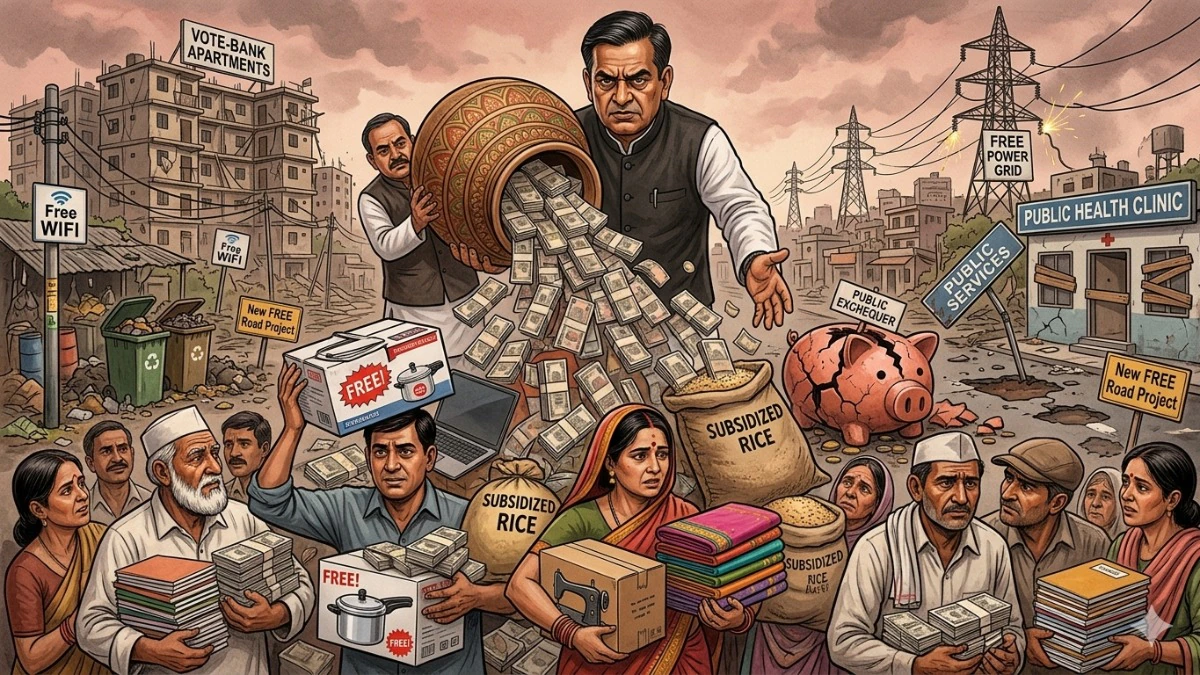
Every 5 years, something remarkable happens across India’s half a billion voting constituencies. Politicians stop pretending to govern and begin, openly and without embarrassment, to run a bidding war. Free electricity. Free gas cylinders. ₹1,500 cash monthly to women. Free smartphones. Laptops. Scooters. Loan waivers. Free bus rides. The promises multiply with each press conference, each manifesto, each dawn rally in a dusty maidaan — and the voter, battered by inflation and ignored between elections, is expected to transact their franchise like a consumer choosing between two discount stores.

This is the auction economy of Indian democracy. And like all auctions, someone is paying — just not the ones bidding.

The person paying is the salaried professional in Pune, the small business owner in Surat, the mid-level IT worker in Bengaluru who files returns honestly, pays GST on every purchase, and receives in exchange for his fiscal discipline — no free electricity, no cash transfer, no loan waiver. Just a tax demand notice and a deteriorating public hospital.

The fiscal arithmetic of India’s freebie culture has begun to acquire genuinely alarming dimensions. In Karnataka alone, the five pre-poll guarantees of the ruling Congress government were estimated by SBI Ecowrap to require approximately ₹60,000 crores annually — a recurring fiscal commitment made on the back of a state that was already running stressed finances.

The Reserve Bank of India, in a report that the Finance Ministry received without apparent alarm, noted that states’ debt-to-GDP ratios remained stubbornly high, and that competitive populism ahead of general elections posed a systemic risk to fiscal consolidation.

Chief Election Commissioner Rajiv Kumar called it outright — this pattern “vitiates the purity of the poll process.”

Finance Minister Nirmala Sitharaman, in what ranks as one of modern democracy’s more surreal spectacles, attacked freebie culture at a rally while her own party governments at the state level were engaged in the same competitive bidding.

Nomura’s analysts warned investors in late 2023 that even a BJP sweep of state elections wouldn’t reduce the likelihood of populism — because the incentive structure of Indian democracy has made it structural, not episodic

Seen vs. Unseen

The philosophical case against freebie culture has been made most elegantly not by Indian economists, but by the classical liberal tradition that Indian polity has studiously ignored.

“The state is the great fictitious entity by which everyone seeks to live at the expense of everyone else.” – Frederic Bastiat

Bastiat’s insight, written 175 years ago about French parliamentary democracy, describes contemporary Indian elections with eerie precision. Every freebie announcement is a visible gift — the “seen” benefit. The unseen is the tax burden quietly distributed across those who pay, the crowding out of productive investment, the fiscal deficit that becomes tomorrow’s inflation, the bond market’s demand for higher yields that raises borrowing costs for small businesses.

Friedrich Hayek’s critique runs deeper. In “The Road to Serfdom” and his essays on competitive democracy, Hayek warned that a political system rewarding vote-maximizing promises rather than policy outcomes would, over time, produce a race to the bottom — where parties outbid each other not on vision but on the size of their redistribution package. The Indian political class has read this as a how-to guide.

Milton Friedman’s concept of the “concentrated benefits, diffused costs problem” is the operating manual of Indian freebie politics. The beneficiary of a free gas cylinder knows exactly who gave it to her. The additional 0.3% of GDP added to the fiscal deficit is invisible, experienced only later as inflation or reduced public investment. This information asymmetry is not a bug in the system — it is the system.

Public Choice theorists, especially James Buchanan and Gordon Tullock, added the institutional layer. Politicians, like all agents, respond to incentives. In a first-past-the-post system with fragmented electorates, the marginal vote is often won not by competence but by targeted distribution. Buchanan’s Nobel-winning framework suggests the only solution is constitutional constraints on government’s power to redistribute — which no Indian political party has any interest in enacting, since it would saw off the branch they all sit on.

Why Subsidy Culture Will Never Leave Indian Polity?

This is where the libertarian analysis, while diagnostically correct, hits its explanatory ceiling. For the freebie culture is not merely a political choice — it is embedded in India’s sociology, psychology, and historical memory in ways that make it structurally ineradicable.

Max Weber’s ‘analysis of patrimonial states’ — where political authority is exercised through personal loyalty and material distribution rather than rational-legal bureaucracy — maps directly onto India’s political economy. The ‘zamindar’ who distributed largesse to his tenants has been replaced by the MLA who distributes ‘sarkari’ schemes to his constituency. The idiom of caste loyalty and patron-client obligation has not dissolved in Indian democracy; it has been democratized. Every voter now expects their leader to deliver ‘kuch toh milega’ — something tangible, something personal.

Sociologist M.N. Srinivas observed in his work on Indian villages that upward mobility (Sanskritization) was always about claiming resources and status, not just abstract aspiration. The scheme, the job, the reservation, the subsidy — these are instruments of status negotiation within the caste-community framework. A politician who refuses to distribute is not being fiscally responsible; from the ground-level sociological reality, he is failing his community.

This creates what political scientist Kanchan Chandra calls “patronage democracy” — where parties are vehicles for delivering benefits to ethnic or caste constituencies. In this model, ideological competition is secondary to distribution capacity. Voters do not choose between visions; they choose between patrons.

Behavioral economics explains why freebie culture is so sticky even when voters abstractly understand its costs. Daniel Kahneman and Amos Tversky’s “Prospect Theory” demonstrated that humans are roughly twice as sensitive to losses as to equivalent gains. Once free electricity has been given, its removal is experienced as a devastating loss — not the restoration of a status quo, but an act of violence against the beneficiary’s sense of entitlement.

No Indian government has ever successfully removed a major subsidy without severe political consequences. Diesel deregulation, LPG rationalization, MGNREGA cuts — every attempt to roll back redistribution has generated electoral punishment disproportionate to the fiscal relief achieved. The reference point shifts. Yesterday’s bonus becomes today’s floor. Tomorrow, the floor becomes the minimum.

Psychologist Robert Cialdini’s “principle of reciprocity” operates here with particular force in Indian political culture. The voter who receives a cash transfer feels a genuine obligation — not merely rational self-interest but something deeper, more visceral — to reciprocate at the ballot box. Politicians understand this. They have understood it for decades.

The “Availability Heuristic” further entrenches the culture: the voter in a village can easily recall the family that received the PM Awas Yojana house, the woman who got the gas cylinder, the student with the free bicycle. The invisible cost — the higher EMI rate because fiscal deficit drove up bond yields, the hospital that wasn’t built because the welfare budget was exhausted — is cognitively inaccessible. You cannot photograph the road that wasn’t constructed.

The NPA Scandal and the Hypocrisy of Selective Rescue

Here is the argument that should generate genuine outrage, and somehow does not: India’s political establishment excoriates freebie culture directed at the poor while overseeing the most spectacular bailout in the country’s financial history — the systematic absorption of corporate bad debt by public sector banks, ultimately financed by the same taxpayers told to be fiscally disciplined.

In a single decade, Indian public sector banks wrote off ₹16.35 lakh crore in bad loans — recovering only a fraction. The write-offs, as the RBI’s own data confirms, were not from priority sector lending to farmers. The NPA crisis of 2014-2019 was primarily corporate — infrastructure projects, power sector loans, real estate. A small number of well-connected industrialists, some of whom subsequently relocated to the United Kingdom, account for a disproportionate share of this fiscal catastrophe.

Vijay Mallya, ₹9,000 crore. Nirav Modi, ₹11,500 crore. These are names. There are hundreds of unnamed others.

The government’s response was recapitalization of public sector banks — injecting taxpayer money into institutions that had lent recklessly to politically connected borrowers. This is, by any definition, a freebie. It is a freebie of staggering scale, directed at the wealthiest tier of Indian society, dressed up in the language of systemic stability.

“Government bailouts to recapitalise banks widen the fiscal deficit, which is then used to justify subsidy cuts or tax hikes — fuelling inflation and deepening inequality.” — Centre for Financial Accountability, 2025

The asymmetry is not incidental — it is structural. When a farmer defaults on a ₹50,000 crop loan, it is a moral failure requiring intervention by the Finance Ministry. When a conglomerate default on ₹5,000 crores, it is a systemic problem requiring compassionate regulatory accommodation. Public Choice theory has a name for this: regulatory capture. The captured regulators, in this case, wear suits.

The Middle Class: Taxed, Unserved, Unrepresented

India’s middle class — roughly 2% of the population, yet bearing the structural weight of the income tax base — occupies the most politically disadvantaged position in the Indian democratic system. It is too small to be a decisive vote bank. It is too prosperous to qualify for targeted welfare. It is too diffuse and individualist to organize as a political constituency. It is, in the language of democratic theory, residually governed.

Direct tax collections in FY24 — up 182% in a decade, heavily dependent on salaried class.

The salaried Indian faces a double taxation that has no analogue in comparable economies. Income is taxed at source — often before it is received, through TDS. Expenditure is taxed through GST at rates between 18% and 28%. A middle-class professional in Mumbai paying 30% income tax on earnings above ₹15 lakhs then pays 18% GST on the insurance policy, 28% on the car, 18% on the restaurant meal, and 12% on the hotel stay. There is no input tax credit for human beings.

Corporations, by contrast, claim input credits on every intermediate purchase. India’s highest tax bracket kicks in at far lower income levels than in Russia, China, or the United States — countries whose middle classes are not simultaneously financing both a welfare state and a corporate bailout apparatus.

The cruel irony is that the middle class relies almost entirely on private alternatives for the public services its taxes nominally finance. Private schools because government schools are broken. Private hospitals because AIIMS waiting lists are measured in months. Private security because police stations are dysfunctional. The Indian middle class is, in effect, paying twice — once to the state and once to the market — for everything that democratic societies conventionally provide through public institutions.

The Brain Drain Signal

The most articulate expression of middle-class frustration is not a political movement. It is an airport. India’s middle and upper-middle class — engineers, doctors, entrepreneurs, finance professionals — have in the past decade executed the largest voluntary exodus in post-Independence history. The destinations are known: Canada, Australia, the UAE, the UK. The stated reasons vary. The structural cause is uniform: India has become, for its most productive and highest-taxed citizens, a country that extracts far more than it returns.

Political scientist Mancur Olson, in “The Logic of Collective Action”, explained why diffuse majorities lose to concentrated minorities in democratic systems. The middle-class taxpayer who stands to gain ₹3,000 annually from subsidy reform has no rational incentive to spend political capital organizing for that outcome. The beneficiary of the subsidy, whose entire material welfare depends on it, will vote, organize, and protest to defend it.

This logic creates a political equilibrium that is extraordinarily stable. No party governing India can afford to be the one that stopped giving things away — because the credit for what you gave away will not be remembered, but the grievance of what you took back will define elections.

Sociologist Dipankar Gupta has observed that Indian democracy, unlike Western welfare states which built universal public goods first and then added transfers, inverted this sequence. India began with targeted redistribution before building institutional capacity. The result is a polity where the demand for visible, personally attributable benefits is far stronger than the demand for impersonal public goods like rule of law, contract enforcement, or clean air.

The late Arun Jaitley, serving as Finance Minister, privately acknowledged what few politicians say publicly: that India’s fiscal federalism creates a structural incentive for state governments to spend recklessly because the RBI and Union government will ultimately backstop sovereign debt. The soft budget constraint is not an aberration — it is the design. And a system designed to absorb fiscal imprudence will produce fiscal imprudence in unlimited quantities.

The Uncomfortable Future!

There is no cavalry coming. The political incentives for freebie culture are not going to change because they are not dysfunctions — they are features of a first-past-the-post democracy operating on a heterogeneous electorate with extreme income inequality and weak institutional memory. The sociological demand for patronage distribution will outlast any government’s resolve to resist it. The psychological architecture of loss aversion will punish every attempt at rationalization. The concentrated beneficiaries will always outorganize the diffuse losers.

What India is running, whether it acknowledges it or not, is a dual welfare state: a formal one for the poor, loudly advertised at press conferences and election rallies; and an informal one for the rich, quietly administered through NPA write-offs, regulatory forbearance, and recapitalization budgets. Both are financed by the middle.

The libertarian critique — that there is no free lunch, that every rupee distributed must first be extracted from someone — is analytically correct and politically irrelevant. The voter who receives a free gas cylinder is not wrong to value it. She is rational. The system that created her predicament is the object of critique, not she herself.

But the middle-class professional who has watched ₹16.35 lakh crore in corporate loans silently written off while being lectured about the irresponsibility of subsidizing cooking gas — she too is rational. Her rage is not ideological. It is arithmetic.

Elections will continue to be auctions. The goods on offer will continue to expand. The bill will continue to be sent to the same address. And somewhere at Terminal 2 of Chhatrapati Shivaji Maharaj International Airport, another suitcase is being quietly checked in.

Views of the author are personal and do not necessarily represent the website’s views.

Dr. Jaimine Vaishnav is a faculty of geopolitics and world economy and other liberal arts subjects, a researcher with publications in SCI and ABDC journals, and an author of 6 books specializing in informal economies, mass media, and street entrepreneurship. With over a decade of experience as an academic and options trader, he is keen on bridging the grassroots business practices with global economic thought. His work emphasizes resilience, innovation, and human action in everyday human life. He can be contacted on jaiminism@hotmail.co.in for further communication.

Long or Short, get news the way you like. No ads. No redirections. Download Newspin and Stay Alert, The CSR Journal Mobile app, for fast, crisp, clean updates!

App Store – https://apps.apple.com/in/app/newspin/id6746449540

Google Play Store – https://play.google.com/store/apps/details?id=com.inventifweb.newspin&pcampaignid=web_share

Latest News

Popular Videos