


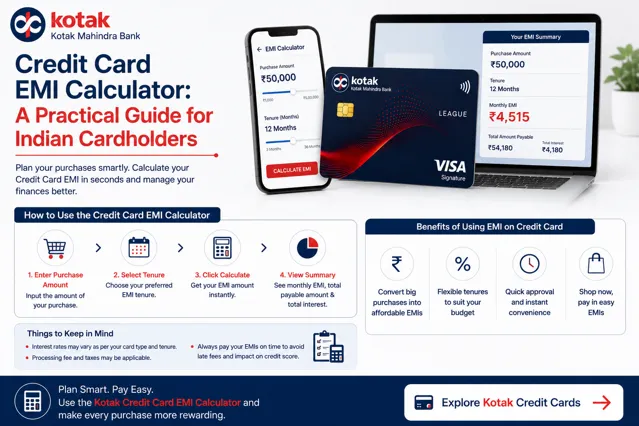

Big-ticket buys look easy on a card until the first statement hits, and the math feels heavier than expected. An EMI calculator puts numbers on the table before you convert. If you’ve ever wondered, “Is this EMI really cheaper than just paying in full next month?”, this guide will help you compare, plan, and avoid silent costs.
What is a Credit Card EMI Calculator?
Think of the credit card EMI calculator as a sandbox for your purchase. You enter the amount, tenure, interest rate, and any processing fee. It returns your EMI, total interest, and total cost, including taxes. You can try multiple scenarios till the monthly number feels in control.
What it calculates
-
Monthly EMI on a reducing balance
-
Total interest payable over the tenure
-
One-time processing/conversion fee impact
-
GST on applicable charges
-
Effective total cost vs paying in full
Why use it
You get a clean picture before committing. People rarely think about this initially: a small processing fee plus GST can push up the effective rate more than the advertised APR.
What is Credit Card EMI?
It’s a conversion of a card purchase into fixed monthly payments over a set tenure. The bank charges an EMI interest rate (usually lower than revolving interest) and may add a one-time fee.
What makes up your monthly EMI
-
Principal: the purchase amount repaid over time
-
Interest: monthly interest on the outstanding principal (reducing balance)
GST on Credit Card EMI
Banks typically levy GST at 18% on credit-card-related fees and finance charges. Expect GST on:
-
Processing/conversion fee
-
Foreclosure/penalty charges (if any)
-
Interest/finance charges shown on statements
This sounds small, but it changes the situation completely if you ignore it while comparing offers.
How Credit Card EMI Works
Credit card EMI works in stages:
-
You buy first or choose merchant EMI at checkout.
-
Select tenure (3–24 months is common) and view the EMI offer.
-
Bank converts the transaction; your available credit limit reduces by the principal outstanding.
-
You pay fixed EMIs each month; the limit frees up gradually as the principal is repaid.
-
Pre-closure might be allowed with a fee; partial prepayment is rare.
Tip: App-based post-purchase conversion within a few days often gives better clarity on fees than in-store pitches.
How to Use a Credit Card EMI Calculator
Here is a step-by-step process to use the Credit Card EMI calculator:
-
Enter purchase amount (e.g., ₹30,000).
-
Choose tenure (6, 9, 12 months, etc.).
-
Input the interest rate (APR) or the monthly rate from the offer.
-
Add processing fee (if any) and select GST inclusion.
-
Compare outputs: EMI, total interest, total cost.
-
Tweak tenure/rate to find a payment you can live with.
-
Cross-check with any instant discount or cashback you’d lose by choosing EMI.
Factors That Affect Your Credit Card EMI
Check these 7 factors that can affect your EMI.
-
Purchase amount and tenure length
-
EMI interest rate vs revolving rate
-
One-time processing/conversion fee
-
GST on fees and finance charges
-
Offer type: merchant “no-cost” EMI vs bank conversion
-
Your card’s credit limit and utilization (higher utilization may limit fresh spending)
-
Foreclosure rules and charges
Smart Strategies to Minimize EMI Costs
Follow them, and you might save some on the outgo.
-
Pick the shortest tenure you can comfortably handle.
-
Prefer genuine no-cost EMI only when it doesn’t kill better instant discounts.
-
Avoid converting small, recurring spends; it signals stress and adds fees.
-
Check processing fee (plus GST); negotiate or wait for a festival offer if it’s steep.
-
If you plan to preclose, confirm the foreclosure fee upfront.
-
Keep overall card utilization below ~30–40% to avoid spillover interest on new spends.
Pros AND Cons of Credit Card EMI
Pros
-
Predictable monthly outflow and better cash flow management.
-
Lower rate than revolving balances in most cases.
-
Access to promo tenures and occasional merchant subsidies.
Cons
-
Processing fees and GST raise the effective cost.
-
Locks up the credit limit until the principal is repaid.
-
Foreclosure penalties are common.
-
Easy to overspend because the monthly EMI feels small.
When to Choose EMI vs. Pay Full
You should choose EMI if the purchase is essential, the rate is clearly lower than revolving, and the tenure is short. Protect your emergency fund.
Pay in full if you can clear next cycle without strain, or if a flat discount beats any EMI “benefit.” That’s where many borrowers miscalculate: they chase “no-cost” and lose a strong upfront discount.
Real EMI Examples
Numbers below are illustrative; banks differ.
-
Standard EMI
-
Purchase: ₹30,000; Tenure: 6 months; Rate: 16% p.a.; Fee: 2% (₹600)
-
EMI ≈ ₹5,240; Total interest ≈ ₹1,440
-
GST: ~₹259 on interest with 108 on fee
-
Effective extra cost ≈ ₹2,407
-
Long tenure weighs on cost
-
Purchase: ₹50,000; Tenure: 18 months; Rate: 20% p.a.; Fee: 2% (₹1,000)
-
EMI ≈ ₹3,240; Total interest ≈ ₹8,320
-
GST: ~₹1,498 on interest with ₹180 on fee
-
Effective extra cost ≈ ₹10,998
-
“No‑cost” EMI trade-off
-
Purchase: ₹24,000; 12 months; 0% rate; No fee
-
EMI: ₹2,000
-
If you gave up a 5% instant discount (₹1,200), that ₹1,200 is your real cost.