


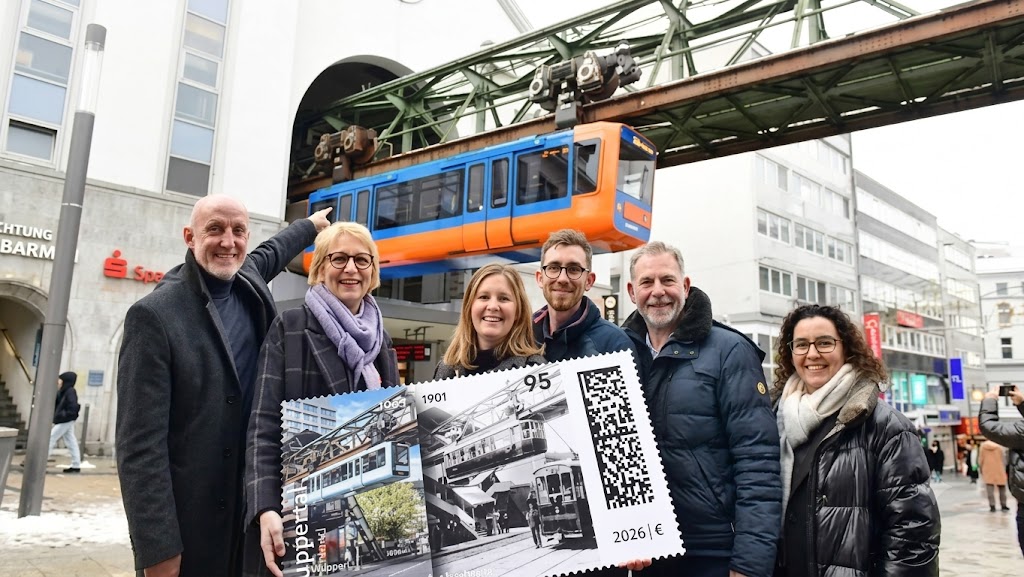

125 Years in the Air: How Germany’s 1901 “Flying Train” Still Moves 80,000 Passengers Daily

The CSR Journal Magazine

In the western German city of Wuppertal, an engineering marvel suspended high above the streets continues to defy time. Known locally as the Schwebebahn, Germany’s iconic “flying train” carries more than 80,000 passengers every day—125 years after its inaugural passenger trip in 1901.

A Solution Born from Necessity

At the turn of the 20th century, the booming industrial towns along the narrow Wupper River valley faced a severe spatial crisis. Dense factories, housing, and steep topography left no space on the ground for conventional rail lines, while hard, rocky terrain made underground subway construction nearly impossible.

German engineer Eugen Langen proposed a radical alternative: build upward. By suspending passenger cars underneath an elevated steel frame, the system could utilize the unused airspace directly above the river. Construction began in 1898, and official passenger service launched on March 1, 1901. The 13.3-kilometer (8.3-mile) route glides 26 to 40 feet above the water and urban streets, linking 20 stations along the valley’s main arterial corridor.

The Backbone of Modern Transit

Far from being a static museum piece, the Schwebebahn serves as the daily transit backbone for Wuppertal. Operated by local utility firm Wuppertaler Stadtwerke (WSW), the line transports commuters across town in roughly 30 minutes.

Over its century-long operation, the railway has continually modernized to meet strict safety and efficiency demands. The original steel frame structure was meticulously rebuilt between 1995 and 2014, and the fleet was replaced with modern, lightweight steel-and-glass carriages. Powered by electric motors, the suspended monorail operates with zero direct emissions, serving as an early prototype for sustainable, space-efficient transit design in congested urban environments.

Cultural Identity and Folklore

Beyond its practical role, the flying train forms the core of Wuppertal’s identity. In fact, the railway is older than the city itself; the independent towns along the valley merged to form modern Wuppertal in 1929, largely tied together by the shared overhead transit line.

The railway’s long history includes legendary tales—most notably the 1950 incident involving Tuffi, a young circus elephant brought aboard as a publicity stunt. Frightened by reporters, the elephant crashed through a side window and tumbled into the Wupper River below, escaping with only minor scratches. Today, the story remains central to city lore, commemorated by a stone sculpture in the riverbed.

As Wuppertal celebrates 125 years of continuous service, the Schwebebahn stands as proof that forward-thinking transit design can endure across generations.

Long or Short, get news the way you like. No ads. No redirections. Download Newspin and Stay Alert, The CSR Journal Mobile app, for fast, crisp, clean updates!

App Store –  https://apps.apple.com/in/app/newspin/id6746449540 

Google Play Store – https://play.google.com/store/apps/details?id=com.inventifweb.newspin&pcampaignid=web_share

Latest News

Popular Videos