


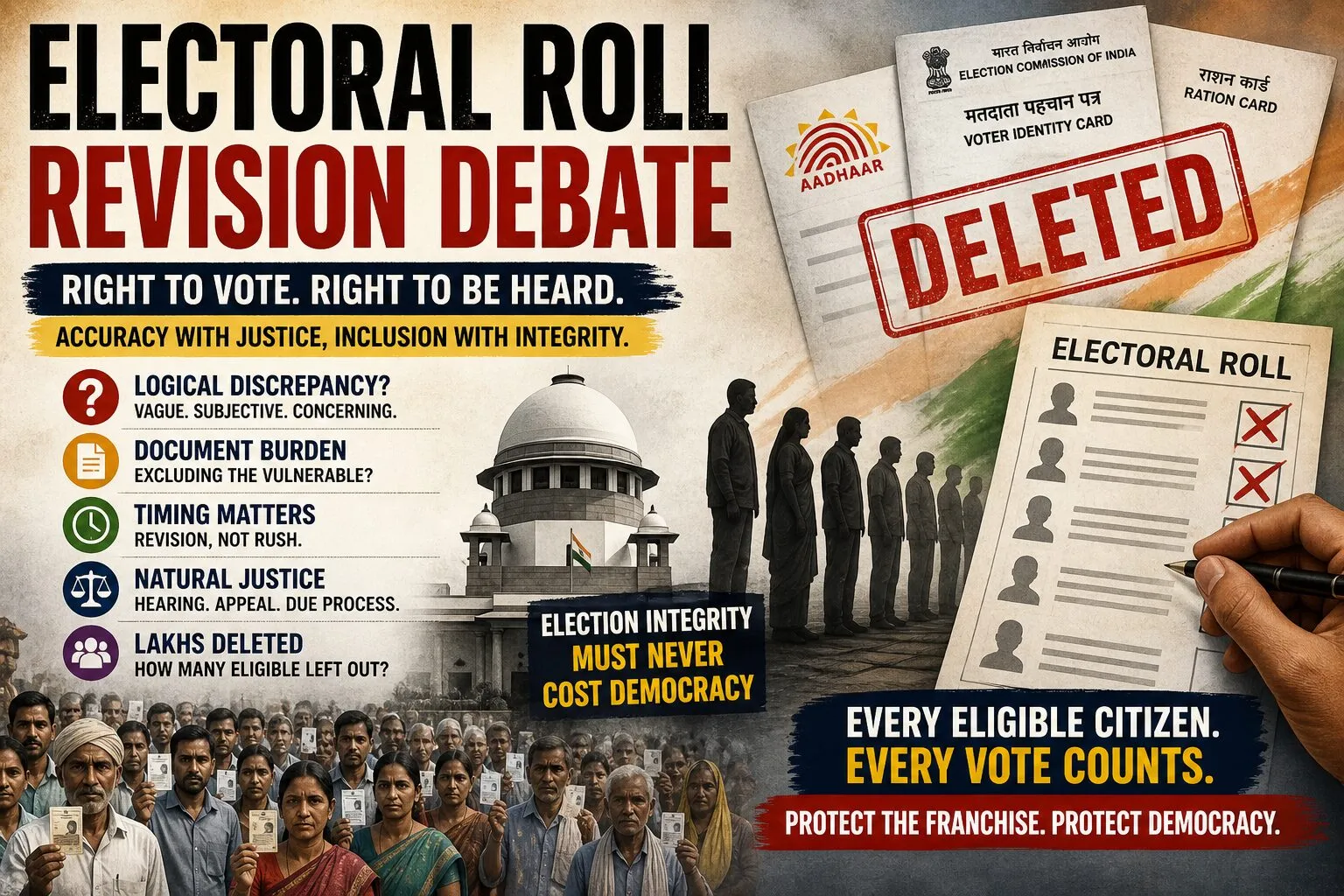


Respected Gyanesh Kumar, it is ‘We the People’, Not ‘We the Registered’

The CSR Journal Magazine

A democracy rarely dies on the day it stops holding elections. It weakens on the quieter days, when the question changes from “who will you vote for?” to “who is permitted to be a voter at all?”

India is living through such a season. It arrives in the polite language of administration: forms, enumeration, verification, cleaning. Nobody announces the end of anything. A Booth Level Officer knocks on a door, a form is handed over, and a household discovers that its place in the republic now depends on a document it may not have.

This essay does not accuse any individual or institution of bad faith. It asks something older and simpler: what happens to a republic when the state, rather than the citizen, decides the terms of membership, and when the bodies meant to guard that membership choose to speak softly?

What the Special Intensive Revision (SIR) is?

The Special Intensive Revision, or SIR, is a house-to-house re-verification of electoral rolls run by the Election Commission of India under Article 324 of the Constitution and Section 21(3) of the Representation of the People Act, 1950. It is not new in name. Intensive revisions were carried out in earlier decades, and the reference rolls for the current exercise in many states date to 2002 to 2004. What is new is scale, speed and method.

Bihar went first in 2025. Its rolls stood at about 7.89 crore electors when the exercise began in June 2025. The draft published on 1 August 2025 listed 7.24 crore, meaning roughly 65 lakh names had been left out. The Election Commission’s own breakdown attributed about 22.34 lakh to death, 36.28 lakh to permanent shifting or absence, and 7.01 lakh to duplicate enrolment. After claims and objections, the final roll of 30 September 2025 stood at 7.42 crore, a net fall of nearly 47 lakhs, or about 5.95%, after 21.53 lakh additions and 3.66 lakh further deletions.

Phase II began in late 2025 across nine states and three Union Territories, covering 321 districts and 1,843 Assembly constituencies. Reported outcomes were larger still. West Bengal’s rolls moved from about 7.69 crore to 6.86 crore, a net reduction of roughly 84 lakhs. Uttar Pradesh reportedly saw around 2.04 crore names removed between October 2025 and April 2026.

Phase III, running from July to December 2026, spans 16 states and 3 Union Territories. The qualifying date is now 1 October 2026. In Maharashtra, home to this writer, claims and objections close on 12 October and the final roll is due on 16 November. Delhi’s final publication is slated for 4 December. Some commentators now speak of cumulative deletions across phases in the range of 13 to 14 crore entries. I treat that figure with caution because it is a critique’s estimate, not an official tally, but even a fraction of it should concentrate the national mind.

On 27 May 2026, the Supreme Court upheld the legality of the SIR, holding that it falls within the Commission’s statutory mandate and advances the constitutional goal of free and fair elections. The Court also clarified something important: removal from the roll-on citizenship grounds is not a declaration that a person is a non-citizen. It means only that the Commission was “unable to be satisfied” for electoral purposes. That distinction matters, and I return to it below.

The quiet inversion of the burden

For 75 years the working assumption of Indian electoral administration was inclusion. An adult who showed up was presumed to belong, and the state bore the burden of showing otherwise. The SIR, in the view of its critics, has softened that presumption. Analysts have described it as a hybrid of intensive and summary revision that, unlike past practice, requires documentary proof at the enumeration stage itself.

Consider who carries that burden. The agricultural labourer who migrates to Surat or Mumbai for eight months a year. The woman who married across districts and whose maiden-home records sit with parents who may no longer be alive. The elderly voter whose name was spelt three different ways by three different clerks across three decades. The urban poor whose addresses are rented, informal and frequently changed. These are people whose lives generate little paper, not people who have done anything wrong. A system that asks for paper will find them wanting, and a system that treats wanting paper as wanting eligibility will remove them.

The Bihar numbers carry a pointed detail. Election Commission data shows 7.72 crore electors in the 2024 Lok Sabha polls and 7.89 crore after the January 2025 summary revision, a jump of about 17 lakhs in months. Critics such as the political scientist Yogendra Yadav argued before the Court that Bihar’s elector-to-population ratio fell from about 97% to 88% after the exercise, a nine-point drop. Civil liberties groups like the PUCL have argued that the shrinkage fell disproportionately on women, minorities, migrants and the poor. The Commission disputes the framing and says it is cleaning the rolls, not shrinking the electorate. Both claims can be examined, which is exactly why the underlying data should be fully open to independent audit.

Here is the hard question for any citizen who values the franchise. Even if most deletions are legitimate, such as the dead, the departed and the duplicated, what is the acceptable error rate for a right that is the precondition of all other rights? A 1% error on a roll of ninety-nine crore is nearly a million people. Journalists and field investigators have reported living citizens recorded as dead or shifted without notice. A democracy cannot treat such cases as rounding errors. Each is a person who loses the ability to hold power to account.

The rise of electoral surveillance

The deeper shift is not only about deletion. It is about what the state now knows, and can know, about the voter.

The modern electoral roll is no longer a printed booklet in a panchayat office. It is a database. It is linked to Booth Level Officers who photograph, geotag and upload. It is increasingly cross matched with other administrative records and processed through centralized software. Reporting on the SIR has flagged exactly this: automated systems that classify a voter as “shifted” or “dead,” with local Electoral Registration Officers lacking effective means to reverse a flag they believe is wrong.

Surveillance in a democracy rarely looks like surveillance. It looks like convenience. A name is matched, a family tree is reconstructed, a “logical discrepancy” is generated by an algorithm that has never met the person it questions, and a notice is issued. In several states, citizens have been summoned to hearings to prove lineage to a roll compiled twenty years earlier. Whatever one thinks of the intent, the experience is of a state that now interrogates the voter before the voter can interrogate the state.

There is a structural asymmetry in this. The voter’s data flows upward, to databases the voter cannot inspect. The state’s reasoning flows downward; in the form of orders the voter cannot easily challenge. The Supreme Court has rightly pushed the Commission to publish the lists of deleted names with reasons, and the Commission complied in Bihar. But disclosure after the fact, on a website, in a country where tens of crores have patchy internet access and limited literacy in the language of the notice, is transparency in form more than in function.

Surveillance also has a chilling effect that numbers cannot capture. When a family learns that its status can be reopened by a clerk, a form or a software flag, it learns to be careful. It learns not to complain, not to join the protest, not to be noticed. The most effective systems of control are the ones that teach citizens to police themselves.

The astute silence of institutions

What strikes the careful observer most is not any single decision but the choreography of quiet around it.

Parliament, the supposed forum of the people, has seen the matter reduced to walkouts and sloganeering rather than sustained legislative scrutiny. The courts, which in India have historically been the final shelter of the vulnerable, upheld the exercise after nearly a year of hearings, while also insisting on safeguards that critics say were then thinly enforced. The national media, with honourable exceptions, has treated mass deletion as a routine administrative story, a table of numbers on page eleven. Many professional bodies, universities and public institutions that once spoke on matters of civic principle have found reasons to say little.

Silence in institutions is rarely cowardice in the crude sense. It is more often prudence: a calculation about funding, appointments, inspections, careers. Each office reasons that it alone cannot change the outcome and that speaking costs more than staying quiet. Multiplied across a thousand offices, this reasoning produces an astonishing result: a profound change in the republic’s membership, with almost no institution willing to call it profound.

I call this silence astute because it is not stupid. It is the rational response of institutions that have learned where the limits are. And that is precisely the danger. A system where every guardian is individually careful is a system with no guardians.

What the last century teaches?

I will not claim that India resembles any particular regime of the twentieth century. Such claims are lazy and, usually, wrong. Historical comparison is useful only when it studies mechanisms, not labels. So, consider the mechanisms.

The regimes of the 1920s and 1930s that destroyed their own republics did not begin by abolishing elections. Many kept them. Several kept parliaments, courts and newspapers for years. What they changed first was the definition of who counted. Citizenship was reclassified by statute and decree, and the registers of the state became the instruments of that reclassification.

In Germany, the legal architecture of exclusion was built through registration, certification and documentary proof of descent, and the decisive step was not violence but paperwork. A person was a citizen if the state’s papers said so, and a non-person if they did not. In Italy, the consolidation of one-party rule ran through the law, through decrees that were technically valid, and through officials who said they were merely applying the rules. In Spain and elsewhere, the vocabulary of order, purification and national renewal gave administrative cleansing a moral gloss.

Three patterns recur in the scholarship on democratic collapse.

First, exclusion is administrative before it is political: lists, forms, certificates.

Second, the language is hygienic, speaking of cleaning, purifying, correcting, rooting out.

Third, the old institutions are not abolished but hollowed, left standing as facades while their independence drains away through caution and compliance.

None of this proves anything about the present. It does supply a set of questions. When a state asks its people to prove their belonging, who gets to define the proof? When the language of purification enters public administration, who is being purified? When courts, commissions and legislatures all agree to do their duty narrowly, who is doing it broadly? Political scientists have a phrase for the end state of this process: competitive authoritarianism, where elections occur, opposition exists, and the field is quietly tilted so that the outcome is never really in doubt. Indian and international democracy indices have already shown concern about India’s trajectory. The SIR becomes a test case for whether that concern is justified.

Democracies rarely get a clean warning. What they get is a series of measures each of which has a plausible defence. The register is only a register. The notice is only a notice. The deletion is only a deletion. History’s lesson is that the sum can differ from the parts.

Democracy as a ritual, and the loss of its substance

India votes more passionately than almost any country on earth. Turnout in recent general elections has exceeded 65 percent, and the sheer logistics of the exercise are a marvel. This is the democracy of the ritual: the queue, the ink on the finger, the results night.

But a democracy has a second life, the democracy of substance, which consists of the conditions that make the ritual meaningful. An accurate and inclusive roll. An election authority that is, and is seen to be, neutral. Courts willing to restrain the executive. A press willing to ask. A civil society free to organize. An electorate that does not fear that dissent will be punished with administrative inconvenience.

When the ritual is intact and the substance thins, citizens sense it before they can articulate it. They feel that something is being managed rather than decided. The vote still counts, but the question of whose vote counts is no longer settled by the citizen. It is settled upstream, by a process in which the citizen is the object and not the author.

This is what I mean by the failure of democratic imagination. Not that democracy has fallen, but that it is being quietly redefined: from a system in which the people choose the state to one in which the state certifies the people. The first is a republic. The second, whatever it calls itself, is something else.

Refusing the logic of statism

The deepest assumption behind exercises like the SIR is a statist one: that the state is the natural owner of the register of belonging, that the individual’s standing is a privilege issued by officials, and that more verification equals more legitimacy. It is worth challenging this assumption directly and calmly.

A constitution does not create a citizen. It recognizes one. The Indian Constitution begins with “We, the people,” not “We, the registered.” The franchise in a republic is not a licence granted after inspection. It is a right held by the person, which the state must protect and may restrict only on narrow, clear and challengeable grounds. When the default flips, and the citizen must continually re-earn recognition, the relationship between person and state has been inverted.

There are practical alternatives that serve the stated goal of clean rolls without the costs of mass re-enumeration. Rolls can be kept accurate through continuous, citizen-initiated updating with strong default protection for the person already enrolled. Deletions can require individual notice, a real hearing and an accessible appeal before removal, not after. Automated flags can be treated as leads for human review, never as verdicts. Independent statistical audits by academic bodies can examine deletion patterns by region, gender, religion and class, with results made public. Migrants can be allowed to carry their enrolment to their place of work without losing their home registration. Data collected for electoral purposes can be ring-fenced from every other use of state power, with legal penalties for misuse.

None of these ideas is radical. Each places the burden on the state, which commands the resources, rather than on the individual, who commands little. Each treats accuracy and inclusion as partners, not rivals.

Citizens also have tools that need no one’s permission. Check your own name, your family’s names and your neighbours’ names against the draft rolls, and file claims and objections within the window, which in Maharashtra closes on 12 October. Help the elderly and the less lettered with forms. Document discrepancies and share them with reporters, researchers and elected representatives. Keep asking for the data. The republic is protected less by grand declarations than by ordinary people refusing to let a form go unexamined.

The other side, fairly stated

In fairness to those who hold the opposite view, here is the case they make. The Election Commission maintains that decades of migration, death and duplication left the rolls inflated and unreliable, and that no ineligible person on the roll is as great a threat to fair elections as an eligible person left off. It points to the Bihar figures on the dead, the permanently shifted and the doubly enrolled, to the claims and objections windows, and to the participation of party-appointed Booth Level Agents at every stage.

The Supreme Court, in May 2026, found the exercise lawful and tied to the constitutional aim of free and fair elections, and clarified that deletion is not a finding of non-citizenship. Defenders argue that a clean roll is the foundation of a credible election, that other democracies verify identity more strictly than India does, and that the scale of the numbers reflects the scale of past neglect, not a political design. Readers should weigh these arguments alongside the criticisms above, and the final rolls and independent audits will be the best evidence for either side.

Last but not least,

A republic is not tested by how it treats the powerful, who can always speak for themselves. It is tested by what happens to the person with the least paper, the least voice and the least time. If that person can be quietly removed from the rolls, and the removal is explained as routine, then the republic has already moved some distance from its founding promise.

The task now is not outrage. It is attention. Count the names. Read the notices. Ask for the audits. Insist that every institution, from the Commission to the courts to the press, say plainly what it sees.

Democracy survives on citizens who refuse to find the unusual normal. And it is preserved, finally, not by the state that certifies us, but by the people who remember that the state exists because we do.

Views of the author are personal and do not necessarily represent the website’s views.

Dr. Jaimine Vaishnav is a faculty of geopolitics and world economy and other liberal arts subjects, a researcher with publications in SCI and ABDC journals, and an author of 6 books specializing in informal economies, mass media, and street entrepreneurship. With over a decade of experience as an academic and options trader, he is keen on bridging the grassroots business practices with global economic thought. His work emphasizes resilience, innovation, and human action in everyday human life. He can be contacted on jaiminism@hotmail.co.in for further communication.

Long or Short, get news the way you like. No ads. No redirections. Download Newspin and Stay Alert, The CSR Journal Mobile app, for fast, crisp, clean updates!

App Store –  https://apps.apple.com/in/app/newspin/id6746449540 

Google Play Store – https://play.google.com/store/apps/details?id=com.inventifweb.newspin&pcampaignid=web_share

Latest News

Popular Videos