


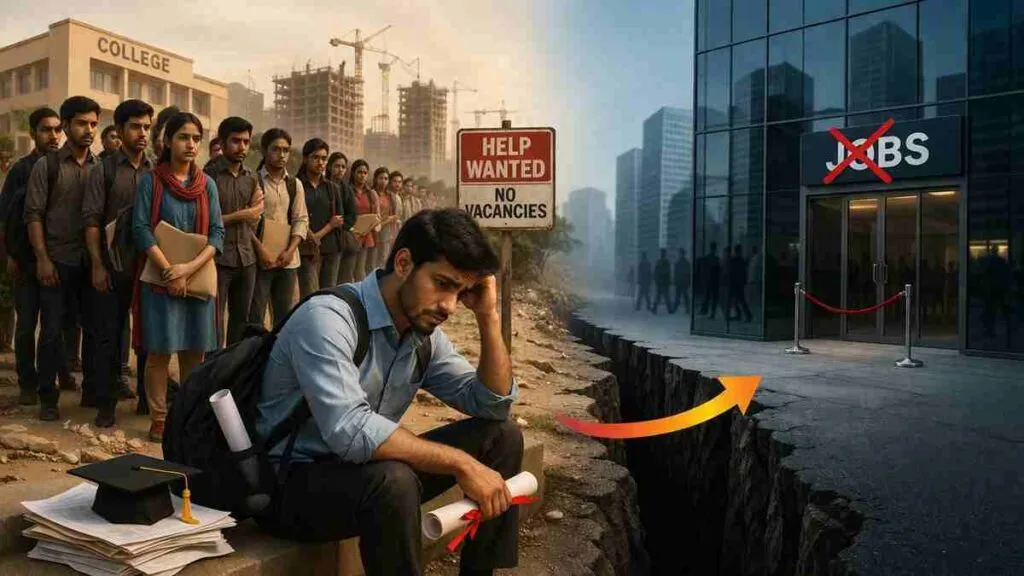


India Prints PhDs Faster Than It Prints Jobs

The CSR Journal Magazine

In 2015, the Uttar Pradesh government advertised 368 peon posts. The only qualifications were Class 5 pass and the ability to ride a bicycle. More than 23 lakh people applied. Among them, 255 were PhD holders. Officials later admitted that even interviewing everyone would take years.

You might think that was a one-off? It wasn’t. In 2018 the telecom wing of the UP Police put out 62 messenger posts. Over 93,000 people applied. Of those, 3,740 held PhDs. Again, the job required only Class 5 and a self-declaration that you could ride a bicycle. Read that slowly: nearly 4,000 PhDs competed for 62 bicycle-riding jobs.

Let’s call one of them Suresh. He’s a composite, but you’ve met him. He spent 5 years on a thesis. Changed topics twice because his guide kept changing his mind. Paid a “consultant” to fix the methodology chapter. Published in a journal that accepted the paper in 4 days and sent the invoice on the fifth. Framed the degree, hung it on the wall, and then discovered the market couldn’t care less about the frame.

Suresh isn’t an accident. He’s the product. We’ve built a system that celebrates admission and ignores what happens after, then acts shocked when the outcome shows up on a peon recruitment form.

The Gross Joke Called GER

Every few years the Ministry of Education releases a number, and everyone claps. The Gross Enrolment Ratio. India’s GER climbed to 30.0 in 2023-24, up from 29.5 the year before and 23.7 in 2014-15. Banners go up. Speeches are written.

Look carefully at the word “Gross.” It’s the most honest word in the entire policy. It counts heads. It does not count learning, skills, jobs, or mental health. A student who enrols, never attends, and writes the exam through a coaching centre is counted the same as one who actually masters the subject.

The target is 50% by 2035. From the current base that means roughly three crore more enrolments. So, the plan is to add 30 million more seats while we still can’t employ the people already sitting in the existing ones. It’s like opening more restaurants in a city where no one can afford to eat.

And right at the top of this pyramid sits the PhD, the most expensive and most abused enrolment of all.

The PhD Factory With No Quality Control

Here’s the number that should stop every policymaker cold. PhD enrolment jumped from 1.17 lakh in 2014-15 to 3.43 lakh in 2023-24, an increase of about 193%, the sharpest rise at any level. The AISHE report puts the latest figure at 3,43,559. In a single year the system added more than a lakh doctoral student (from 2.33 lakh to 3.44 lakh). The survey itself offers no explanation for that sudden leap.

Now the other side. PhD out-turn is only 0.3% of the total 1.10 crore out-turn, which works out to roughly 33,000 PhDs awarded in 2023-24. That’s an estimate based on the published share, but it’s the best public number we have.

Notice what’s missing. The government can tell you how many people enter a PhD programme. It can roughly estimate how many leave with the degree. What it cannot (or will not) tell you is what happens to those people afterwards: where they work, what they earn, whether they do any research at all. Nobody tracks it, because the answer would embarrass almost everyone involved.

We measure the intake of the factory and never inspect the product.

The Job Market Laughs Back

Central universities have 18,951 sanctioned teaching posts. As of July 2025, 4,889 of them were vacant. That’s the entire central university system — the most sought-after academic employer in the country. Against 3.44 lakh PhD students, that works out to roughly 18 doctoral students for every single sanctioned central university teaching post. One year’s output of about 33,000 PhDs is nearly seven times the total number of vacancies.

And yet posts remain vacant while PhDs remain jobless. How? Because the system cannot match supply with demand, and often simply refuses to. In one parliamentary reply, 549 reserved teaching posts stayed empty for five years because universities declared that “no suitable candidate” had been found. Lakhs of doctors on one side, empty chairs on the other, and a committee in the middle saying nobody is good enough. If that doesn’t tell you something about the quality of the degree being produced, nothing will.

Outside government the picture is no better. Private colleges hire the “Dr.” title as a branding asset and pay as if they’re doing you a favour. Guest lecturers are paid by the hour, with no research time, no security, and no future. Industry looks at a typical Indian PhD and sees someone trained to write two hundred pages that nobody will ever read — not a skill any company is willing to pay for. India spends well under 1 percent of GDP on R&D. China spends more than 2.4 percent. Without a real research economy, a PhD is a ticket to a train that isn’t running.

What Serious Systems Actually Look Like?

In the US, Germany, the UK and the Netherlands, a doctoral candidate is treated as a junior researcher. Most are funded through stipends, assistantships or actual employment contracts. Theses go through external examiners. Supervisors have strict limits on how many students they can take. The timeline is fixed and the money runs out when the time does. Admission is selective precisely because the university is paying.

Now China — the comparison we prefer to avoid. China is no utopia, but it is a serious player. The US and China together host about a quarter of the world’s doctoral candidates and more than a quarter of its graduates. Projections suggested that by 2025 Chinese universities would produce over 77,000 STEM PhDs a year against roughly 40,000 in the United States. Around 45% of China’s PhDs come from its 42 most elite institutions; only about 20% come from weaker local or private universities. They concentrate doctoral training where the research capacity exists. Even they worry about oversupply.

India, meanwhile, hands out PhD admissions like loyalty points. A college with two shelves of books and a part-time librarian can declare itself a “research centre.” The country that does not fund research at any serious scale expands doctoral enrolment at scale. That is not a strategy. That is a clerical habit.

Guides, Gurus and Free Labour

Every PhD in India has a guide, and that relationship decides almost everything. When it works, it can be excellent. When it fails, it is feudal.

The exploited scholar is a familiar figure. He writes the guide’s papers and gets second authorship if he’s lucky. He drafts the guide’s project proposals. He grades scripts, runs departmental events, collects forms, and sometimes collects the guide’s relatives from the railway station. His own thesis waits until the guide has time, which is never. If he complains, the guide controls his progress reports, his viva date, and his recommendation letter. There is no real ombudsman and no external appeal.

Honest guides are trapped too. They are handed scholar quotas, institutional targets, and students who cannot write a coherent paragraph without help. A guide who insists on quality is asked why the scholar is “delayed.” A guide who clears everyone is called efficient.

So, the power sits almost entirely with one person, and the scholar has almost no leverage. In any serious system, supervision involves a committee, external review, and written accountability. In ours, it often involves a phone call and a favour.

Pressure Cooker, Zero Accountability, and the AI Shortcut

Regulators set maximum tenures. Institutions advertise the number of PhDs awarded because rankings reward that count. Completion becomes the key performance indicator. Quality is not even a column in the spreadsheet.

The scholar is under pressure to finish. The guide is under pressure to deliver a finisher. The institution is under pressure to report the number. Everyone is incentivised to push the file through. Nobody is incentivised to stop and ask whether the work is any good. When a thesis is rejected, it becomes a scandal. When a poor thesis is accepted it becomes a statistic.

Then came AI — the most convenient accomplice in history. A scholar can now generate a literature review in ten minutes, complete with references (some of which do not exist). Entire chapters appear in smooth, correct-sounding prose. The plagiarism checker reports low similarity because the text is technically original. The overworked guide skims it with the help of another AI tool. A machine writes, a machine checks, a machine summarises, and a human collects the degree.

I’m not against AI in research. Used properly it can accelerate real work enormously. But in a system with almost no accountability, AI doesn’t raise the floor. It removes it. The viva, which is supposed to test whether the scholar understands the work, has in too many places become a polite formality where nobody asks how a regression was run, because nobody wants to discover that it wasn’t.

When a degree can be purchased, fabricated, or machine-written, employers notice. They are not stupid. They simply stop trusting the letters “Dr.”

What a Serious Country Would Do?

If India wanted a research economy rather than a PhD economy, it would do a few obvious things.

It would stop admitting students it cannot fund. A doctorate should be a funded position, not a self-financed hobby. It would restrict doctoral programmes to institutions that already have real research capacity, instead of spreading the label across every campus with a signboard.

It would require external examination of every thesis and put every thesis, with its data, into an open national repository. Sunlight is cheaper than any plagiarism software. It would cap the number of scholars per guide and give every scholar a genuine grievance route outside their own department. It would stop treating a fee-charging journal as a publication and start auditing outlets honestly.

It would track PhD outcomes nationally — employment, salary, research output, time to placement — and publish those numbers so a student could choose a programme the way a customer chooses a product. And it would link doctoral training more tightly to industry and public research labs, so a PhD becomes a professional pathway rather than an exit ramp from unemployment.

Above all, it would change what it celebrates. Stop applauding the GER and start asking what the G stands for, and what comes after the E.

Back to Suresh

Suresh did not get the peon job. There were 3,739 other doctors in the queue. He is now a guest lecturer at two colleges, paid by the hour, teaching a syllabus he did not write, in a department that will never give him a permanent post. His WhatsApp status still says “Dr. Suresh, Ph.D.” His bank balance says otherwise.

The country has given him a title and kept the opportunity. It has called that progress, put the number in a press release, and moved on to the next target. This is what happens when a nation mistakes enrolment for education, a degree for competence, and a headcount for a future.

Three lakh doctoral students are waiting for someone to ask the only question that matters.

Not “how many?”

But “for what?”

Views of the author are personal and do not necessarily represent the website’s views.

Dr. Jaimine Vaishnav is a faculty of geopolitics and world economy and other liberal arts subjects, a researcher with publications in SCI and ABDC journals, and an author of 6 books specializing in informal economies, mass media, and street entrepreneurship. With over a decade of experience as an academic and options trader, he is keen on bridging the grassroots business practices with global economic thought. His work emphasizes resilience, innovation, and human action in everyday human life. He can be contacted on jaiminism@hotmail.co.in for further communication.

Long or Short, get news the way you like. No ads. No redirections. Download Newspin and Stay Alert, The CSR Journal Mobile app, for fast, crisp, clean updates!

App Store –  https://apps.apple.com/in/app/newspin/id6746449540 

Google Play Store – https://play.google.com/store/apps/details?id=com.inventifweb.newspin&pcampaignid=web_shar

Latest News

Popular Videos